
催产素与亲社会行为的神经生物学。
Oxytocin and the Neurobiology of Prosocial Behavior.
机构信息
Department of Psychiatry, Carl von Ossietzky University Oldenburg, Oldenburg, Lower Saxony, Germany.
Department of Psychology, Georgetown University, Washington, DC, USA.
出版信息
Neuroscientist. 2021 Dec;27(6):604-619. doi: 10.1177/1073858420960111. Epub 2020 Sep 26.
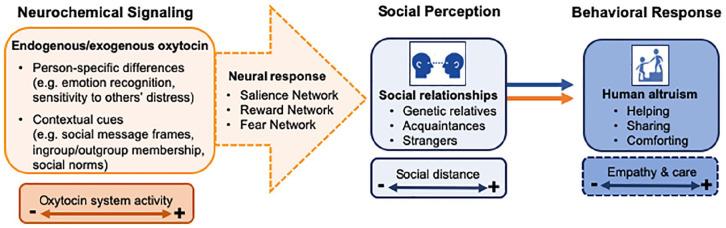
Humans are an unusually prosocial species, who engage in social behaviors that include altruism-whereby an individual engages in costly or risky acts to improve the welfare of another person-care, and cooperation. Current perspectives on the neurobiology of human prosociality suggest that it is deeply rooted in the neuroendocrine architecture of the social brain and emphasize the modulatory role of the neuropeptide hormone oxytocin. In this review, we provide a conceptual overview of the neurobiology of prosocial behavior with a focus on oxytocin's modulatory role in human prosociality. Specifically, we aim to encourage a better understanding of the peptide's susceptibility to diverse factors that produce heterogeneity in outcomes and the resulting methodological implications for measuring the behavioral effects of oxytocin in humans. After providing an overview of the state-of-the-art research on oxytocin's exogenous use, we elaborate on the peptide's modulatory role in the context of care-based altruism, cooperation, and conflict and discuss its potential for therapeutic interventions in psychiatric disorders characterized by social dysfunction.
人类是一种非常善于社交的物种,他们会参与各种社交行为,包括利他主义——个体做出代价高昂或有风险的行为来提高他人的福利、关爱和合作。目前关于人类亲社会性的神经生物学观点表明,它深深植根于社会大脑的神经内分泌结构,并强调神经肽激素催产素的调节作用。在这篇综述中,我们提供了亲社会性行为神经生物学的概念概述,重点介绍了催产素在人类亲社会性中的调节作用。具体来说,我们旨在鼓励更好地理解该肽对产生结果异质性的各种因素的敏感性,以及对测量催产素在人类中的行为效应的方法学影响。在概述了催产素外源性使用的最新研究之后,我们详细阐述了该肽在关爱型利他主义、合作和冲突背景下的调节作用,并讨论了它在以社交功能障碍为特征的精神障碍的治疗干预中的潜力。

 Zotero 插件