
探究成功抗结核治疗结束后结核患者的非灭菌治愈情况。
Investigating Non-sterilizing Cure in TB Patients at the End of Successful Anti-TB Therapy.
机构信息
Department of Science and Technology/National Research Foundation, Centre of Excellence for Biomedical Tuberculosis Research and South African Medical Research Council Centre for Tuberculosis Research, Cape Town, South Africa.
Division of Molecular Biology and Human Genetics, Department of Biomedical Sciences, Faculty of Medicine and Health Sciences, Stellenbosch University, Cape Town, South Africa.
出版信息
Front Cell Infect Microbiol. 2020 Aug 25;10:443. doi: 10.3389/fcimb.2020.00443. eCollection 2020.
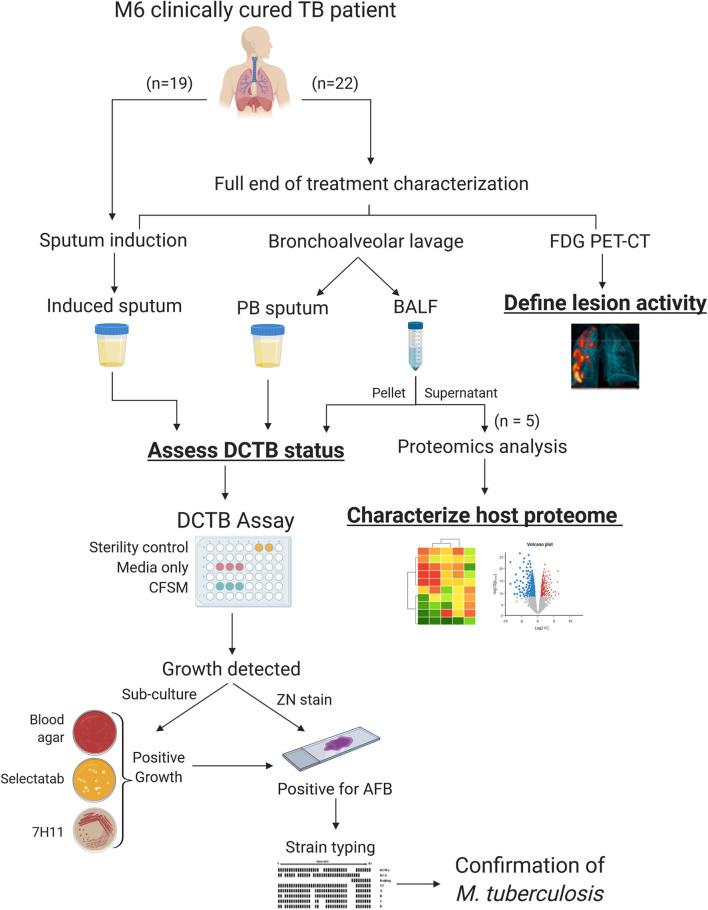
(Mtb) is extremely recalcitrant to antimicrobial chemotherapy requiring 6 months to treat drug-sensitive tuberculosis (TB). Despite this, 4-10% of cured patients will develop recurrent disease within 12 months after completing therapy. Reasons for relapse in cured TB patients remains speculative, attributed to both pathogen and host factors. Populations of dormant bacilli are hypothesized to cause relapse in initially cured TB patients however, development of tests to convincingly demonstrate their presence at the end of anti-TB treatment has been challenging. Previous studies have indicated the utility of culture filtrate supplemented media (CFSM) to detect differentially culturable tubercle bacilli (DCTB). Here, we show that 3/22 of clinically cured patients retained DCTB in induced sputum and bronchoalveolar lavage fluid (BALF), with one DCTB positive patient relapsing within the first year of completing therapy. We also show a correlation of DCTB status with "unresolved" end of treatment FDG PET-CT imaging. Additionally, 19 end of treatment induced sputum samples from patients not undergoing bronchoscopy were assessed for DCTB, identifying a further relapse case with DCTB. We further show that induced sputum is a less reliable source for the DCTB assay at the end of treatment, limiting the utility of this assay in a clinical setting. We next investigated the host proteome at the site of disease (BALF) using multiplexed proteomic analysis and compared these to active TB cases to identify host-specific factors indicative of cure. Distinct signatures stratified active from cured TB patients into distinct groups, with a DCTB positive, subsequently relapsing, end of treatment patient showing a proteomic signature closer to active TB disease than cure. This exploratory study offers evidence of live Mtb, undetectable with conventional culture methods, at the end of clinically successful treatment and putative host protein biomarkers of active disease and cure. These findings have implications for the assessment of true sterilizing cure in TB patients and opens new avenues for targeted approaches to monitor treatment response.
(Mtb)对抗菌化疗具有极强的抗药性,治疗药物敏感型肺结核(TB)需要 6 个月的时间。尽管如此,在完成治疗后 12 个月内,仍有 4-10%的治愈患者会复发疾病。治愈的 TB 患者复发的原因仍在推测中,归因于病原体和宿主因素。休眠杆菌群被假设为导致最初治愈的 TB 患者复发的原因,然而,开发能够令人信服地证明它们在抗 TB 治疗结束时存在的测试一直具有挑战性。先前的研究表明,培养滤液补充培养基(CFSM)在检测差异可培养结核分枝杆菌(DCTB)方面具有实用性。在这里,我们表明,在诱导痰和支气管肺泡灌洗液(BALF)中,有 3/22 例临床治愈的患者保留了 DCTB,其中 1 例 DCTB 阳性患者在完成治疗的第一年就复发了。我们还显示了 DCTB 状态与治疗结束时“未解决”的 FDG PET-CT 成像之间的相关性。此外,对未行支气管镜检查的 19 例治疗结束时的诱导痰样本进行了 DCTB 检测,发现了另 1 例 DCTB 阳性复发病例。我们进一步表明,诱导痰在治疗结束时 DCTB 检测的可靠性较低,限制了该检测在临床环境中的应用。我们接下来使用多重蛋白质组学分析研究了疾病部位(BALF)的宿主蛋白质组,并将其与活动性 TB 病例进行比较,以确定预示治愈的宿主特异性因素。不同的特征将活动性 TB 患者和治愈 TB 患者分为不同的组,DCTB 阳性、随后复发的治疗结束患者的蛋白质组特征与活动性 TB 疾病比治愈更接近。这项探索性研究提供了证据表明,在临床成功治疗结束时存在无法用常规培养方法检测到的活 Mtb,以及活动性疾病和治愈的潜在宿主蛋白生物标志物。这些发现对评估 TB 患者的真正杀菌治愈具有影响,并为监测治疗反应的靶向方法开辟了新途径。


 Zotero 插件