
呼吸训练对帕金森病的影响:系统评价。
The Effects of Respiratory Training in Parkinson's Disease: A Systematic Review.
机构信息
Radboud University Medical Center, Donders Institute for Brain, Cognition and Behavior, Department of Rehabilitation, Nijmegen, the Netherlands.
Radboud University Medical Center, Radboud Institute for Health Sciences, Department of Rehabilitation and IQ Healthcare, Nijmegen, The Netherlands.
出版信息
J Parkinsons Dis. 2020;10(4):1315-1333. doi: 10.3233/JPD-202223.
BACKGROUND
Signs of respiratory dysfunction can be present already early in the course of Parkinson's disease (PD). Respiratory training could alleviate this, but its effectiveness is not well understood.
OBJECTIVE
The purpose of this systematic review is to review the efficacy of different respiratory training interventions in PD.
METHODS
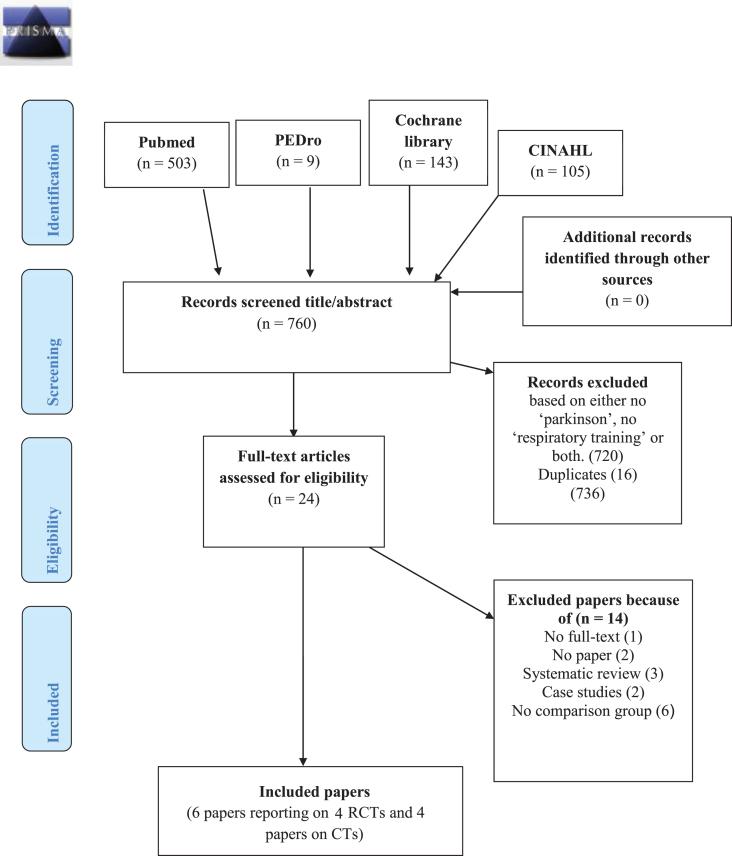
A search strategy was performed in four databases: PubMed, Physiotherapy Evidence Database (PEDro), Cochrane Library, and Cumulative Index to Nursing and Allied Health Literature (CINAHL). Methodological quality of original full-text articles was assessed using the Cochrane Risk of Bias tool for randomized controlled trials (RCTs) and the Risk Of Bias In Non-randomized Studies of Interventions (ROBINS-I) tool for the controlled trials (CTs). Levels of evidence were rated by the Grading of Recommendation Assessment, Development and Evaluation (GRADE) approach.
RESULTS
Six papers reporting on four randomized controlled trials and another four controlled trials were included. Positive effects were reported for inspiratory muscle strength training (IMST), expiratory muscle strength training (EMST), air stacking, breath-stacking, incentive spirometry and postural training on respiratory muscle strength, swallowing safety, phonatory aspects and chest wall volumes. Best methodological quality was found for breath-stacking and incentive spirometry. Best levels of evidence were found for EMST, IMST and EMST plus air stacking.
CONCLUSION
Respiratory training shows positive effects and should be considered when people with PD experience respiratory dysfunction. Future studies should focus on standardizing both training devices, instruments to measure outcomes and intervention protocols to further increase the level of evidence.
背景
帕金森病(PD)患者的呼吸功能障碍可能很早就会出现。呼吸训练可以缓解这种情况,但它的有效性尚不清楚。
目的
本系统评价的目的是回顾不同呼吸训练干预措施在 PD 中的疗效。
方法
在四个数据库中进行了搜索策略:PubMed、物理治疗证据数据库(PEDro)、Cochrane 图书馆和 Cumulative Index to Nursing and Allied Health Literature(CINAHL)。使用 Cochrane 随机对照试验(RCTs)偏倚风险工具和非随机干预试验(ROBINS-I)工具评估原始全文文章的方法学质量。证据水平通过推荐评估、制定和评估(GRADE)方法进行评级。
结果
纳入了六篇报告四项随机对照试验和另外四项对照试验的论文。吸气肌力量训练(IMST)、呼气肌力量训练(EMST)、空气堆积、呼吸堆积、激励性肺活量计和姿势训练对呼吸肌力量、吞咽安全性、发声方面和胸壁容积均有积极影响。呼吸堆积和激励性肺活量计的方法学质量最佳。EMST、IMST 和 EMST 加空气堆积的证据水平最佳。
结论
呼吸训练显示出积极的效果,当 PD 患者出现呼吸功能障碍时应考虑使用。未来的研究应侧重于标准化训练设备、测量结果的仪器以及干预方案,以进一步提高证据水平。
 Zotero 插件