
机器学习辅助的循环DNA定量分析在癌症筛查中的评估
Machine Learning-Assisted Evaluation of Circulating DNA Quantitative Analysis for Cancer Screening.
作者信息
Tanos Rita, Tosato Guillaume, Otandault Amaelle, Al Amir Dache Zahra, Pique Lasorsa Laurence, Tousch Geoffroy, El Messaoudi Safia, Meddeb Romain, Diab Assaf Mona, Ychou Marc, Du Manoir Stanislas, Pezet Denis, Gagnière Johan, Colombo Pierre-Emmanuel, Jacot William, Assénat Eric, Dupuy Marie, Adenis Antoine, Mazard Thibault, Mollevi Caroline, Sayagués José María, Colinge Jacques, Thierry Alain R
机构信息
IRCM Institut de Recherche en Cancérologie de Montpellier INSERM U1194 Montpellier F-34090 France.
Institut régional du Cancer de Montpellier Montpellier F-34298 France.
出版信息
Adv Sci (Weinh). 2020 Jul 29;7(18):2000486. doi: 10.1002/advs.202000486. eCollection 2020 Sep.
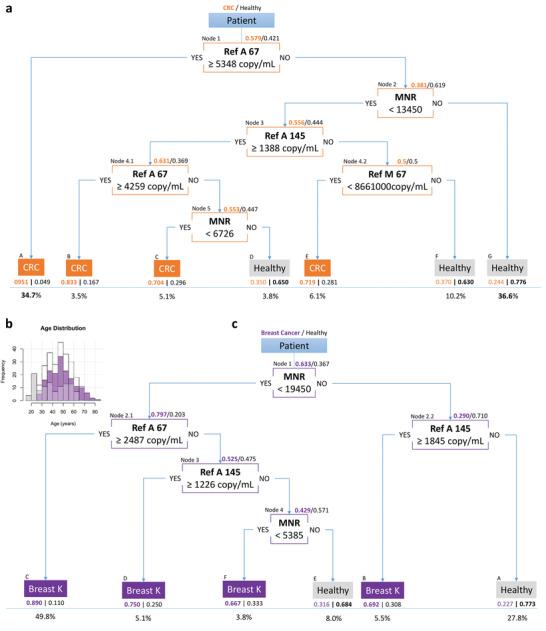
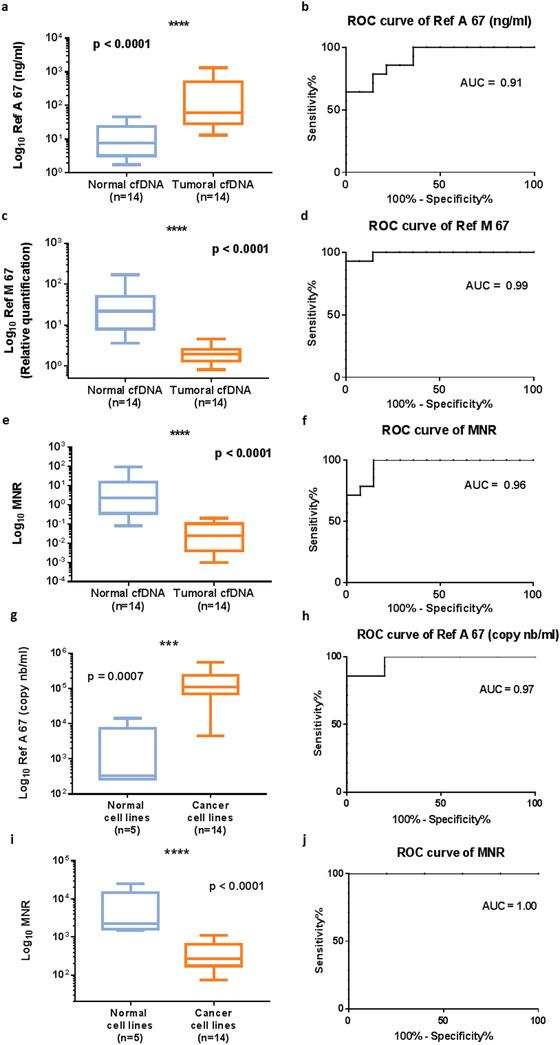
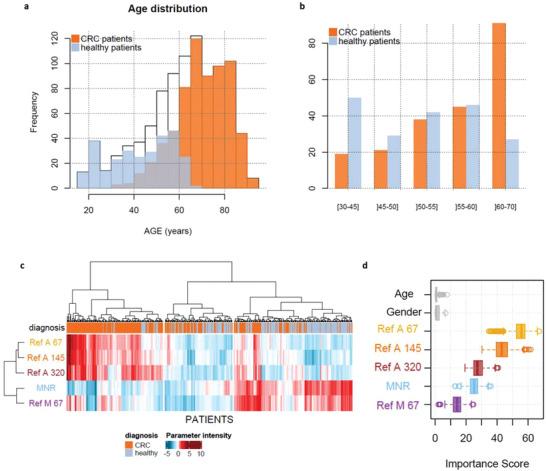
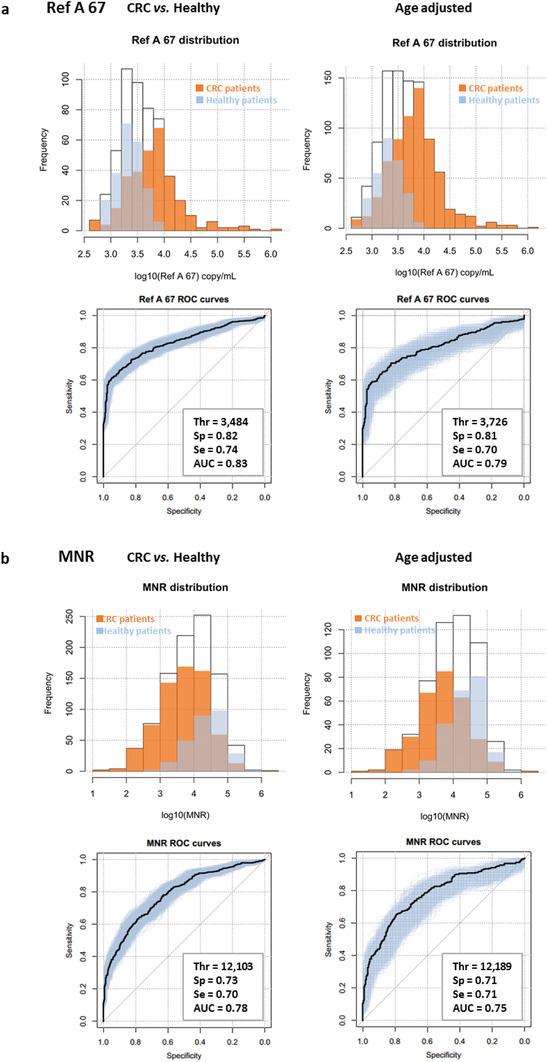
While the utility of circulating cell-free DNA (cfDNA) in cancer screening and early detection have recently been investigated by testing genetic and epigenetic alterations, here, an original approach by examining cfDNA quantitative and structural features is developed. First, the potential of cfDNA quantitative and structural parameters is independently demonstrated in cell culture, murine, and human plasma models. Subsequently, these variables are evaluated in a large retrospective cohort of 289 healthy individuals and 983 patients with various cancer types; after age resampling, this evaluation is done independently and the variables are combined using a machine learning approach. Implementation of a decision tree prediction model for the detection and classification of healthy and cancer patients shows unprecedented performance for 0, I, and II colorectal cancer stages (specificity, 0.89 and sensitivity, 0.72). Consequently, the methodological proof of concept of using both quantitative and structural biomarkers, and classification with a machine learning method are highlighted, as an efficient strategy for cancer screening. It is foreseen that the classification rate may even be improved by the addition of such biomarkers to fragmentomics, methylation, or the detection of genetic alterations. The optimization of such a multianalyte strategy with this machine learning method is therefore warranted.
虽然最近通过检测基因和表观遗传改变对循环游离DNA(cfDNA)在癌症筛查和早期检测中的效用进行了研究,但在此开发了一种通过检查cfDNA定量和结构特征的原始方法。首先,在细胞培养、小鼠和人血浆模型中分别证明了cfDNA定量和结构参数的潜力。随后,在289名健康个体和983名患有各种癌症类型的患者的大型回顾性队列中对这些变量进行评估;在年龄重采样后,独立进行此评估,并使用机器学习方法将变量组合起来。用于检测和分类健康和癌症患者的决策树预测模型的实施显示出对0、I和II期结直肠癌阶段前所未有的性能(特异性为0.89和敏感性为0.72)。因此,强调了使用定量和结构生物标志物以及通过机器学习方法进行分类的方法学概念证明,作为一种有效的癌症筛查策略。可以预见,通过将此类生物标志物添加到片段组学、甲基化或基因改变检测中,分类率甚至可能提高。因此,有必要用这种机器学习方法优化这种多分析物策略。
 Zotero 插件