
BRAF 状态通过 CHOP 依赖性机制调节结直肠癌中的白细胞介素-8 表达。
BRAF status modulates Interelukin-8 expression through a CHOP-dependent mechanism in colorectal cancer.
机构信息
Medical Oncology 1, IRCCS - Regina Elena National Cancer Institute, Via Elio Chianesi 53, 00144, Rome, Italy.
Department of Pathology, IRCCS - Regina Elena National Cancer Institute, Via Elio Chianesi 53, 00144, Rome, Italy.
出版信息
Commun Biol. 2020 Oct 1;3(1):546. doi: 10.1038/s42003-020-01263-y.
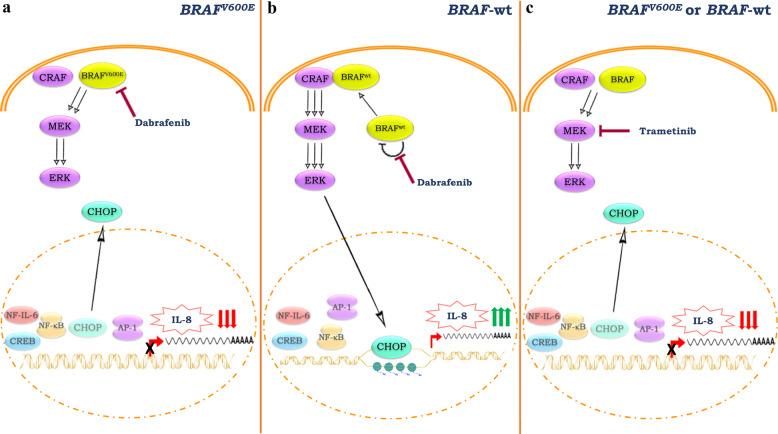
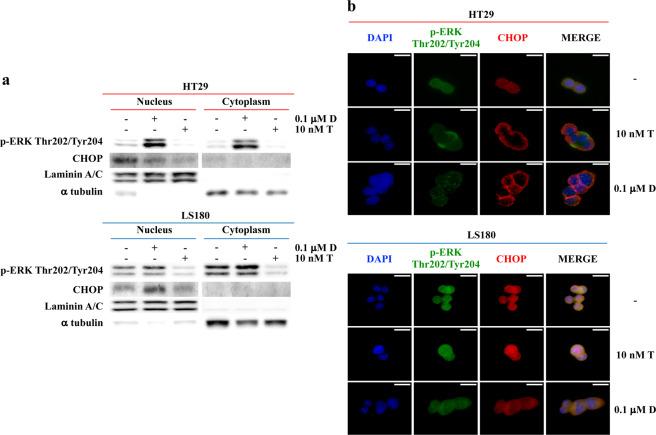
Inflammation might substantially contribute to the limited therapeutic success of current systemic therapies in colorectal cancer (CRC). Amongst cytokines involved in CRC biology, the proinflammatory chemokine IL-8 has recently emerged as a potential prognostic/predictive biomarker. Here, we show that BRAF mutations and PTEN-loss are associated with high IL-8 levels in CRC models in vitro and that BRAF/MEK/ERK, but not PI3K/mTOR, targeting controls its production in different genetic contexts. In particular, we identified a BRAF/ERK2/CHOP axis affecting IL-8 transcription, through regulation of CHOP subcellular localization, and response to targeted inhibitors. Moreover, RNA Pol II and an open chromatin status in the CHOP-binding region of the IL-8 gene promoter cooperate towards increased IL-8 expression, after a selective BRAF inhibition. Overall, our data show that IL-8 production is finely and differentially regulated depending on the tumor genetic context and might be targeted for therapeutic purposes in molecularly defined subgroups of CRC patients.
炎症可能是导致目前结直肠癌(CRC)全身治疗疗效有限的主要原因。在参与 CRC 生物学的细胞因子中,促炎趋化因子 IL-8 最近成为一种有潜力的预后/预测生物标志物。在这里,我们表明 BRAF 突变和 PTEN 缺失与体外 CRC 模型中的高 IL-8 水平相关,并且 BRAF/MEK/ERK,而不是 PI3K/mTOR 靶向控制其在不同遗传背景下的产生。特别是,我们确定了 BRAF/ERK2/CHOP 轴通过调节 CHOP 的亚细胞定位和对靶向抑制剂的反应来影响 IL-8 的转录。此外,在选择性 BRAF 抑制后,RNA Pol II 和 IL-8 基因启动子中 CHOP 结合区域的开放染色质状态共同导致 IL-8 表达增加。总的来说,我们的数据表明,IL-8 的产生是根据肿瘤的遗传背景精细且差异调节的,并且可能成为 CRC 患者中分子定义亚组的治疗靶点。



 Zotero 插件