
导致个人防护设备短缺的因素在 COVID-19 大流行期间。
Contributing factors to personal protective equipment shortages during the COVID-19 pandemic.
机构信息
Department of Global and Intercultural Studies, Miami University, 501 E. High St. Oxford, OH 45056, USA; Ezintsha, Wits Reproductive Health and HIV Institute, Department of Medicine, Faculty of Health Sciences, 32 Princess of Wales Terr., Sunnyside Office Park, Block D, Floor 5, University of the Witwatersrand, Johannesburg 2193, South Africa.
Department of Labor Studies & Employment Relations, and Department of Women's, Gender, & Sexuality Studies, Rutgers University, 94 Rockafeller Road, Piscataway, NJ 08854, USA.
出版信息
Prev Med. 2020 Dec;141:106263. doi: 10.1016/j.ypmed.2020.106263. Epub 2020 Oct 2.
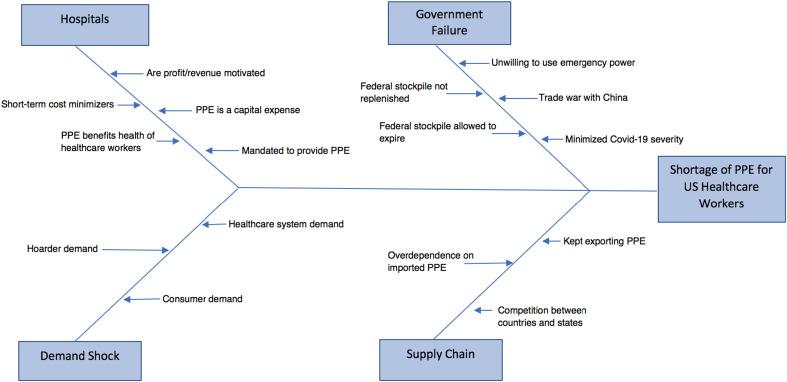
This study investigates the forces that contributed to severe shortages in personal protective equipment in the US during the COVID-19 crisis. Problems from a dysfunctional costing model in hospital operating systems were magnified by a very large demand shock triggered by acute need in healthcare and panicked marketplace behavior that depleted domestic PPE inventories. The lack of effective action on the part of the federal government to maintain and distribute domestic inventories, as well as severe disruptions to the PPE global supply chain, amplified the problem. Analysis of trade data shows that the US is the world's largest importer of face masks, eye protection, and medical gloves, making it highly vulnerable to disruptions in exports of medical supplies. We conclude that market prices are not appropriate mechanisms for rationing inputs to health because health is a public good. Removing the profit motive for purchasing PPE in hospital costing models, strengthening government capacity to maintain and distribute stockpiles, developing and enforcing regulations, and pursuing strategic industrial policy to reduce US dependence on imported PPE will help to better protect healthcare workers with adequate supplies of PPE.
这项研究调查了导致 COVID-19 危机期间美国个人防护设备严重短缺的原因。医院运营系统中功能失调的成本核算模型问题,因医疗保健领域的迫切需求和恐慌性市场行为导致的巨大需求冲击而放大,这些行为耗尽了国内个人防护设备的库存。联邦政府缺乏维护和分发国内库存的有效行动,以及个人防护设备全球供应链的严重中断,进一步加剧了这一问题。贸易数据的分析表明,美国是全球最大的口罩、眼部防护和医用手套进口国,因此极易受到医疗用品出口中断的影响。我们的结论是,市场价格并不是将投入品配给给卫生保健的合适机制,因为卫生保健是一种公共产品。从医院成本核算模型中去除购买个人防护设备的利润动机,增强政府维持和分配库存的能力,制定和执行法规,并采取战略产业政策以减少美国对进口个人防护设备的依赖,将有助于更好地为医护人员提供充足的个人防护设备,以保护他们的安全。
 Zotero 插件