
用于酮症监测的高分辨率呼气丙酮测量仪的特性分析。
Characterization of a high-resolution breath acetone meter for ketosis monitoring.
作者信息
Suntrup Iii Donald J, Ratto Timothy V, Ratto Matt, McCarter James P
机构信息
Readout Health, St. Louis, MO, United States of America.
Abbott Diabetes Care, Almeda, CA, United States of America.
出版信息
PeerJ. 2020 Sep 24;8:e9969. doi: 10.7717/peerj.9969. eCollection 2020.
BACKGROUND
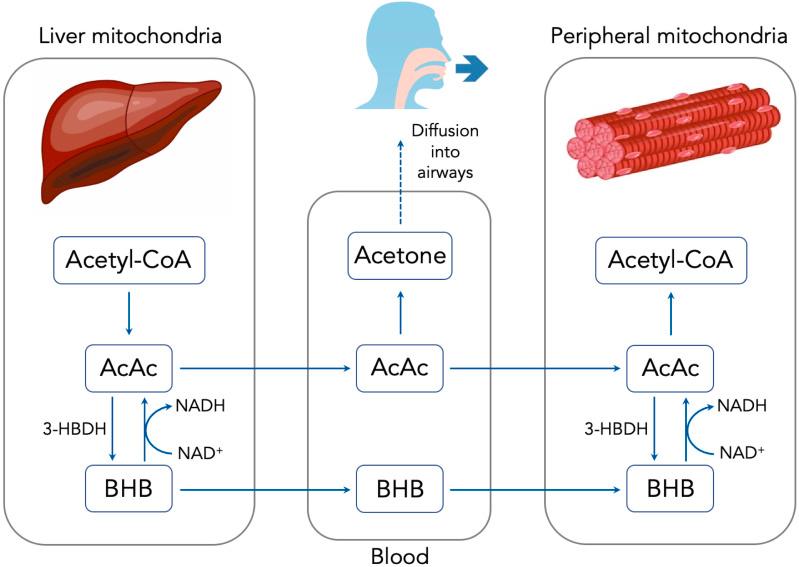
The ketone bodies beta-hydroxybutyrate (BHB) and acetone are endogenous products of fatty acid metabolism. Although ketone levels can be monitored by measuring either blood BHB or breath acetone, determining the precise correlation between these two measurement methods has been challenging. The purpose of this study is to characterize the performance of a novel portable breath acetone meter (PBAM) developed by Readout, Inc., to compare single versus multiple daily ketone measurements, and to compare breath acetone (BrAce) and blood BHB measurements.
METHODS
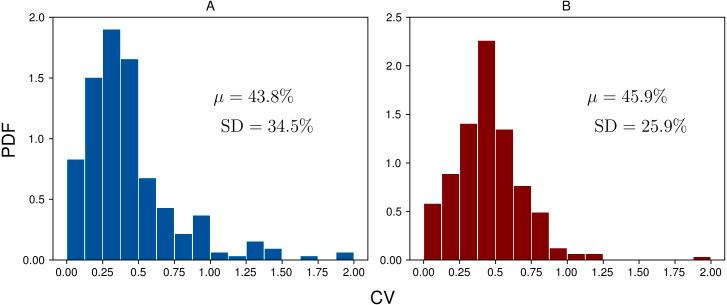
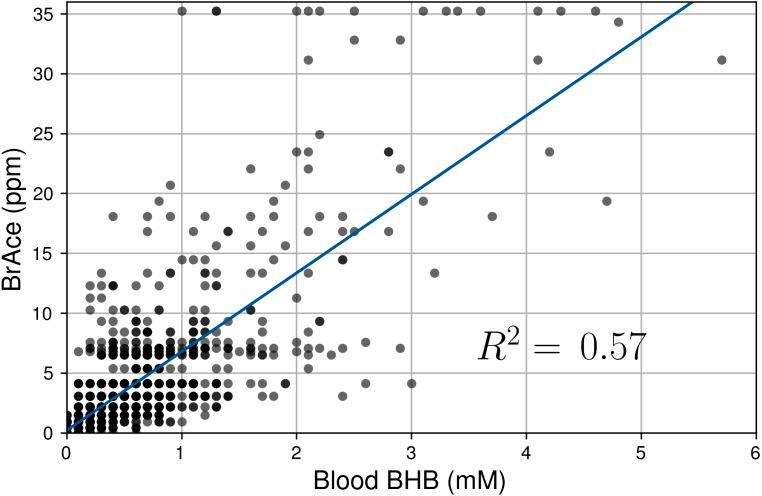
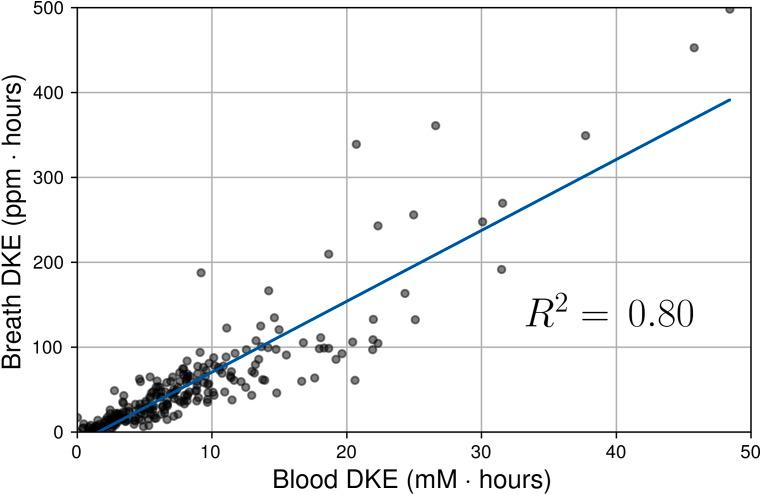
We conducted a 14-day prospective observational cohort study of 21 subjects attempting to follow either a low-carbohydrate/ketogenic or a standard diet. Subjects were asked to concurrently measure both blood BHB and BrAce five times per day and report the results using an online data entry system. We evaluated the utility of multiple daily measurements by calculating the coefficient of variation (CV) for each daily group of measurements. We calculated the correlation between coincident BrAce and blood BHB measurements using linear ordinary least squares regression analysis. We assessed the ability of the BrAce measurement to accurately predict blood BHB states using receiver operating characteristic (ROC) analysis. Finally, we calculated a daily ketone exposure (DKE) using the area under the curve (AUC) of a ketone concentration versus time graph and compared the DKE of BrAce and blood BHB using linear ordinary least squares regression.
RESULTS
BrAce and blood BHB varied throughout the day by an average of 44% and 46%, respectively. The BrAce measurement accurately predicted whether blood BHB was greater than or less than the following thresholds: 0.3 mM (AUC = 0.898), 0.5 mM (AUC = 0.854), 1.0 mM (AUC = 0.887), and 1.5 mM (AUC = 0.935). Coincident BrAce and blood BHB measurements were moderately correlated with = 0.57 ( < 0.0001), similar to literature reported values. However, daily ketone exposures, or areas under the curve, for BrAce and blood BHB were highly correlated with = 0.80 ( < 0.0001).
CONCLUSIONS
The results validated the performance of the PBAM. The BrAce/BHB correlation was similar to literature values where BrAce was measured using highly accurate lab instruments. Additionally, BrAce measurements using the PBAM can be used to predict blood BHB states. The relatively high daily variability of ketone levels indicate that single blood or breath ketone measurements are often not sufficient to assess daily ketone exposure for most users. Finally, although single coincident blood and breath ketone measurements show only a moderate correlation, possibly due to the temporal lag between BrAce and blood BHB, daily ketone exposures for blood and breath are highly correlated.
背景
酮体β-羟基丁酸(BHB)和丙酮是脂肪酸代谢的内源性产物。尽管可以通过测量血液中的BHB或呼出气体中的丙酮来监测酮体水平,但确定这两种测量方法之间的精确相关性一直具有挑战性。本研究的目的是评估Readout公司开发的新型便携式呼出气体丙酮测量仪(PBAM)的性能,比较每日单次与多次酮体测量,并比较呼出气体丙酮(BrAce)和血液BHB测量结果。
方法
我们对21名尝试采用低碳水化合物/生酮饮食或标准饮食的受试者进行了为期14天的前瞻性观察队列研究。受试者被要求每天同时测量血液BHB和BrAce五次,并使用在线数据录入系统报告结果。我们通过计算每组每日测量值的变异系数(CV)来评估每日多次测量的效用。我们使用线性普通最小二乘法回归分析计算同时测量的BrAce和血液BHB之间的相关性。我们使用受试者工作特征(ROC)分析评估BrAce测量准确预测血液BHB状态的能力。最后,我们使用酮体浓度与时间关系图的曲线下面积(AUC)计算每日酮体暴露量(DKE),并使用线性普通最小二乘法回归比较BrAce和血液BHB的DKE。
结果
BrAce和血液BHB在一天中的变化平均分别为44%和46%。BrAce测量能够准确预测血液BHB是否高于或低于以下阈值:0.3 mM(AUC = 0.898)、0.5 mM(AUC = 0.854)、1.0 mM(AUC = 0.887)和1.5 mM(AUC = 0.935)。同时测量的BrAce和血液BHB具有中等程度的相关性,r = 0.57(P < 0.0001),与文献报道的值相似。然而,BrAce和血液BHB的每日酮体暴露量或曲线下面积具有高度相关性,r = 0.80(P < 0.0001)。
结论
结果验证了PBAM的性能。BrAce/BHB的相关性与使用高精度实验室仪器测量BrAce的文献值相似。此外,使用PBAM进行的BrAce测量可用于预测血液BHB状态。酮体水平相对较高的每日变异性表明,对于大多数使用者而言,单次血液或呼出气体酮体测量往往不足以评估每日酮体暴露量。最后,尽管单次同时进行的血液和呼出气体酮体测量仅显示中等程度的相关性,可能是由于BrAce和血液BHB之间存在时间滞后,但血液和呼出气体的每日酮体暴露量具有高度相关性。




 Zotero 插件