
虾青素生物合成的立体化学在海洋桡足类中的研究。
Stereochemistry of Astaxanthin Biosynthesis in the Marine Harpacticoid Copepod .
机构信息
Nutrition Research Center Ireland, School of Health Science, Carriganore House, Waterford Institute of Technology West Campus, Carriganore, Waterford X91K236, Ireland.
Surfactant and Bioenergy Research Center, IPB University, Bogor 16143, Indonesia.
出版信息
Mar Drugs. 2020 Oct 5;18(10):506. doi: 10.3390/md18100506.
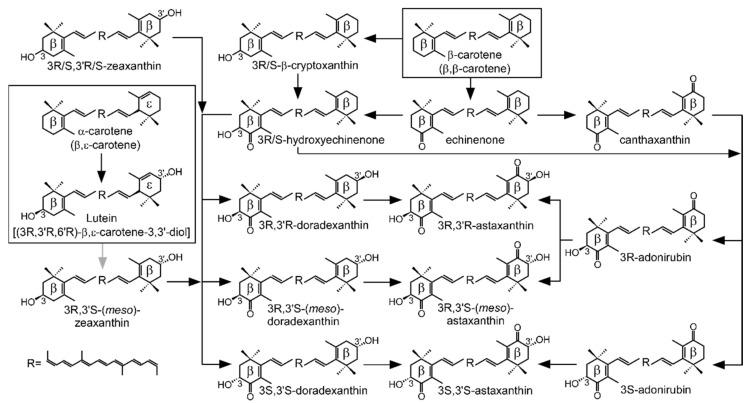
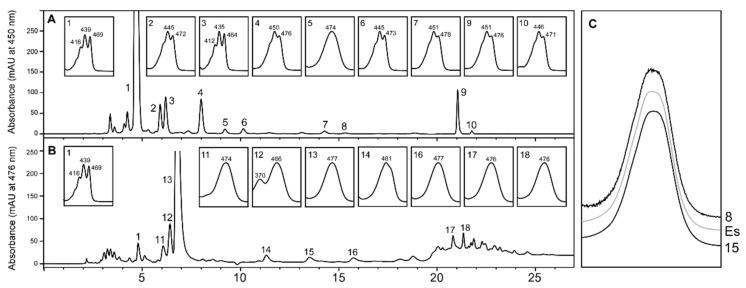
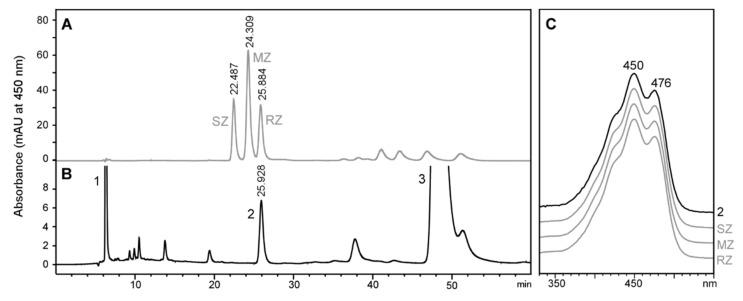
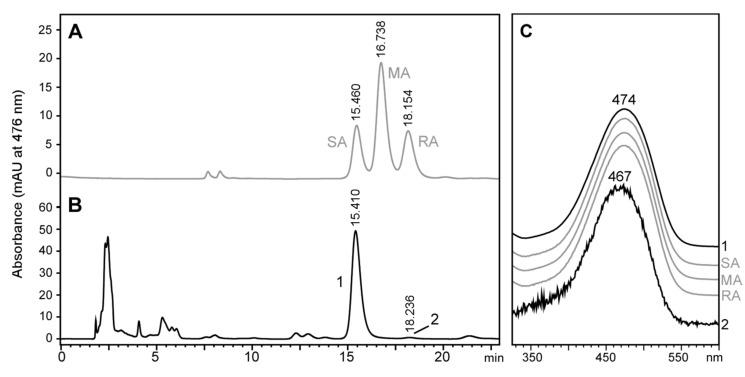
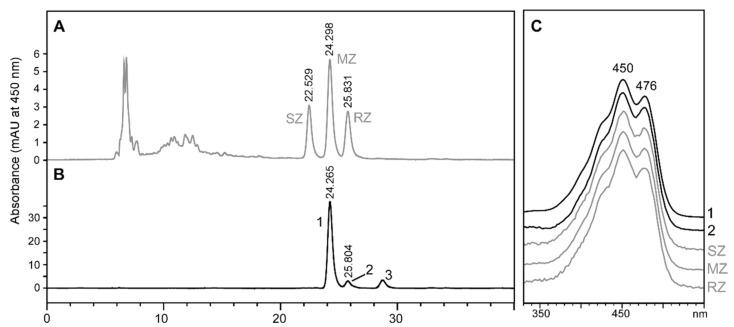
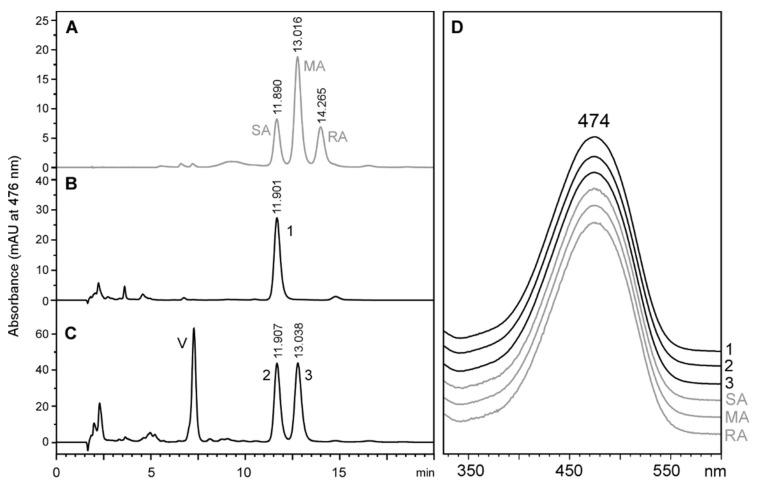
The harpacticoid copepod has been recognized as a model organism for the study of marine pollutants. Furthermore, the nutritional profile of this copepod is of interest to the aquafeed industry. Part of this interest lies in the fact that produces astaxanthin, an essential carotenoid in salmonid aquaculture. Here, we study for the first time the stereochemistry of the astaxanthin produced by this copepod. We cultured with different feeding sources and used chiral high-performance liquid chromatography with diode array detection (HPLC-DAD) to determine that synthesizes pure 3,3'-astaxanthin. Using -zeaxanthin as feed, we found that the putative ketolase enzyme from can work with β-rings with either 3- or 3-oriented hydroxyl groups. Despite this ability, experiments in the presence of hydroxylated and non-hydroxylated carotenoids suggest that prefers to use the latter to produce 3,3'-astaxanthin. We suggest that the biochemical tools described in this work can be used to study the mechanistic aspects of the recently identified avian ketolase.
桡足类动物已被公认为研究海洋污染物的模式生物。此外,这种桡足类动物的营养状况也引起了水产饲料行业的兴趣。部分原因在于它能产生虾青素,这是鲑鱼养殖中必不可少的类胡萝卜素。在这里,我们首次研究了这种桡足类动物产生的虾青素的立体化学。我们用不同的饲料源培养了桡足类动物,并使用手性高效液相色谱与二极管阵列检测(HPLC-DAD)来确定桡足类动物合成的是纯 3,3'-虾青素。使用β-玉米黄质作为饲料,我们发现来自桡足类动物的假定酮酶可以与β-环具有 3-或 3-取向的羟基一起作用。尽管有这种能力,但在存在羟基化和非羟基化类胡萝卜素的实验中,表明桡足类动物更倾向于使用后者来产生 3,3'-虾青素。我们认为,本工作中描述的生化工具可用于研究最近发现的禽类酮酶的机制方面。


 Zotero 插件