
加纳国家医疗保险计划(NHIS)的实施:给南非及中低收入国家的经验教训
Implementation of the National Health Insurance Scheme (NHIS) in Ghana: Lessons for South Africa and Low- and Middle-Income Countries.
作者信息
Christmals Christmal Dela, Aidam Kizito
机构信息
Research on the Health Workforce for Equity and Quality, Centre for Health Policy, School of Public Health, University of Witwatersrand, Johannesburg, South Africa.
Department of Bacteriology, Noguchi Memorial Institute for Medical Research, University of Ghana, Accra, Ghana.
出版信息
Risk Manag Healthc Policy. 2020 Oct 2;13:1879-1904. doi: 10.2147/RMHP.S245615. eCollection 2020.
BACKGROUND
South Africa is having difficulties in rolling out the National Health Insurance(NHI) policy. There are ongoing arguments on whether the NHI will provide access to quality and equitable healthcare it is intended to and whether South Africa is ready to implement the policy. Many stakeholders believe the country needs more preparation if the policy will be successful. Ghana, on the other hand, has successfully implemented the National Health Insurance Scheme(NHIS) for over 15 years.
OBJECTIVE
This paper sought to explore the implementation of the NHIS in Ghana and the lessons South Africa and other low- and middle-income countries can learn from such a process.
METHODS
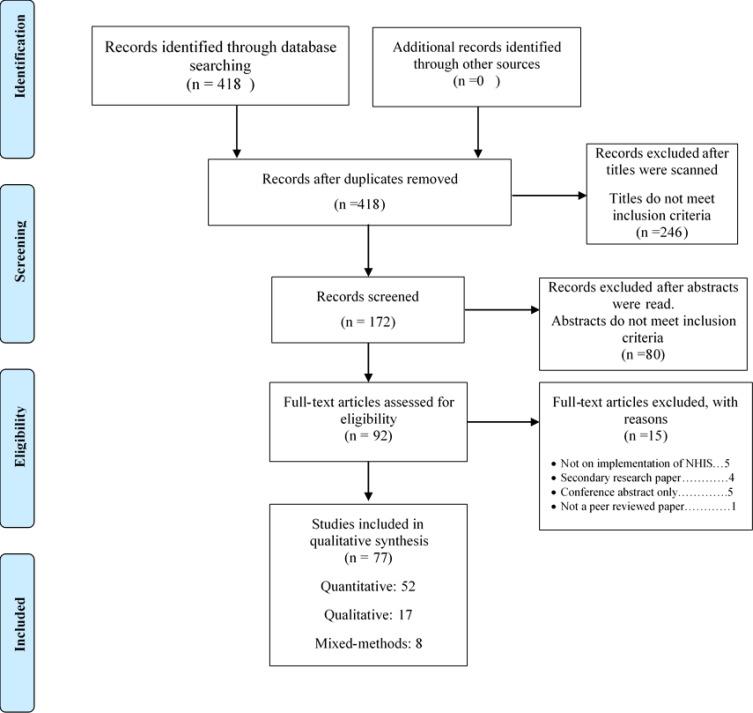
A scoping review was conducted using the Joanna Brigs Institute's System for the Unified Management, Assessment and Review of Information (SUMARI) and Mendeley reference manager to manage the review process. Journal articles published on the NHIS in Ghana from January 2003 to December 2018 were searched from Science Direct, PubMed, Scopus, CINAHL, and Medline using the keywords: Ghana, Health, and Insurance.
RESULTS
The implementation of the NHIS has provided access to healthcare for the Ghanaian population, especially to poor and vulnerable . Despite the successful implementation of the NHIS in Ghana, the scheme is challenged with poor coverage; poor quality of care; corruption and ineffective governance; poor stakeholder participation; lack of clarity on concepts in the policy; intense political influence; and poor financing.
CONCLUSION
The marked inequity in the South African health system makes the implementation of the NHI inevitable. The challenges experienced in the implementation of the NHIS in Ghana are not new to the South African healthcare system. South Africa must learn from the experiences of Ghana,a context that shares common socio-cultural and economic factors and disease burden,in order to successfully implement the NHI.
背景
南非在推行国家医疗保险(NHI)政策方面面临困难。关于NHI是否能提供其预期的优质且公平的医疗服务,以及南非是否准备好实施该政策,一直存在争论。许多利益相关者认为,如果该政策要取得成功,该国需要更多准备。另一方面,加纳已成功实施国家医疗保险计划(NHIS)超过15年。
目的
本文旨在探讨加纳NHIS的实施情况,以及南非和其他低收入和中等收入国家可从此过程中学到的经验教训。
方法
使用乔安娜·布里格斯研究所的信息统一管理、评估和审查系统(SUMARI)以及Mendeley参考文献管理器进行范围审查,以管理审查过程。使用关键词“加纳”“健康”和“保险”,在科学Direct、PubMed、Scopus、CINAHL和Medline上搜索2003年1月至2018年12月在加纳发表的关于NHIS的期刊文章。
结果
NHIS的实施为加纳民众提供了医疗服务,尤其是为贫困和弱势群体提供了服务。尽管加纳成功实施了NHIS,但该计划面临覆盖率低、医疗质量差、腐败和治理无效、利益相关者参与度低、政策概念不清晰、政治影响强烈以及融资困难等挑战。
结论
南非卫生系统中明显的不公平使得实施NHI成为必然。加纳在实施NHIS过程中遇到的挑战对南非医疗系统来说并不陌生。南非必须借鉴加纳的经验,加纳与南非有着共同的社会文化和经济因素以及疾病负担,以便成功实施NHI。
 Zotero 插件