
重新审视 TNF 在 MS 发病机制和治疗中的作用。
Re-Examining the Role of TNF in MS Pathogenesis and Therapy.
机构信息
Synaptic Immunopathology Lab, IRCCS San Raffaele Pisana, 00166 Rome, Italy.
Synaptic Immunopathology Lab, Department of Systems Medicine, Tor Vergata University, 00133 Rome, Italy.
出版信息
Cells. 2020 Oct 14;9(10):2290. doi: 10.3390/cells9102290.
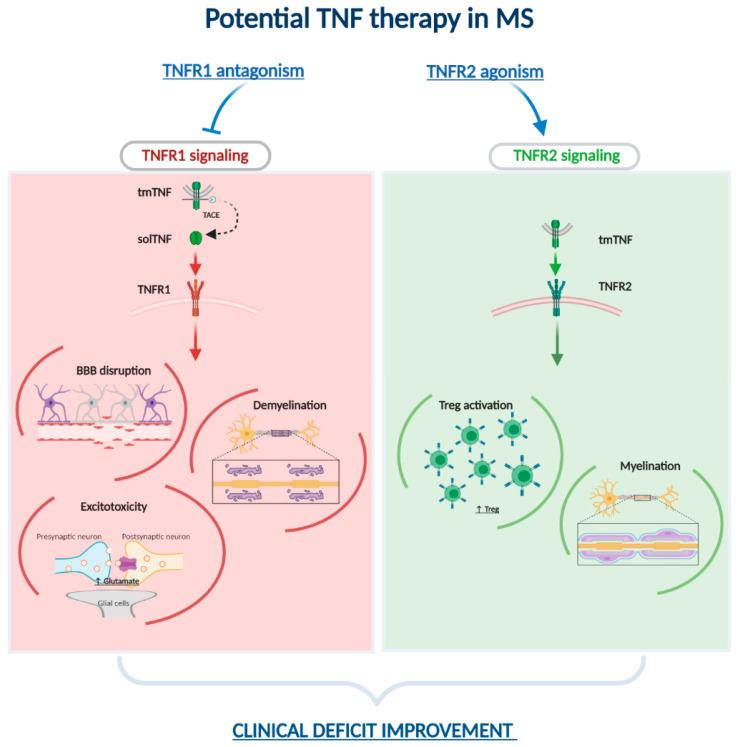
Multiple sclerosis (MS) is a common neurological disorder of putative autoimmune origin. Clinical and experimental studies delineate abnormal expression of specific cytokines over the course of the disease. One major cytokine that has been shown to play a pivotal role in MS is tumor necrosis factor (TNF). TNF is a pleiotropic cytokine regulating many physiological and pathological functions of both the immune system and the central nervous system (CNS). Convincing evidence from studies in human and experimental MS have demonstrated the involvement of TNF in various pathological hallmarks of MS, including immune dysregulation, demyelination, synaptopathy and neuroinflammation. However, due to the complexity of TNF signaling, which includes two-ligands (soluble and transmembrane TNF) and two receptors, namely TNF receptor type-1 (TNFR1) and type-2 (TNFR2), and due to its cell- and context-differential expression, targeting the TNF system in MS is an ongoing challenge. This review summarizes the evidence on the pathophysiological role of TNF in MS and in different MS animal models, with a special focus on pharmacological treatment aimed at controlling the dysregulated TNF signaling in this neurological disorder.
多发性硬化症(MS)是一种常见的神经障碍,其发病机制可能与自身免疫有关。临床和实验研究描绘了疾病过程中特定细胞因子异常表达的情况。有证据表明,肿瘤坏死因子(TNF)在 MS 中起着关键作用。TNF 是一种多效细胞因子,调节免疫系统和中枢神经系统(CNS)的许多生理和病理功能。来自人类和实验性 MS 的研究提供了令人信服的证据,表明 TNF 参与了 MS 的各种病理特征,包括免疫失调、脱髓鞘、突触病和神经炎症。然而,由于 TNF 信号转导的复杂性,包括两种配体(可溶性和跨膜 TNF)和两种受体,即 TNF 受体 1(TNFR1)和 2(TNFR2),以及由于其细胞和上下文差异表达,针对 MS 中的 TNF 系统仍然是一个挑战。这篇综述总结了 TNF 在 MS 及不同 MS 动物模型中的病理生理作用的证据,特别关注旨在控制这种神经障碍中失调的 TNF 信号转导的药物治疗。
 Zotero 插件