
新冠疫情对主观心理健康的影响:感知威胁、未来焦虑与心理韧性的相互作用。
The impact of the COVID-19 pandemic on subjective mental well-being: The interplay of perceived threat, future anxiety and resilience.
作者信息
Paredes Mario R, Apaolaza Vanessa, Fernandez-Robin Cristóbal, Hartmann Patrick, Yañez-Martinez Diego
机构信息
Universidad del Rosario, School of Management and Business, Bogotá, Colombia.
Faculty of Economics and Business Administration, University of the Basque Country UPV/EHU, Bilbao, Spain.
出版信息
Pers Individ Dif. 2021 Feb 15;170:110455. doi: 10.1016/j.paid.2020.110455. Epub 2020 Oct 13.
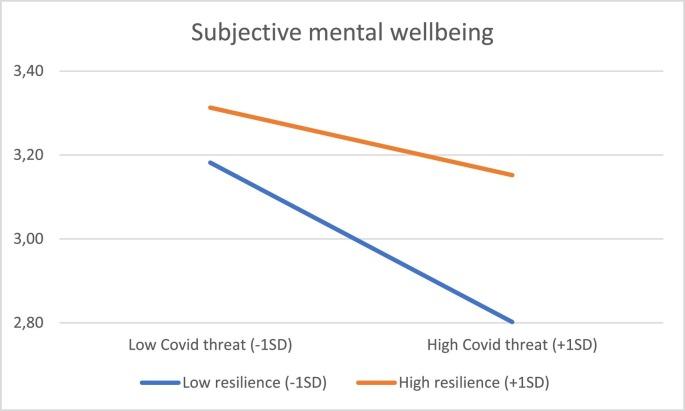
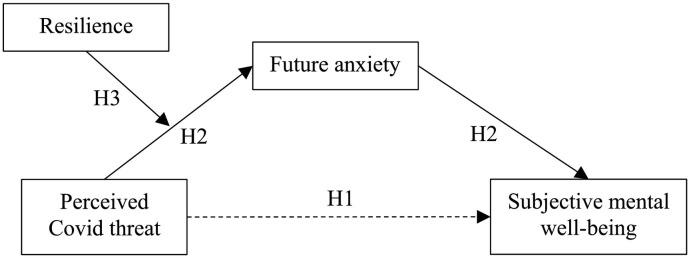
The COVID-19 pandemic has potentially a serious impact on many people's mental well-being. This study analyses the influence of the perceived threat of COVID-19 on subjective mental well-being with an online survey (n = 711). Findings confirmed the hypothesized model that provides a process explanation for this effect through the mediating influence of the activation of future anxiety. In addition, results confirmed that this influence via future anxiety is moderated by resilience, a personality trait that enables individuals to cope better with stressful or traumatic events. Individuals with higher levels of resilience compared to those with lower levels registered a lower impact of perceived Covid threat on future anxiety and, in turn, on subjective well-being. This study contributes theoretically to a better understanding of the factors that determine the impact of traumatic events such as a pandemic on people's mental health. The implications of this study indicate interventions that may be carried out to minimize the pandemic's negative psychological consequences.
新冠疫情可能会对许多人的心理健康产生严重影响。本研究通过一项在线调查(n = 711)分析了对新冠疫情的感知威胁对主观心理健康的影响。研究结果证实了假设模型,该模型通过未来焦虑激活的中介作用,对这种影响提供了一个过程解释。此外,结果证实,这种通过未来焦虑产生的影响会受到心理韧性的调节,心理韧性是一种使个体能够更好地应对压力或创伤性事件的人格特质。与心理韧性较低的个体相比,心理韧性较高的个体所感知到的新冠威胁对未来焦虑进而对主观幸福感的影响较小。本研究在理论上有助于更好地理解诸如疫情等创伤性事件对人们心理健康产生影响的决定因素。本研究的意义在于指出了可以采取的干预措施,以尽量减少疫情的负面心理后果。
 Zotero 插件