
年轻男性精液质量的区域差异:关于胎儿期和成年期环境与生活方式因素影响的综述
Regional difference in semen quality of young men: a review on the implication of environmental and lifestyle factors during fetal life and adulthood.
作者信息
Rahban Rita, Nef Serge
机构信息
Swiss Centre for Applied Human Toxicology (SCAHT), Switzerland and Department of Genetic Medicine and Development, Faculty of Medicine, University of Geneva, Rue Michel-Servet 1, 1206 Geneva, Switzerland.
出版信息
Basic Clin Androl. 2020 Oct 15;30:16. doi: 10.1186/s12610-020-00114-4. eCollection 2020.
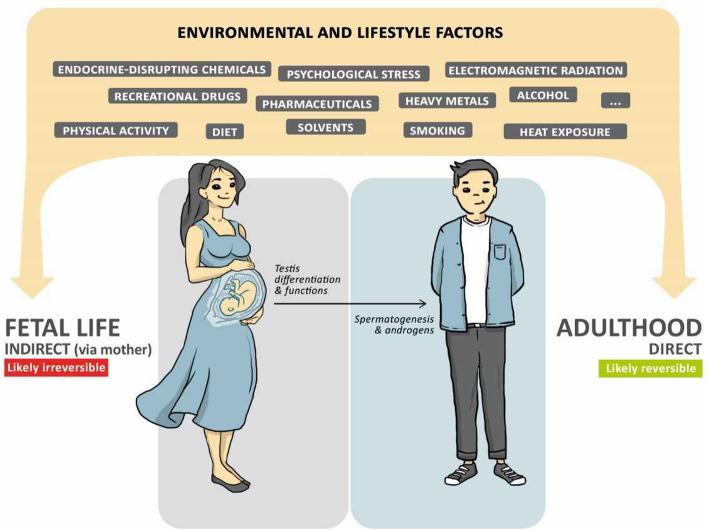
The prevalence of low semen quality and the incidence of testicular cancer have been steadily increasing over the past decades in different parts of the World. Although these conditions may have a genetic or epigenetic origin, there is growing evidence that multiple environmental and lifestyle factors can act alone or in combination to induce adverse effects. Exposure to these factors may occur as early as during fetal life, via the mother, and directly throughout adulthood after full spermatogenic capacity is reached. This review aims at providing an overview of past and current trends in semen quality and its relevance to fertility as well as a barometer of men's general health. The focus will be on recent epidemiological studies of young men from the general population highlighting geographic variations in Europe. The impact of some lifestyle and environmental factors will be discussed with their role in both fetal life and adulthood. These factors include smoking, alcohol consumption, psychological stress, exposure to electromagnetic radiation, and Endocrine Disrupting Chemicals (EDCs). Finally, the challenges in investigating the influence of environmental factors on semen quality in a fast changing world are presented.
在过去几十年里,世界不同地区精液质量低下的患病率和睾丸癌的发病率一直在稳步上升。尽管这些情况可能有遗传或表观遗传起源,但越来越多的证据表明,多种环境和生活方式因素可以单独或共同作用,从而产生不良影响。对这些因素的接触可能早在胎儿期就通过母亲发生,在成年后达到完全生精能力后则会直接接触。这篇综述旨在概述精液质量的过去和当前趋势及其与生育能力的相关性,以及作为男性总体健康的一个晴雨表。重点将放在近期对普通人群中年轻男性的流行病学研究上,突出欧洲的地理差异。将讨论一些生活方式和环境因素的影响及其在胎儿期和成年期的作用。这些因素包括吸烟、饮酒、心理压力、接触电磁辐射以及内分泌干扰化学物质(EDCs)。最后,介绍了在快速变化的世界中研究环境因素对精液质量影响所面临的挑战。

 Zotero 插件