
在乌干达,接受抗逆转录病毒治疗的人群中,每日使用异烟肼和利福喷丁一个月与每周使用异烟肼和利福喷丁三个月预防结核病的成本效益比较。
Cost-effectiveness of one month of daily isoniazid and rifapentine versus three months of weekly isoniazid and rifapentine for prevention of tuberculosis among people receiving antiretroviral therapy in Uganda.
机构信息
Department of Epidemiology, Johns Hopkins Bloomberg School of Public Health, Baltimore, MD, USA.
Department of Medicine, Center for Tuberculosis Research, Johns Hopkins University School of Medicine, Baltimore, MD, USA.
出版信息
J Int AIDS Soc. 2020 Oct;23(10):e25623. doi: 10.1002/jia2.25623.
INTRODUCTION
Preventive therapy is essential for reducing tuberculosis (TB) burden among people living with HIV (PLWH) in high-burden settings. Short-course preventive therapy regimens, such as three-month weekly rifapentine and isoniazid (3HP) and one-month daily rifapentine and isoniazid (1HP), may help facilitate uptake of preventive therapy for latently infected patients, but the comparative cost-effectiveness of these regimens under different conditions is uncertain.
METHODS
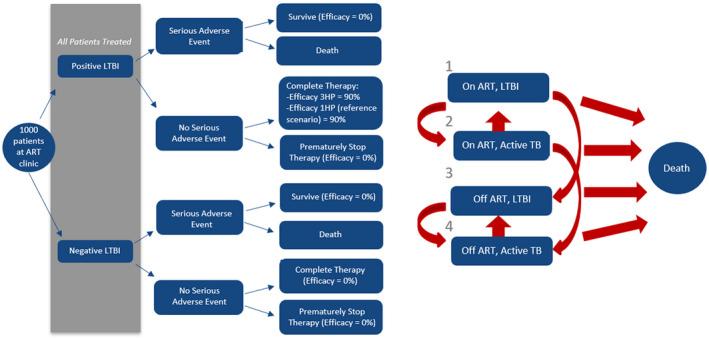
We used a Markov state-transition model to estimate the incremental costs and effectiveness of 1HP versus 3HP in a simulated cohort of patients attending an HIV clinic in Uganda, as an example of a low-income, high-burden setting in which TB preventive therapy might be prescribed to PLWH. Our primary outcome was the incremental cost-effectiveness ratio, expressed as 2019 US dollars per disability-adjusted life year (DALY) averted. We estimated cost-effectiveness under different conditions of treatment completion and efficacy of 1HP versus 3HP, latent TB prevalence and rifapentine price.
RESULTS
Assuming equivalent clinical outcomes using 1HP and 3HP and a rifapentine price of $0.21 per 150 mg, 1HP would cost an additional $4.66 per patient treated. Assuming equivalent efficacy but 20% higher completion with 1HP versus 3HP, 1HP would cost $1,221 per DALY averted relative to 3HP. This could be reduced to $18 per DALY averted if 1HP had 5% greater efficacy than 3HP and the price of rifapentine were 50% lower. At a rifapentine price of $0.06 per 150 mg, 1HP would become cost-neutral relative to 3HP.
CONCLUSIONS
1HP has the potential to be cost-effective under many realistic circumstances. Cost-effectiveness depends on rifapentine price, relative completion and efficacy, prevalence of latent TB and local willingness-to-pay.
引言
在高负担地区,预防疗法对于降低艾滋病毒感染者(PLHIV)的结核病(TB)负担至关重要。短程预防疗法方案,如三个月每周利福平加异烟肼(3HP)和一个月每日利福平加异烟肼(1HP),可能有助于促进潜伏性感染患者接受预防治疗,但在不同情况下,这些方案的比较成本效益尚不确定。
方法
我们使用马尔可夫状态转移模型来估计在乌干达的一个艾滋病毒诊所接受治疗的患者模拟队列中,1HP 与 3HP 的增量成本和效果,这是一个低收入、高负担地区,在这些地区可能会为 PLHIV 开具 TB 预防治疗药物。我们的主要结果是增量成本效益比,以 2019 年每避免一个残疾调整生命年(DALY)的美元数表示。我们根据 1HP 与 3HP 的治疗完成情况和疗效、潜伏性结核病患病率和利福平价格的不同条件来估计成本效益。
结果
假设 1HP 和 3HP 的临床结果相同,且利福平的价格为每 150mg0.21 美元,那么每治疗一名患者,1HP 将额外增加 4.66 美元。假设 1HP 与 3HP 的完成率提高 20%,但疗效相同,那么 1HP 相对于 3HP 每避免一个 DALY 将花费 1221 美元。如果 1HP 的疗效比 3HP 高 5%,且利福平的价格降低 50%,则可将这一费用降低至 18 美元。如果利福平的价格为每 150mg0.06 美元,则 1HP 相对于 3HP 将具有成本效益。
结论
在许多现实情况下,1HP 具有成本效益的潜力。成本效益取决于利福平的价格、相对完成率和疗效、潜伏性结核病的患病率和当地的支付意愿。

 Zotero 插件