
DAZ3 启动子低甲基化与特发性弱精子症:液体活检的筛查工具。
Hypomethylation of the DAZ3 promoter in idiopathic asthenospermia: a screening tool for liquid biopsy.
机构信息
Department of Laboratory Medicine, The First Affiliated Hospital of Nanjing Medical University, Nanjing, 210029, China.
Department of Clinical Nutrition, The First Affiliated Hospital of Nanjing Medical University, Nanjing, 210029, China.
出版信息
Sci Rep. 2020 Oct 22;10(1):17996. doi: 10.1038/s41598-020-75110-9.
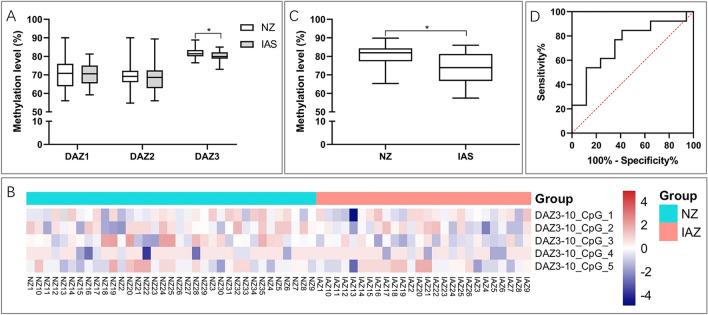
Given the role of the deleted in azoospermia gene in male infertility, whether the somatic deleted in azoospermia methylation status is associated with idiopathic asthenospermia should be determined. To investigate the methylation levels of the deleted in azoospermia promoter in peripheral white blood cells from idiopathic asthenospermia patients relative to those in normozoospermia controls, 61 ethylene diamine tetraacetic acid anticoagulant blood samples were drawn from all participants for DNA isolation. The deleted in azoospermia promoter methylation ratio was detected by MassARRAY-based methylation quantification and confirmed by quantitative methylation-specific polymerase chain reaction. A MassARRAY-based methylation analysis showed that the deleted in azoospermia 3 promoter (0 to - 2 kbp) was significantly hypomethylated in peripheral white blood cells from idiopathic asthenospermia males, specifically one CpG site (- 246 to - 247). Quantitative methylation-specific polymerase chain reaction data further confirmed that the methylation level of the deleted in azoospermia 3 promoter region in idiopathic asthenospermia patients was significantly lower than that in normozoospermia males. The area under the receiver operating characteristic curve determined by quantitative methylation-specific polymerase chain reaction was 0.737 (95% confidence interval: 0.552 to 0.924), with a sensitivity of 53.9% and a specificity of 88.2% at a cut-off level of 74.7%. Therefore, our results suggested that methylation ratio detection of the deleted in azoospermia 3 promoter region by real-time polymerase chain reaction assay is a promising and feasible tool for liquid biopsy in the clinical laboratories. The methylation status of other reported infertility-related genes should also be investigated in peripheral white blood cells.
鉴于缺失型精子发生基因在男性不育中的作用,应确定不育症患者外周血白细胞中缺失型精子发生的去甲基化状态是否与特发性弱精子症有关。为了研究特发性弱精子症患者与正常生育力对照组外周血白细胞中缺失型精子发生启动子的甲基化水平,从所有参与者中抽取 61 份乙二胺四乙酸抗凝血样用于 DNA 分离。通过基于 MassARRAY 的甲基化定量检测缺失型精子发生启动子的甲基化比值,并通过定量甲基化特异性聚合酶链反应进行验证。基于 MassARRAY 的甲基化分析显示,特发性弱精子症男性外周血白细胞中缺失型精子发生 3 号启动子(0 至-2kbp)显著低甲基化,特别是一个 CpG 位点(-246 至-247)。定量甲基化特异性聚合酶链反应数据进一步证实,特发性弱精子症患者缺失型精子发生 3 号启动子区域的甲基化水平明显低于正常生育力男性。定量甲基化特异性聚合酶链反应确定的受试者工作特征曲线下面积为 0.737(95%置信区间:0.552 至 0.924),在截断值为 74.7%时,灵敏度为 53.9%,特异性为 88.2%。因此,我们的结果表明,实时聚合酶链反应检测缺失型精子发生 3 号启动子区域的甲基化比值是临床实验室液体活检的一种有前途和可行的工具。还应研究其他报道的与不育相关基因在外周血白细胞中的甲基化状态。


 Zotero 插件