
HLA Ⅱ类错配联合移植后环磷酰胺可改善haploidentical 移植的预后。
Class II HLA mismatch improves outcomes following haploidentical transplantation with posttransplant cyclophosphamide.
机构信息
The Blood and Marrow Transplant Program, Northside Hospital Cancer Institute, Atlanta, GA.
University of Colorado Cord Blood Bank & Clinimmune Laboratory, Aurora, CO; and.
出版信息
Blood Adv. 2020 Oct 27;4(20):5311-5321. doi: 10.1182/bloodadvances.2020003110.
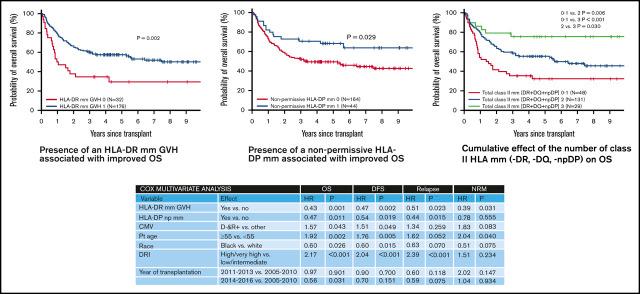
HLA disparity is the major predictor of outcome following unrelated donor (UD) transplantation, where a single mismatch (mm) at the HLA-A, HLA-B, HLA-C, or HLA-DRB1 locus leads to increased mortality, and mismatching at multiple loci compounds this effect. In contrast, HLA disparity has not been shown to increase mortality in the context of haploidentical transplant using posttransplant cyclophosphamide (PTCy). To better define the consequences of loci-specific HLA mm, we analyzed 208 consecutive patients undergoing haploidentical transplantation for hematologic malignancy using PTCy at our institution (median age, 52 years [range, 19-75 years]; peripheral blood stem cell, 66%; reduced-intensity conditioning, 59%). Median follow-up was 65.4 months (range, 34.3-157.2 months). In univariate analysis, a single class II HLA mm at HLA-DR, HLA-DQ or a nonpermissive (np) HLA-DP mm had a protective effect on disease-free and overall survival (OS), primarily a result of reduced relapse risk. Furthermore, this survival effect was cumulative, so that patients with 3 class II mm (HLA-DR, HLA-DQ, and np HLA-DP) had the best OS. In multivariate analysis, HLA-DR mm and np HLA-DP mm were both independently associated with improved OS (hazard ratio [HR], 0.43; P =.001; and HR, 0.47; P =.011, respectively). In contrast, single or multiple mm at HLA-A, HLA-B, or HLA-C loci had no effect on acute graft-versus-host disease (GVHD), nonrelapse mortality (NRM), relapse, or survival, although the presence of an HLA-A mm was associated with increased chronic GVHD incidence. The association of class II mm with lower relapse occurred without a corresponding increase in NRM or acute or chronic GVHD. These findings will require validation in larger registry studies.
HLA 错配是异基因供体(UD)移植后结局的主要预测因素,HLA-A、HLA-B、HLA-C 或 HLA-DRB1 位点的单个错配(mm)会导致死亡率增加,而多个位点的错配则会加剧这种影响。相比之下,在使用移植后环磷酰胺(PTCy)的单倍体相合移植中,HLA 错配并未显示出增加死亡率。为了更好地定义特定 HLA 错配的后果,我们分析了在我们机构接受 PTCy 治疗的 208 例连续接受血液系统恶性肿瘤单倍体相合移植的患者(中位年龄,52 岁[范围,19-75 岁];外周血干细胞,66%;强度降低的调理,59%)。中位随访时间为 65.4 个月(范围,34.3-157.2 个月)。在单因素分析中,HLA-DR、HLA-DQ 或非许可性(np)HLA-DP 中的单个 II 类 HLA mm 对无病生存和总生存(OS)具有保护作用,主要是降低复发风险的结果。此外,这种生存效果是累积的,因此具有 3 个 II 类 mm(HLA-DR、HLA-DQ 和 np HLA-DP)的患者具有最佳的 OS。多因素分析显示,HLA-DR mm 和 np HLA-DP mm 均与 OS 改善独立相关(风险比[HR],0.43;P=.001;和 HR,0.47;P=.011)。相比之下,HLA-A、HLA-B 或 HLA-C 位点的单个或多个 mm 对急性移植物抗宿主病(GVHD)、非复发死亡率(NRM)、复发或生存没有影响,尽管 HLA-A mm 的存在与慢性 GVHD 发生率增加有关。II 类 mm 与较低复发率相关,而没有相应增加 NRM 或急性或慢性 GVHD。这些发现需要在更大的登记研究中进行验证。
 Zotero 插件