
糖尿病患者中n-6多不饱和脂肪酸与糖尿病视网膜病变风险的关联
Association of n-6 PUFAs with the risk of diabetic retinopathy in diabetic patients.
作者信息
Li Ju-Shuang, Wang Tao, Zuo Jing-Jing, Guo Cheng-Nan, Peng Fang, Zhao Shu-Zhen, Li Hui-Hui, Hou Xiang-Qing, Lan Yuan, Wei Ya-Ping, Zheng Chao, Mao Guang-Yun
机构信息
Division of Epidemiology and Health Statistics, Department of Preventive Medicine, School of Public Health & Management, Wenzhou Medical Unviersity, Wenzhou, Zhejiang, China.
Center on Evidence-Based Medicine & Clinical Epidemiological Research, School of Public Health & Management, Wenzhou Medical University, Wenzhou, Zhejiang, China.
出版信息
Endocr Connect. 2020 Dec;9(12):1191-1201. doi: 10.1530/EC-20-0370.
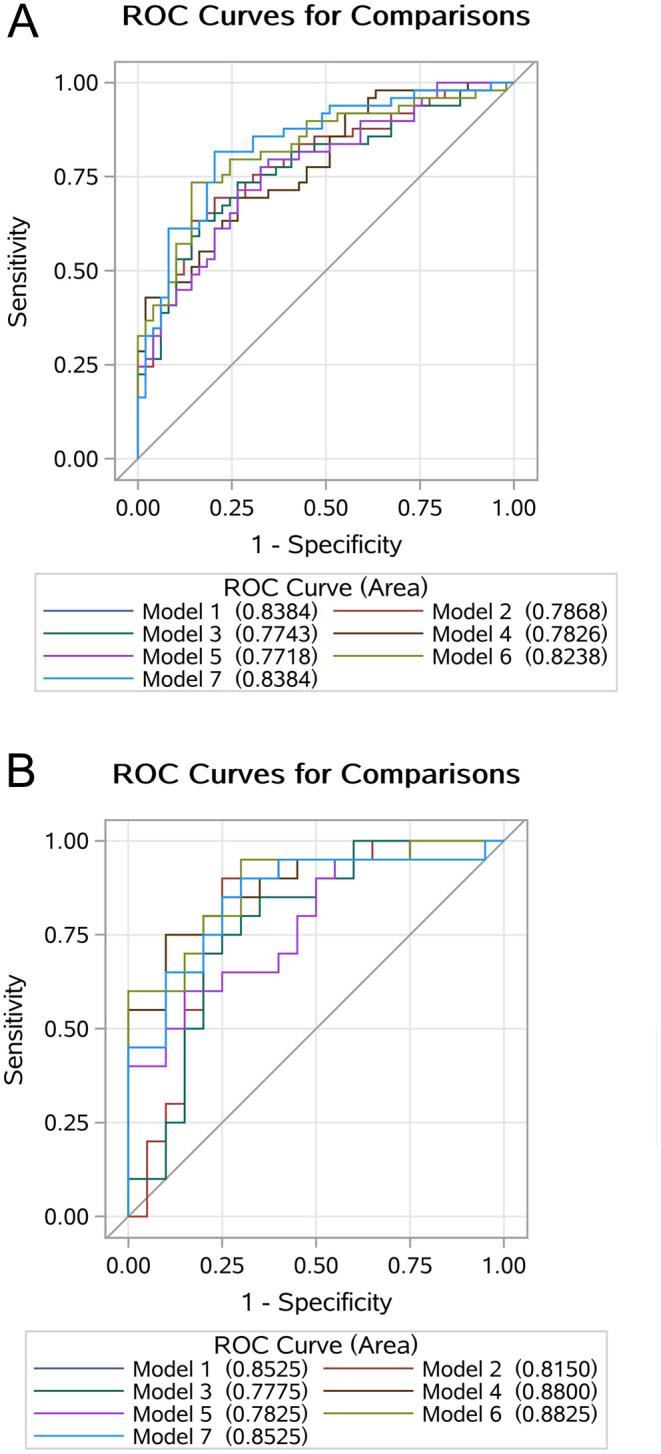
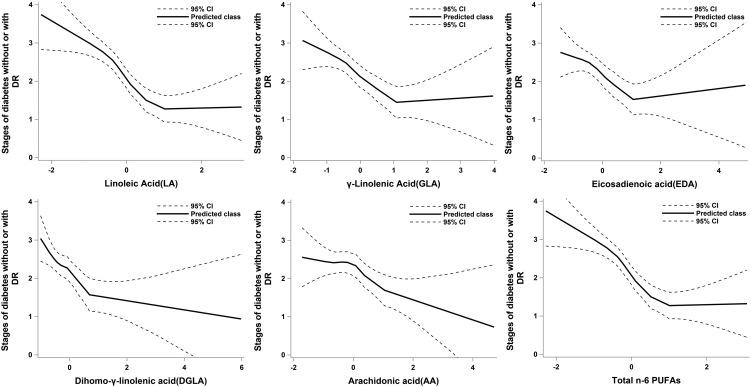
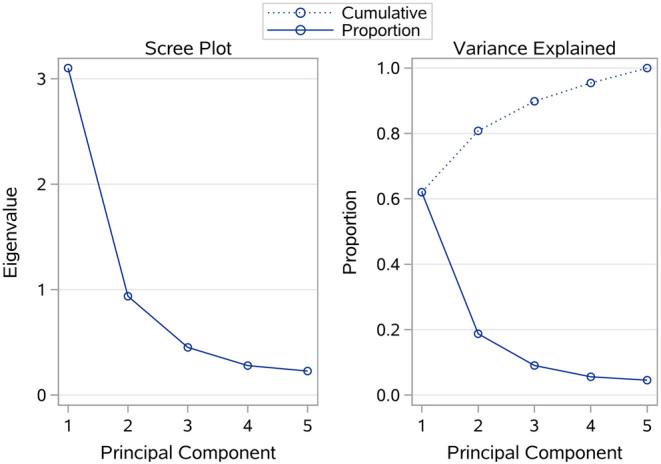
Diabetic retinopathy (DR), the most common microvascular complication of diabetes and leading cause of visual impairment in adults worldwide, is suggested to be linked to abnormal lipid metabolism. The present study aims to comprehensively investigate the relationship between n-6 polyunsaturated fatty acids (PUFAs) and DR. This was a propensity score matching based case-control study, including 69 pairs of DR patients and type 2 diabetic patients without DR with mean age of 56.7 ± 9.2 years. Five n-6 PUFAs were determined by UPLC-ESI-MS/MS system. Principle component regression (PCR) and multiple conditional logistic regression models were used to investigate the association of DR risk with n-6 PUFAs depending on independent training and testing sets, respectively. According to locally weighted regression model, we observed obvious negative correlation between levels of five n-6 PUFAs (linoleic acid, γ-linolenic acid, eicosadienoic acid, dihomo-γ-linolenic acid and arachidonicacid) and DR. Based on multiple PCR model, we also observed significant negative association between the five n-6 PUFAs and DR with adjusted OR (95% CI) as 0.62 (0.43,0.87). When being evaluated depending on the testing set, the association was still existed, and PCR model had excellent classification performance, in which area under the curve (AUC) was 0.88 (95% CI: 0.78, 0.99). In addition, the model also had valid calibration with a non-significant Hosmer-Lemeshow Chi-square of 9.44 (P = 0.307) in the testing set. n-6 PUFAs were inversely associated with the presence of DR, and the principle component could be potential indicator in distinguishing DR from other T2D patients.
糖尿病视网膜病变(DR)是糖尿病最常见的微血管并发症,也是全球成年人视力损害的主要原因,提示其与脂质代谢异常有关。本研究旨在全面探讨n-6多不饱和脂肪酸(PUFAs)与DR之间的关系。这是一项基于倾向评分匹配的病例对照研究,包括69对DR患者和无DR的2型糖尿病患者,平均年龄为56.7±9.2岁。采用超高效液相色谱-电喷雾串联质谱系统测定5种n-6 PUFAs。分别根据独立的训练集和测试集,使用主成分回归(PCR)和多条件逻辑回归模型研究DR风险与n-6 PUFAs的关联。根据局部加权回归模型,我们观察到5种n-6 PUFAs(亚油酸、γ-亚麻酸、二十碳二烯酸、二高-γ-亚麻酸和花生四烯酸)水平与DR之间存在明显的负相关。基于多PCR模型,我们还观察到5种n-6 PUFAs与DR之间存在显著的负相关,调整后的OR(95%CI)为0.62(0.43,0.87)。根据测试集评估时,这种关联仍然存在,并且PCR模型具有出色的分类性能,其中曲线下面积(AUC)为0.88(95%CI:0.78,0.99)。此外,该模型在测试集中还具有有效的校准,Hosmer-Lemeshow卡方值为9.44(P = 0.307),无显著性差异。n-6 PUFAs与DR的存在呈负相关,其主成分可能是区分DR与其他2型糖尿病患者的潜在指标。
 Zotero 插件