
免疫检查点抑制剂相关毒性的预测生物标志物。
Predictive Biomarkers of Immune Checkpoint Inhibitors-Related Toxicities.
机构信息
Cancer Center, Renmin Hospital of Wuhan University, Wuhan, China.
Department of Oncology, Xiangyang Hospital, Hubei University of Chinese Medicine, Xiangyang, China.
出版信息
Front Immunol. 2020 Oct 6;11:2023. doi: 10.3389/fimmu.2020.02023. eCollection 2020.
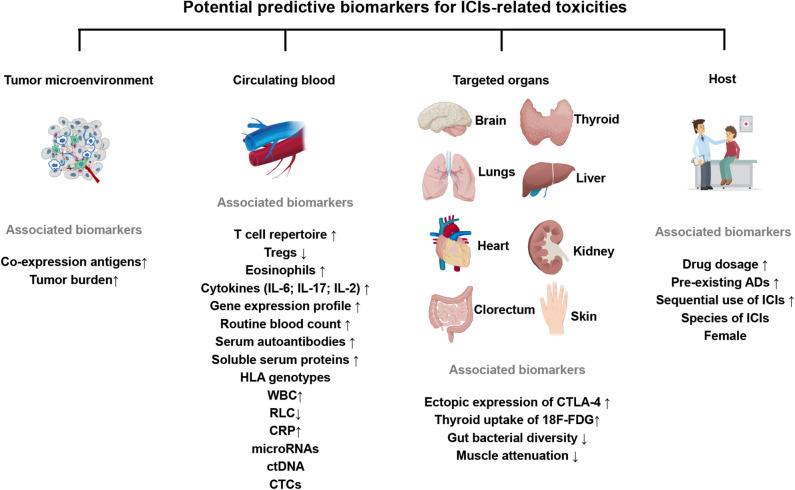
The emergence and continuous development of immune checkpoint inhibitors (ICIs) therapy brings a revolution in cancer therapy history, but the major hurdle associated with their usage is the concomitant ICIs-related toxicities that present a challenge for oncologists. The toxicities may involve non-specific symptoms of multiple systems as for the unique mechanism of formation, which are not easily distinguishable from traditional toxicities. A few of these adverse events are self-limiting and readily manageable, but others may limit treatment, cause interruption and need to be treated with methylprednisolone or tumor necrosis factor-α (TNF-α) antibody infliximab, and even directly threaten life. Early accurate recognition and adequate management are critical to the patient's prognosis and overall survival (OS). Several biomarkers such as the expression of programmed cell death ligand 1 (PD-L1), tumor mutation burden (TMB), and microsatellite instability-high (MSI-H)/mismatch repair-deficient (dMMR) have been proved to be the predictors for anti-tumor efficacy of ICIs, but there is a gap in clinical needs for effective biomarkers that predict toxicities and help filter out the patients who may benefit most from these costly therapies while avoiding major risks of toxicities. Here, we summarize several types of risk factors correlated with ICIs-related toxicities to provide a reference for oncologists to predict the occurrence of ICIs-related toxicities resulting in a timely process in clinical practice.
免疫检查点抑制剂(ICIs)疗法的出现和不断发展在癌症治疗史上带来了一场革命,但与它们的使用相关的主要障碍是伴随而来的 ICI 相关毒性,这给肿瘤学家带来了挑战。这些毒性可能涉及多个系统的非特异性症状,因为其形成的独特机制,与传统毒性不易区分。其中一些不良反应是自限性的,易于处理,但其他不良反应可能会限制治疗、导致中断,并需要用甲基强的松龙或肿瘤坏死因子-α(TNF-α)抗体英夫利昔单抗治疗,甚至直接威胁生命。早期准确识别和充分管理对患者的预后和总生存期(OS)至关重要。几种生物标志物,如程序性细胞死亡配体 1(PD-L1)的表达、肿瘤突变负荷(TMB)和微卫星不稳定高(MSI-H)/错配修复缺陷(dMMR),已被证明是预测 ICI 抗肿瘤疗效的指标,但在预测毒性并帮助筛选出最有可能从这些昂贵治疗中获益、同时避免毒性的主要风险的有效生物标志物方面,仍存在临床需求的差距。在这里,我们总结了几种与 ICI 相关毒性相关的风险因素,为肿瘤学家预测 ICI 相关毒性的发生提供参考,从而在临床实践中及时处理。

 Zotero 插件