
COVID-19 大流行期间退伍军人健康管理局虚拟护理的扩展:与利用相关的临床服务和患者特征。
Virtual care expansion in the Veterans Health Administration during the COVID-19 pandemic: clinical services and patient characteristics associated with utilization.
机构信息
Center for Innovation to Implementation, Veterans Affairs Palo Alto Health Care System, Menlo Park, California, USA.
Division of Primary Care and Population Health, Stanford University School of Medicine, Stanford, California, USA.
出版信息
J Am Med Inform Assoc. 2021 Mar 1;28(3):453-462. doi: 10.1093/jamia/ocaa284.
OBJECTIVES
To describe the shift from in-person to virtual care within Veterans Affairs (VA) during the early phase of the COVID-19 pandemic and to identify at-risk patient populations who require greater resources to overcome access barriers to virtual care.
MATERIALS AND METHODS
Outpatient encounters (N = 42 916 349) were categorized by care type (eg, primary, mental health, etc) and delivery method (eg, in-person, video). For 5 400 878 Veterans, we used generalized linear models to identify patient sociodemographic and clinical characteristics associated with: 1) use of virtual (phone or video) care versus no virtual care and 2) use of video care versus no video care between March 11, 2020 and June 6, 2020.
RESULTS
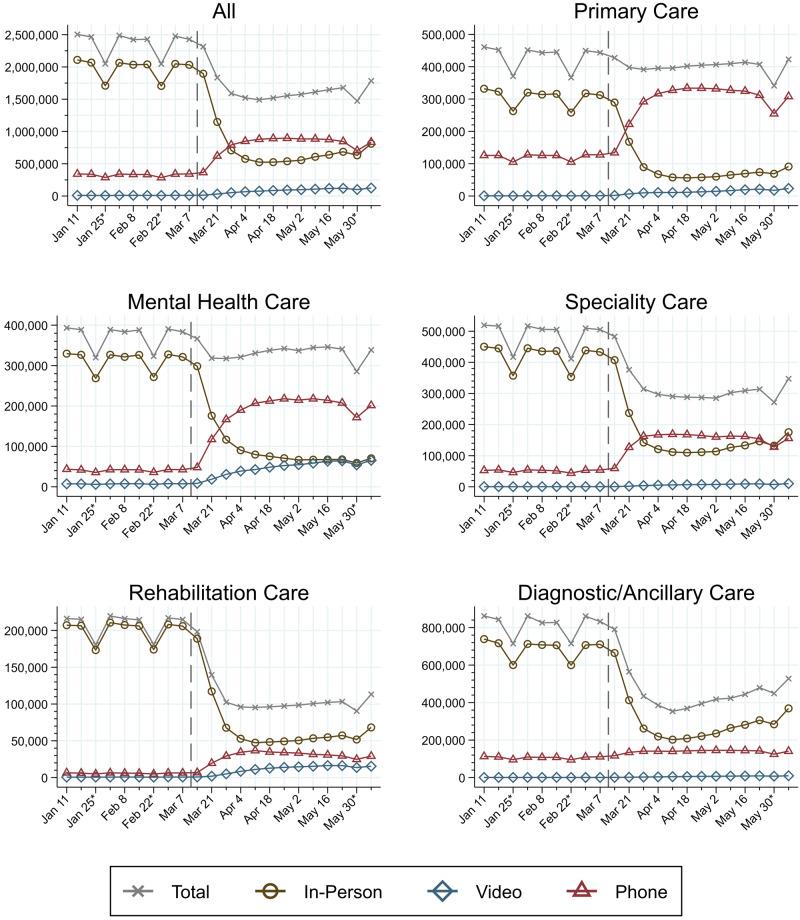
By June, 58% of VA care was provided virtually compared to only 14% prior. Patients with lower income, higher disability, and more chronic conditions were more likely to receive virtual care during the pandemic. Yet, Veterans aged 45-64 and 65+ were less likely to use video care compared to those aged 18-44 (aRR 0.80 [95% confidence interval (CI) 0.79, 0.82] and 0.50 [95% CI 0.48, 0.52], respectively). Rural and homeless Veterans were 12% and 11% less likely to use video care compared to urban (0.88 [95% CI 0.86, 0.90]) and nonhomeless Veterans (0.89 [95% CI 0.86, 0.92]).
DISCUSSION
Veterans with high clinical or social need had higher likelihood of virtual service use early in the COVID-19 pandemic; however, older, homeless, and rural Veterans were less likely to have video visits, raising concerns for access barriers.
CONCLUSIONS AND RELEVANCE
While virtual care may expand access, access barriers must be addressed to avoid exacerbating disparities.
目的
描述 COVID-19 大流行早期期间退伍军人事务部(VA)内从面对面护理向虚拟护理的转变,并确定需要更多资源克服虚拟护理获取障碍的高危患者人群。
材料和方法
将门诊就诊(N=42916349)按护理类型(例如,初级保健、心理健康等)和提供方式(例如,面对面、视频)进行分类。对于 5400878 名退伍军人,我们使用广义线性模型来确定与以下方面相关的患者社会人口统计学和临床特征:1)使用虚拟(电话或视频)护理与不使用虚拟护理,以及 2)在 2020 年 3 月 11 日至 2020 年 6 月 6 日期间使用视频护理与不使用视频护理。
结果
到 6 月,VA 护理的 58%是通过虚拟方式提供的,而之前只有 14%。收入较低、残疾程度较高和患有更多慢性疾病的患者在大流行期间更有可能接受虚拟护理。然而,与 18-44 岁年龄组相比,45-64 岁和 65 岁以上的退伍军人使用视频护理的可能性较低(调整后的相对风险 [aRR]0.80 [95%置信区间 [CI]0.79,0.82]和 0.50 [95% CI 0.48,0.52])。与城市(0.88 [95% CI 0.86,0.90])和非无家可归退伍军人(0.89 [95% CI 0.86,0.92])相比,农村和无家可归的退伍军人使用视频护理的可能性分别低 12%和 11%。
讨论
在 COVID-19 大流行早期,具有较高临床或社会需求的退伍军人更有可能使用虚拟服务;然而,年龄较大、无家可归和农村的退伍军人不太可能进行视频访问,这引发了对获取障碍的担忧。
结论和相关性
虽然虚拟护理可能会扩大服务的可及性,但必须解决获取障碍问题,以避免加剧差距。
 Zotero 插件