
基因组建模作为一种识别替代物的方法,用于紫外线-C处理对严重急性呼吸综合征冠状病毒2型和人诺如病毒灭活的实验验证。
Genomic Modeling as an Approach to Identify Surrogates for Use in Experimental Validation of SARS-CoV-2 and HuNoV Inactivation by UV-C Treatment.
作者信息
Pendyala Brahmaiah, Patras Ankit, Pokharel Bharat, D'Souza Doris
机构信息
Department of Agricultural and Environmental Sciences, Food Science Program, College of Agriculture, Tennessee State University, Nashville, TN, United States.
Department of Food Science, University of Tennessee, Knoxville, Knoxville, TN, United States.
出版信息
Front Microbiol. 2020 Sep 29;11:572331. doi: 10.3389/fmicb.2020.572331. eCollection 2020.
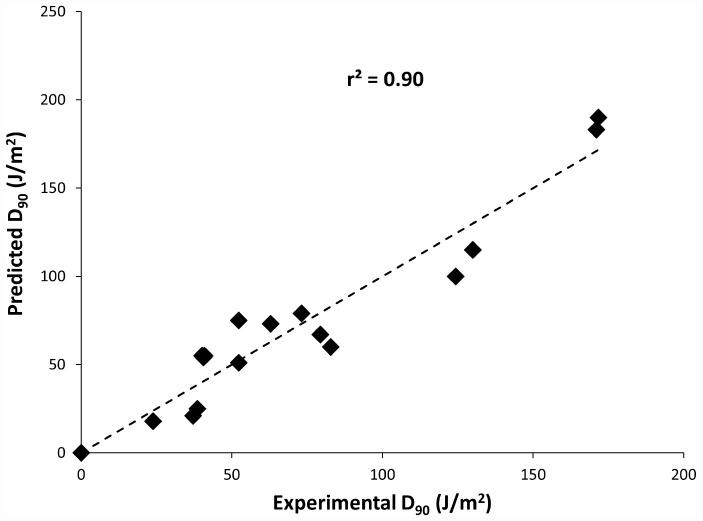
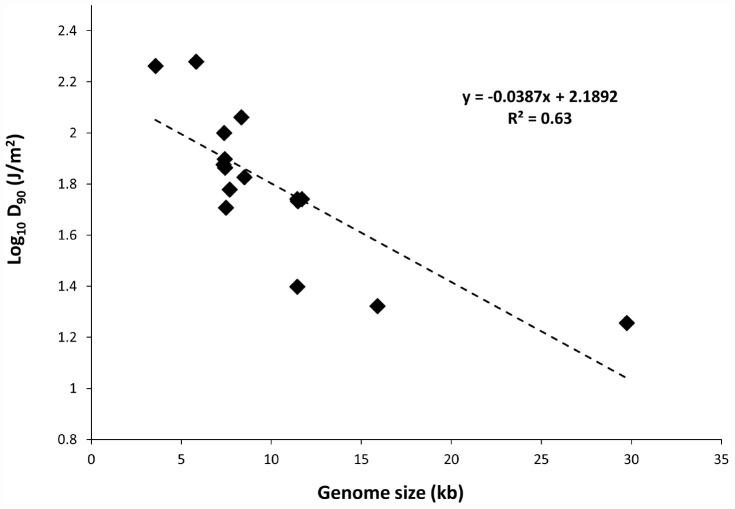
Severe Acute Respiratory Syndrome coronavirus-2 (SARS-CoV-2) is responsible for the COVID-19 pandemic that continues to pose significant public health concerns. While research to deliver vaccines and antivirals are being pursued, various effective technologies to control its environmental spread are also being targeted. Ultraviolet light (UV-C) technologies are effective against a broad spectrum of microorganisms when used even on large surface areas. In this study, we developed a pyrimidine dinucleotide frequency based genomic model to predict the sensitivity of select enveloped and non-enveloped viruses to UV-C treatments in order to identify potential SARS-CoV-2 and human norovirus surrogates. The results revealed that this model was best fitted using linear regression with = 0.90. The predicted UV-C sensitivity ( - dose for 90% inactivation) for SARS-CoV-2 and MERS-CoV was found to be 21.5 and 28 J/m, respectively (with an estimated 18 J/m obtained from published experimental data for SARS-CoV-1), suggesting that coronaviruses are highly sensitive to UV-C light compared to other ssRNA viruses used in this modeling study. Murine hepatitis virus (MHV) A59 strain with a of 21 J/m close to that of SARS-CoV-2 was identified as a suitable surrogate to validate SARS-CoV-2 inactivation by UV-C treatment. Furthermore, the non-enveloped human noroviruses (HuNoVs), had predicted values of 69.1, 89, and 77.6 J/m for genogroups GI, GII, and GIV, respectively. Murine norovirus (MNV-1) of GV with a = 100 J/m was identified as a potential conservative surrogate for UV-C inactivation of these HuNoVs. This study provides useful insights for the identification of potential non-pathogenic (to humans) surrogates to understand inactivation kinetics and their use in experimental validation of UV-C disinfection systems. This approach can be used to narrow the number of surrogates used in testing UV-C inactivation of other human and animal ssRNA viral pathogens for experimental validation that can save cost, labor and time.
严重急性呼吸综合征冠状病毒2(SARS-CoV-2)引发了仍在引起重大公共卫生关注的COVID-19大流行。在致力于研发疫苗和抗病毒药物的同时,各种控制其环境传播的有效技术也成为目标。紫外线(UV-C)技术即使在大面积使用时也能有效对抗多种微生物。在本研究中,我们开发了一种基于嘧啶二核苷酸频率的基因组模型,以预测特定包膜病毒和非包膜病毒对UV-C处理的敏感性,从而识别潜在的SARS-CoV-2和人类诺如病毒替代物。结果显示,该模型采用线性回归拟合效果最佳,R² = 0.90。发现SARS-CoV-2和中东呼吸综合征冠状病毒(MERS-CoV)的预测UV-C敏感性(90%灭活剂量)分别为21.5和28 J/m²(从已发表的SARS-CoV-1实验数据估计为18 J/m²),这表明与本模型研究中使用的其他单链RNA病毒相比,冠状病毒对UV-C光高度敏感。确定具有21 J/m²(接近SARS-CoV-2)的小鼠肝炎病毒(MHV)A59株作为通过UV-C处理验证SARS-CoV-2灭活的合适替代物。此外,非包膜的人类诺如病毒(HuNoVs),基因组群GI、GII和GIV的预测D10值分别为69.1、89和77.6 J/m²。基因组群GV的小鼠诺如病毒(MNV-1),D10 = 100 J/m²,被确定为这些HuNoVs的UV-C灭活的潜在保守替代物。本研究为识别潜在的(对人类)非致病性替代物以了解灭活动力学及其在UV-C消毒系统实验验证中的应用提供了有用的见解。这种方法可用于减少用于测试其他人类和动物单链RNA病毒病原体UV-C灭活的替代物数量,以进行实验验证,从而节省成本、劳动力和时间。

 Zotero 插件