
日本COVID-19疫情早期一家骨科手术科室的经验,包括严重急性呼吸综合征冠状病毒2的实时聚合酶链反应检测结果
Experience of an Orthopaedic Surgery Department Early During the COVID-19 Outbreak in Japan Including Real-Time Polymerase Chain Reaction Assay Results for SARS-CoV-2.
作者信息
Inoue Gen, Uchida Kentaro, Fukushima Kensuke, Uchiyama Katsufumi, Nakazawa Toshiyuki, Aikawa Jun, Matsuura Terumasa, Miyagi Masayuki, Takahira Naonobu, Takaso Masashi
机构信息
Orthopaedic Surgery, Kitasato University, Sagamihara, JPN.
Rehabilitation, Kitasato University, Sagamihara, JPN.
出版信息
Cureus. 2020 Oct 24;12(10):e11140. doi: 10.7759/cureus.11140.
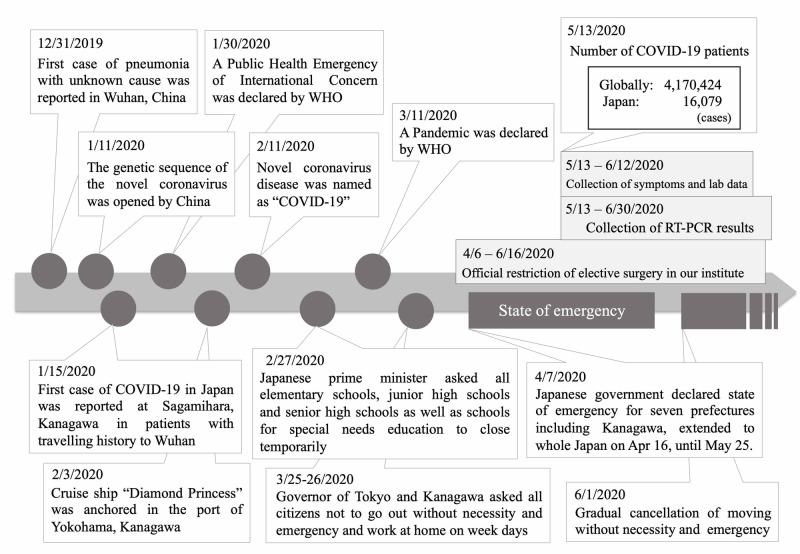
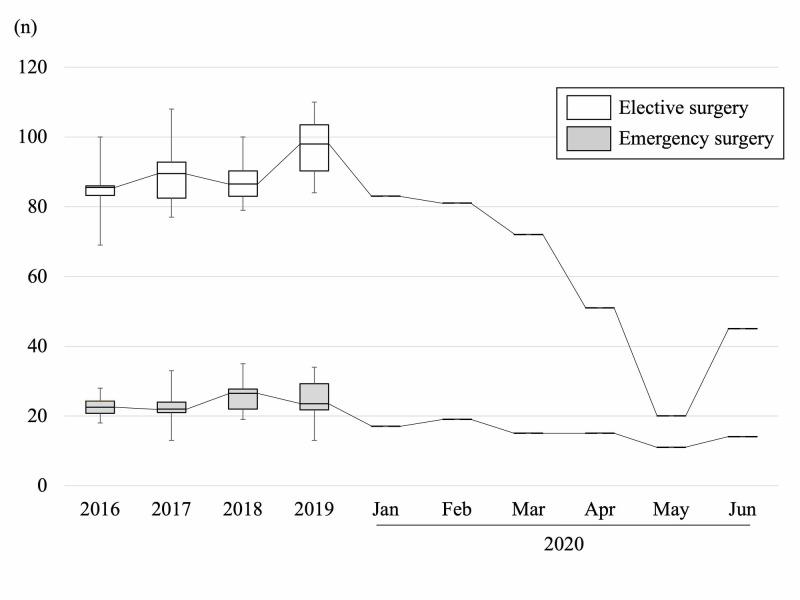
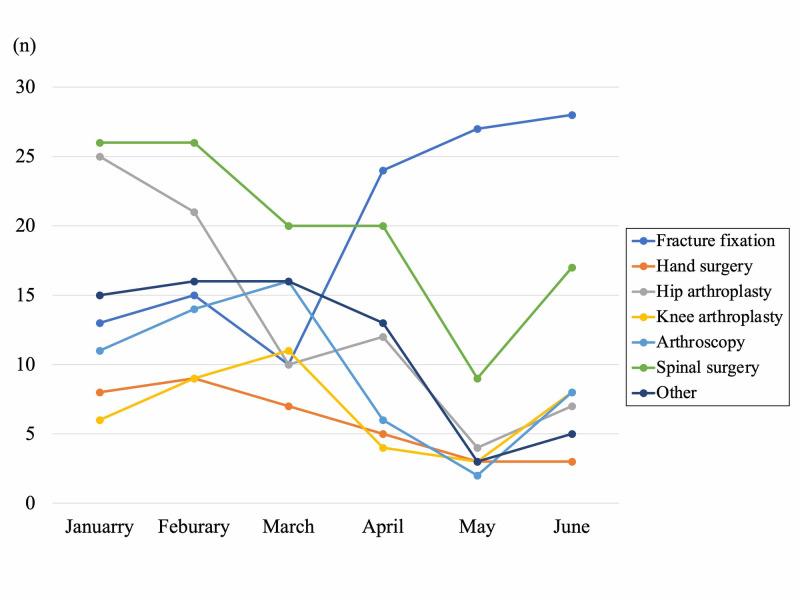
Introduction The coronavirus disease 2019 (COVID-19) epidemic beginning December 2019 in China has now become a worldwide pandemic. With the need to develop an approach to manage orthopaedic surgeries, we aimed to evaluate the most current data on all the surgical cases in our department including the results of the reverse-transcriptase polymerase chain reaction (RT-PCR) assay for infection with severe acute respiratory syndrome coronavirus 2 (SARS-CoV-2). Methods The monthly number of surgical cases from 2016 were reviewed, and compared the numbers of surgical cases both in elective and emergency surgery during the pandemic with the pre-pandemic period. The results of RT-PCR for SARS-CoV-2 in 94 orthopaedic surgery cases from May 13 to June 30, 2020, and clinical signs/symptoms, and laboratory data of 48 consecutive cases within a month from May 13 were also evaluated. Results The mean monthly number of surgeries from January to May 2020 was significantly lower than the mean number in 2019 (73.8 vs 121.9, respectively, p=0.01). The proportion of emergency surgeries in all surgeries performed in May 2020 was 35.5%, which is significantly more than the mean rate of 20.4% in 2019 (p=0.04). Hip arthroplasties and spine surgeries showed the greatest reduction, at greater than 80% and 65%, respectively. Although none of the 94 patients were positive for SARS-CoV-2, 66.7% showed signs/symptoms typical of COVID-19. The most frequent signs/symptoms were production of nasal mucus (25.5%), followed by dry cough (19.1%); and fatigue, headache, and dizziness (17.0% each). The incidence of abnormal values, which are commonly noted in COVID-19 patients, were eosinopaenia 37.5%; lymphopaenia 18.8%; thrombocytopaenia 8.3%; and elevated prothrombin time 10.4%. Conclusions Our results show that our RT-PCR negative patients showed signs/symptoms and abnormal laboratory values typical of COVID-19, indicating surgeons should be aware of these abnormalities in patients and the need to rule out COVID-19 before proceeding with surgery.
引言 2019年12月始于中国的2019冠状病毒病(COVID-19)疫情现已成为全球大流行。鉴于需要制定一种管理骨科手术的方法,我们旨在评估本部门所有手术病例的最新数据,包括针对严重急性呼吸综合征冠状病毒2(SARS-CoV-2)感染的逆转录聚合酶链反应(RT-PCR)检测结果。方法 回顾2016年以来每月的手术病例数,并将疫情期间择期手术和急诊手术的病例数与疫情前时期进行比较。还评估了2020年5月13日至6月30日94例骨科手术病例的SARS-CoV-2 RT-PCR结果,以及5月13日起一个月内连续48例病例的临床体征/症状和实验室数据。结果 2020年1月至5月的月平均手术例数显著低于2019年(分别为73.8例和121.9例,p = 0.01)。2020年5月所有手术中急诊手术的比例为35.5%,显著高于2019年20.4%的平均比例(p = 0.04)。髋关节置换术和脊柱手术的降幅最大,分别超过80%和65%。虽然94例患者中没有一例SARS-CoV-2呈阳性,但66.7%的患者表现出COVID-19的典型体征/症状。最常见的体征/症状是流涕(25.5%),其次是干咳(19.1%);以及疲劳、头痛和头晕(各17.0%)。COVID-19患者中常见的异常值发生率分别为:嗜酸性粒细胞减少37.5%;淋巴细胞减少症18.8%;血小板减少症8.3%;凝血酶原时间升高10.4%。结论 我们的结果表明,RT-PCR检测呈阴性的患者表现出COVID-19的典型体征/症状和实验室异常值,这表明外科医生应了解患者的这些异常情况,并在手术前排除COVID-19的必要性


 Zotero 插件