
Obelisc:一种基于 SNP 条纹的同系映射工具。
Obelisc: an identical-by-descent mapping tool based on SNP streak.
机构信息
Department of Statistical Genetics, Osaka University Graduate School of Medicine, Suita 565-0871, Japan.
Laboratory of Statistical Immunology, Immunology Frontier Research Center (WPI-IFReC), Osaka University, Suita 565-0871, Japan.
出版信息
Bioinformatics. 2021 Apr 5;36(24):5567-5570. doi: 10.1093/bioinformatics/btaa940.
MOTIVATION
Genetic linkage analysis has made a huge contribution to the genetic mapping of Mendelian diseases. However, most previously available linkage analysis methods have limited applicability. Since parametric linkage analysis requires predefined model of inheritance with a fixed set of parameters, it is inapplicable without fully structured pedigree information. Furthermore, the analytical results are dependent on the specification of model parameters. While non-parametric linkage analysis can avoid these problems, the runs of homozygosity (ROH) mapping, a widely used non-parametric linkage analysis method, can only deal with recessive inheritance. The implementation of non-parametric linkage analyses capable of dealing with both dominant and recessive inheritance has been required.
RESULTS
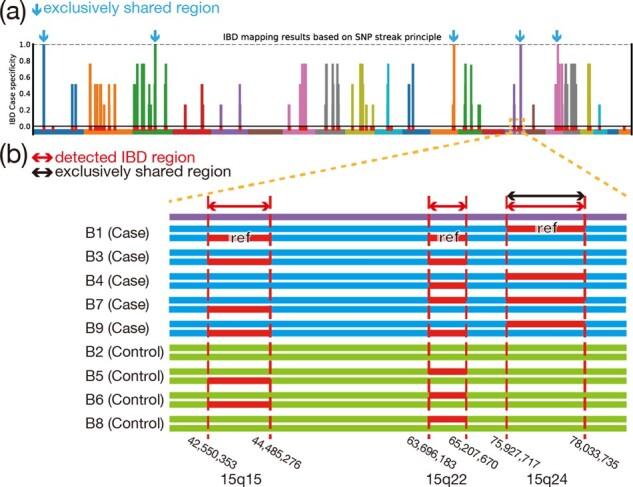
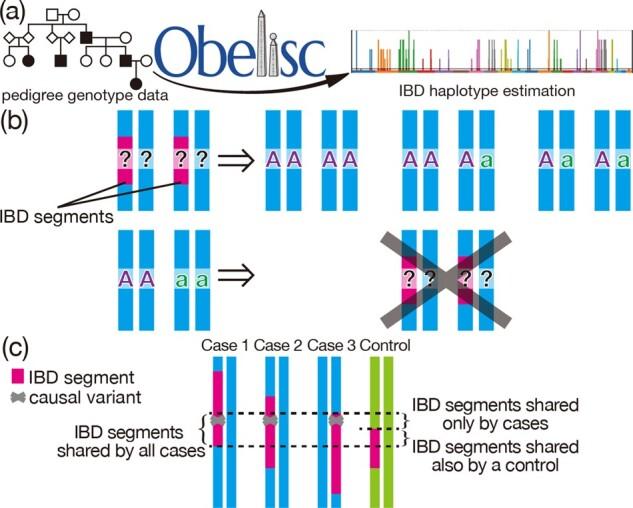
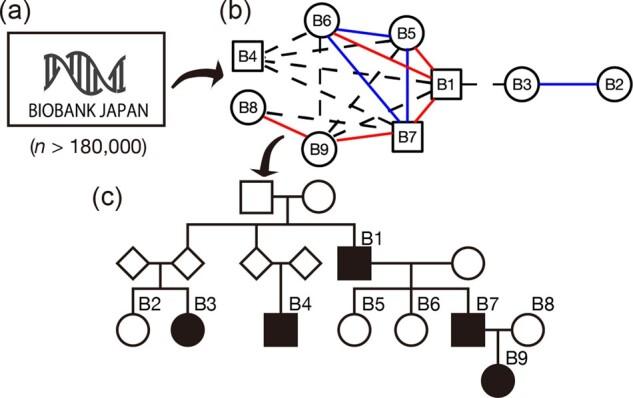
We have developed the Obelisc (Observational linkage scan), a flexibly applicable user-friendly non-parametric linkage analysis tool, which also provides an intuitive visualization of the analytical results. Obelisc is based on the SNP streak approach, which does not require any predefined inheritance model with parameters. In contrast to the ROH mapping, the SNP streak approach is applicable to both dominant and recessive traits. To illustrate the performance of Obelisc, we generated a pseudo-pedigree from the publicly available BioBank Japan Project genome-wide genotype dataset (n > 180 000). By applying Obelisc to this pseudo-pedigree, we successfully identified the regions with inherited identical-by-descent haplotypes shared among the members of the pseudo-pedigree, which was validated by the population-based haplotype phasing approach.
AVAILABILITY AND IMPLEMENTATION
Obelisc is feely available at https://github.com/qsonehara/Obelisc as a python package with example datasets.
SUPPLEMENTARY INFORMATION
Supplementary data are available at Bioinformatics online.
动机
遗传连锁分析为孟德尔疾病的遗传图谱绘制做出了巨大贡献。然而,大多数先前可用的连锁分析方法的适用性有限。由于参数连锁分析需要具有固定参数集的预定义遗传模型,因此在没有完全结构化的系谱信息的情况下不适用。此外,分析结果取决于模型参数的规范。虽然非参数连锁分析可以避免这些问题,但广泛使用的非参数连锁分析方法——纯合子运行(ROH)作图只能处理隐性遗传。需要开发能够处理显性和隐性遗传的非参数连锁分析。
结果
我们开发了 Obelisc(观察性连锁扫描),这是一种灵活适用的用户友好型非参数连锁分析工具,还提供了分析结果的直观可视化。Obelisc 基于 SNP 条纹方法,不需要任何具有参数的预定义遗传模型。与 ROH 作图相比,SNP 条纹方法适用于显性和隐性特征。为了说明 Obelisc 的性能,我们从公开的 BioBank Japan Project 全基因组基因型数据集(n>180,000)中生成了一个伪系谱。通过将 Obelisc 应用于这个伪系谱,我们成功地识别出了在伪系谱成员之间共享的遗传相同的血统单倍型区域,这通过基于群体的单倍型相位方法得到了验证。
可用性和实现
Obelisc 可在 https://github.com/qsonehara/Obelisc 上免费获得,作为一个带有示例数据集的 Python 包。
补充信息
补充数据可在 Bioinformatics 在线获得。
 Zotero 插件