
新冠疫情期间的担忧、回避和应对:综合网络分析。
Worry, avoidance, and coping during the COVID-19 pandemic: A comprehensive network analysis.
机构信息
Department of Psychiatry, University of British Columbia, Vancouver, BC, Canada.
Department of Psychology, University of Regina, Regina, SK, Canada.
出版信息
J Anxiety Disord. 2020 Dec;76:102327. doi: 10.1016/j.janxdis.2020.102327. Epub 2020 Oct 24.
BACKGROUND
Many psychological factors play a role in the COVID-19 pandemic, including various forms of worry, avoidance, and coping. Adding to the complexity, some people believe the threat of COVID-19 is exaggerated. We used network analysis to investigate how these diverse elements are interrelated.
METHODS
A population-representative sample of 3075 American and Canadian adults completed an online survey, including measures of COVID-19-related worry, avoidance, self-protective behaviors, and other variables.
RESULTS
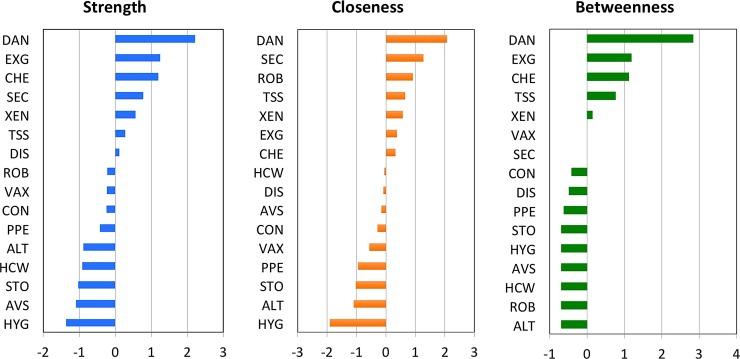
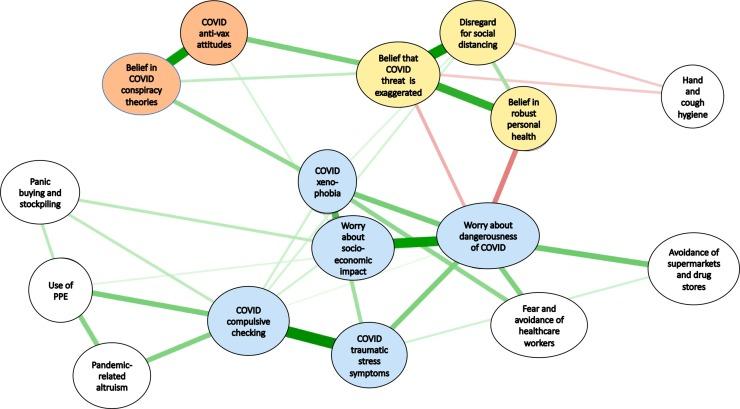
The network contained three major hubs, replicated across gender and age groups. The most important hub centered around worries about the dangerousness of COVID-19, and formed the core of the previously identified COVID Stress Syndrome. The second most important hub, which was negatively correlated with the first hub, centered around the belief that the COVID-19 threat is exaggerated, and was associated with disregard for social distancing, poor hand hygiene, and anti-vaccination attitudes. The third most important hub, which was linked to the first hub, centered around COVID-19-related compulsive checking and reassurance-seeking, including self-protective behaviors such as panic buying and use of personal protective equipment.
CONCLUSION
Network analysis showed how various forms of worry, avoidance, coping, and other variables are interrelated. Implications for managing disease and distress are discussed.
背景
许多心理因素在 COVID-19 大流行中发挥作用,包括各种形式的担忧、回避和应对。更复杂的是,有些人认为 COVID-19 的威胁被夸大了。我们使用网络分析来研究这些不同元素是如何相互关联的。
方法
一项针对美国和加拿大 3075 名成年人的代表性人群调查,完成了一项在线调查,包括与 COVID-19 相关的担忧、回避、自我保护行为和其他变量的测量。
结果
网络包含三个主要中心,在性别和年龄组中均得到复制。最重要的中心围绕着对 COVID-19 危险性的担忧,构成了之前确定的 COVID 应激综合征的核心。第二大重要中心,与第一个中心呈负相关,围绕着 COVID-19 威胁被夸大的信念,与不遵守社交距离、手部卫生差和反疫苗接种态度有关。第三个最重要的中心,与第一个中心相连,围绕着与 COVID-19 相关的强迫性检查和寻求安慰,包括自我保护行为,如恐慌性购买和使用个人防护设备。
结论
网络分析显示了各种形式的担忧、回避、应对和其他变量是如何相互关联的。讨论了管理疾病和痛苦的影响。
 Zotero 插件