
肯尼亚西部牲畜市场和屠宰场中的蜱传病原体,包括克里米亚-刚果出血热病毒。
Tick-borne pathogens, including Crimean-Congo haemorrhagic fever virus, at livestock markets and slaughterhouses in western Kenya.
机构信息
International Centre of Insect Physiology and Ecology (icipe), Nairobi, Kenya.
Department of Zoology and Entomology, University of Pretoria, Pretoria, South Africa.
出版信息
Transbound Emerg Dis. 2021 Jul;68(4):2429-2445. doi: 10.1111/tbed.13911. Epub 2020 Dec 5.
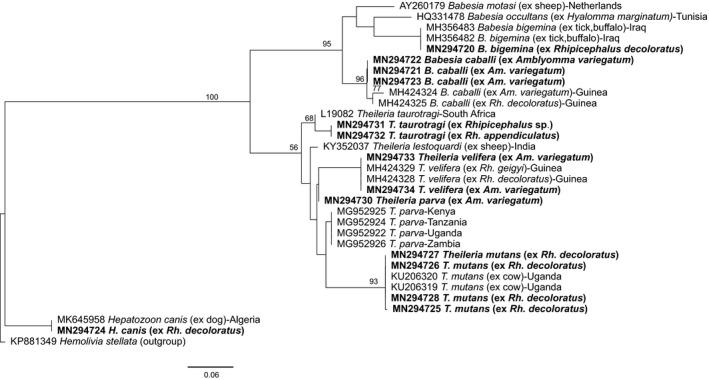
Vectors of emerging infectious diseases have expanded their distributional ranges in recent decades due to increased global travel, trade connectivity and climate change. Transboundary range shifts, arising from the continuous movement of humans and livestock across borders, are of particular disease control concern. Several tick-borne diseases are known to circulate between eastern Uganda and the western counties of Kenya, with one fatal case of Crimean-Congo haemorrhagic fever (CCHF) reported in 2000 in western Kenya. Recent reports of CCHF in Uganda have highlighted the risk of cross-border disease translocation and the importance of establishing inter-epidemic, early warning systems to detect possible outbreaks. We therefore carried out surveillance of tick-borne zoonotic pathogens at livestock markets and slaughterhouses in three counties of western Kenya that neighbour Uganda. Ticks and other ectoparasites were collected from livestock and identified using morphological keys. The two most frequently sampled tick species were Rhipicephalus decoloratus (35%) and Amblyomma variegatum (30%); Ctenocephalides felis fleas and Haematopinus suis lice were also present. In total, 486 ticks, lice and fleas were screened for pathogen presence using established molecular workflows incorporating high-resolution melting analysis and identified through sequencing of PCR products. We detected CCHF virus in Rh. decoloratus and Rhipicephalus sp. cattle ticks, and 82 of 96 pools of Am. variegatum were positive for Rickettsia africae. Apicomplexan protozoa and bacteria of veterinary importance, such as Theileria parva, Babesia bigemina and Anaplasma marginale, were primarily detected in rhipicephaline ticks. Our findings show the presence of several pathogens of public health and veterinary importance in ticks from livestock at livestock markets and slaughterhouses in western Kenya. Confirmation of CCHF virus, a Nairovirus that causes haemorrhagic fever with a high case fatality rate in humans, highlights the risk of under-diagnosed zoonotic diseases and calls for continuous surveillance and the development of preventative measures.
由于全球旅行、贸易联系和气候变化的增加,近年来,新发传染病的传播范围不断扩大。由于人类和牲畜不断跨境移动,跨界范围转移尤其令人关注疾病控制。已知几种蜱传疾病在乌干达东部和肯尼亚西部各县之间传播,2000 年肯尼亚西部报告了一例克里米亚-刚果出血热 (CCHF) 死亡病例。最近乌干达报告的 CCHF 病例突出了跨境疾病转移的风险,强调了建立跨疫情、早期预警系统以检测可能暴发的重要性。因此,我们在与乌干达接壤的肯尼亚西部三个县的牲畜市场和屠宰场进行了蜱传动物传染病的监测。从牲畜身上采集蜱虫和其他外寄生虫,并使用形态学钥匙进行鉴定。最常采样的两种蜱虫是 Rhipicephalus decoloratus(35%)和 Amblyomma variegatum(30%);还存在 Ctenocephalides felis 跳蚤和 Haematopinus suis 虱子。总共使用建立的分子工作流程筛选了 486 个蜱虫、虱子和跳蚤,该流程包括高分辨率熔解分析,并通过 PCR 产物测序进行鉴定。我们在 Rh. decoloratus 和 Rhipicephalus sp. 牛蜱中检测到 CCHF 病毒,在 96 个 Am. variegatum 中,有 82 个对非洲立克次体呈阳性。在牲畜市场和屠宰场的牲畜身上的蜱虫中,主要检测到对兽医重要的 Apicomplexan 原生动物和细菌,如 Theileria parva、Babesia bigemina 和 Anaplasma marginale。我们的研究结果表明,肯尼亚西部牲畜市场和屠宰场的蜱虫中存在几种公共卫生和兽医重要的病原体。确认 CCHF 病毒(一种引起人类出血热的 Nairovirus,病死率很高)突显了对未确诊的人畜共患病的风险,需要持续监测和制定预防措施。


 Zotero 插件