
43 种植物中 C-重复结合因子/脱水响应元件结合蛋白 1(CBF/DREB1)蛋白家族的进化历史及马铃薯 CBF/DREB1 蛋白的特性研究。
Evolutionary history of the C-repeat binding factor/dehydration-responsive element-binding 1 (CBF/DREB1) protein family in 43 plant species and characterization of CBF/DREB1 proteins in Solanum tuberosum.
机构信息
State Key Laboratory of Crop Stress Biology for Arid Areas, College of Agronomy, Northwest A&F University, Yangling, Shaanxi, 712100, China.
College of Food Science and Engineering, Northwest A&F University, Yangling, Shaanxi, 712100, China.
出版信息
BMC Evol Biol. 2020 Nov 3;20(1):142. doi: 10.1186/s12862-020-01710-8.
BACKGROUND
Plants are easily affected by temperature variations, and high temperature (heat stress) and low temperature (cold stress) will lead to poor plant development and reduce crop yields. Therefore, it is very important to identify resistance genes for improving the ability of plants to resist heat stress or cold stress by using modern biotechnology. Members of the C-repeat binding factor/Dehydration responsive element-binding 1 (CBF/DREB1) protein family are related to the stress resistance of many plant species. These proteins affect the growth and development of plants and play vital roles during environmental stress (cold, heat, drought, salt, etc.). In this study, we identified CBF/DREB1 genes from 43 plant species (including algae, moss, ferns, gymnosperms, angiosperms) by using bioinformatic methods to clarify the characteristics of the CBF/DREB1 protein family members and their functions in potato under heat and cold stresses.
RESULTS
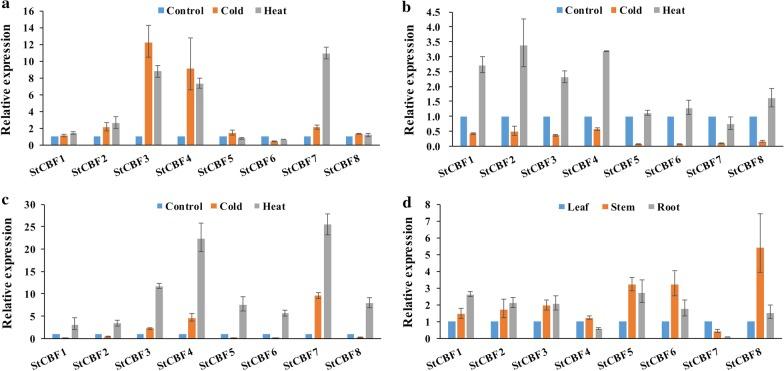
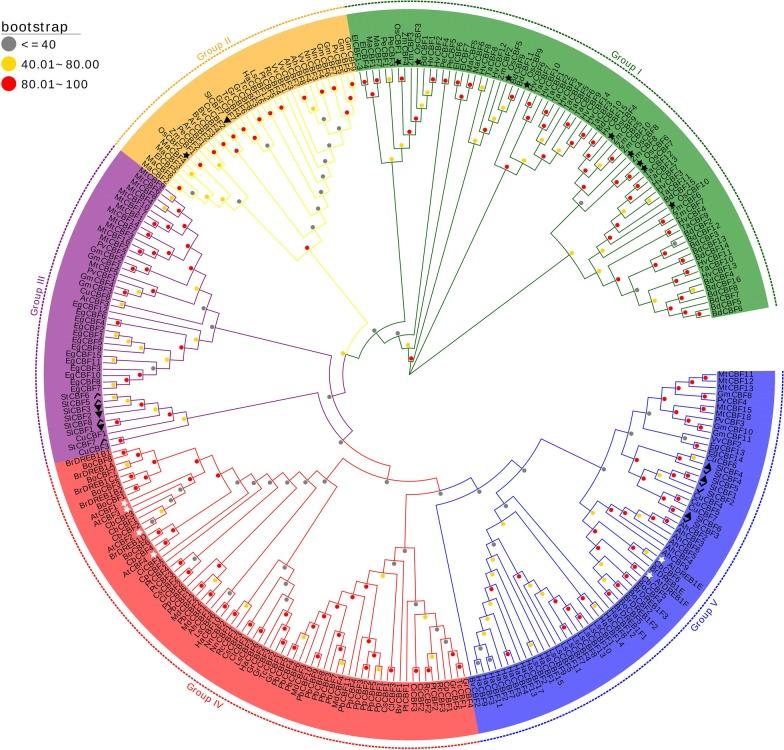
In this study, we identified 292 CBF/DREB1 proteins from 43 plant species. However, no CBF/DREB1 protein was found in algae, moss, ferns, or gymnosperms; members of this protein family exist only in angiosperms. Phylogenetic analysis of all the CBF/DREB1 proteins revealed five independent groups. Among them, the genes of group I do not exist in eudicots and are found only in monocots, indicating that these genes have a special effect on monocots. The analysis of motifs, gene duplication events, and the expression data from the PGSC website revealed the gene structures, evolutionary relationships, and expression patterns of the CBF/DREB1 proteins. In addition, analysis of the transcript levels of the 8 CBF/DREB1 genes in potato (Solanum tuberosum) under low-temperature and high-temperature stresses showed that these genes were related to temperature stresses. In particular, the expression levels of StCBF3 and StCBF4 in the leaves, stems, and roots significantly increased under high-temperature conditions, which suggested that StCBF3 and StCBF4 may be closely related to heat tolerance in potato.
CONCLUSION
Overall, members of the CBF/DREB1 protein family exist only in angiosperms and plays an important role in the growth and development of plants. In addition, the CBF/DREB1 protein family is related to the heat and cold resistance of potato. Our research revealed the evolution of the CBF/DREB1 family, and is useful for studying the precise functions of the CBF/DREB1 proteins when the plants are developing and are under temperature stress.
背景
植物很容易受到温度变化的影响,高温(热应激)和低温(冷应激)会导致植物发育不良,降低作物产量。因此,利用现代生物技术鉴定植物抗热应激或抗冷应激的抗性基因非常重要。C-重复结合因子/脱水应答元件结合蛋白 1(CBF/DREB1)蛋白家族成员与许多植物物种的抗应激性有关。这些蛋白质影响植物的生长和发育,在环境胁迫(冷、热、干旱、盐等)期间发挥重要作用。在这项研究中,我们通过生物信息学方法从 43 种植物物种(包括藻类、苔藓、蕨类、裸子植物、被子植物)中鉴定出 CBF/DREB1 基因,以阐明 CBF/DREB1 蛋白家族成员的特征及其在马铃薯热冷胁迫下的功能。
结果
在这项研究中,我们从 43 种植物物种中鉴定出 292 种 CBF/DREB1 蛋白。然而,藻类、苔藓、蕨类和裸子植物中没有发现 CBF/DREB1 蛋白;该蛋白家族成员仅存在于被子植物中。所有 CBF/DREB1 蛋白的系统发育分析显示出五个独立的组。其中,第 I 组的基因不存在于双子叶植物中,只存在于单子叶植物中,表明这些基因对单子叶植物有特殊作用。基序分析、基因复制事件以及 PGSC 网站的表达数据揭示了 CBF/DREB1 蛋白的基因结构、进化关系和表达模式。此外,对低温和高温胁迫下马铃薯(Solanum tuberosum)8 个 CBF/DREB1 基因的转录水平分析表明,这些基因与温度胁迫有关。特别是在高温条件下,叶片、茎和根中的 StCBF3 和 StCBF4 的表达水平显著增加,这表明 StCBF3 和 StCBF4 可能与马铃薯的耐热性密切相关。
结论
总体而言,CBF/DREB1 蛋白家族成员仅存在于被子植物中,在植物的生长和发育中发挥重要作用。此外,CBF/DREB1 蛋白家族与马铃薯的抗热和抗冷性有关。我们的研究揭示了 CBF/DREB1 家族的进化,这对于研究植物在发育过程中和处于温度胁迫下 CBF/DREB1 蛋白的精确功能很有帮助。



 Zotero 插件