
一项抗 CD3 单克隆抗体 otelixizumab 在新发 1 型糖尿病中的随机、单盲、安慰剂对照、剂量探索安全性和耐受性研究。
A randomised, single-blind, placebo-controlled, dose-finding safety and tolerability study of the anti-CD3 monoclonal antibody otelixizumab in new-onset type 1 diabetes.
机构信息
Academic Hospital and Diabetes Research Center, Vrije Universiteit Brussel, Brussels, Belgium.
Belgian Diabetes Registry, Brussels, Belgium.
出版信息
Diabetologia. 2021 Feb;64(2):313-324. doi: 10.1007/s00125-020-05317-y. Epub 2020 Nov 4.
AIMS/HYPOTHESIS: Numerous clinical studies have investigated the anti-CD3ɛ monoclonal antibody otelixizumab in individuals with type 1 diabetes, but limited progress has been made in identifying the optimal clinical dose with acceptable tolerability and safety. The aim of this study was to evaluate the association between dose-response, safety and tolerability, beta cell function preservation and the immunological effects of otelixizumab in new-onset type 1 diabetes.
METHODS
In this randomised, single-blind, placebo-controlled, 24 month study, conducted in five centres in Belgium via the Belgian Diabetes Registry, participants (16-27 years old, <32 days from diagnosis of type 1 diabetes) were scheduled to receive placebo or otelixizumab in one of four dose cohorts (cumulative i.v. dose 9, 18, 27 or 36 mg over 6 days; planned n = 40). Randomisation to treatment was by a central computer system; only participants and bedside study personnel were blinded to study treatment. The co-primary endpoints were the incidence of adverse events, the rate of Epstein-Barr virus (EBV) reactivation, and laboratory measures and vital signs. A mixed-meal tolerance test was used to assess beta cell function; exploratory biomarkers were used to measure T cell responses.
RESULTS
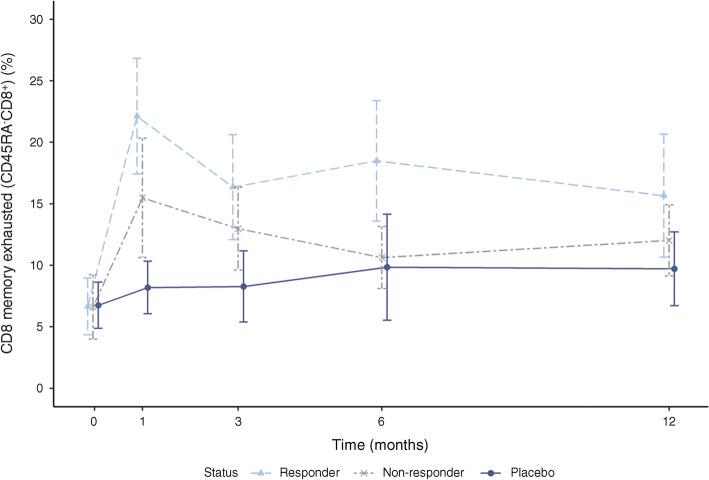
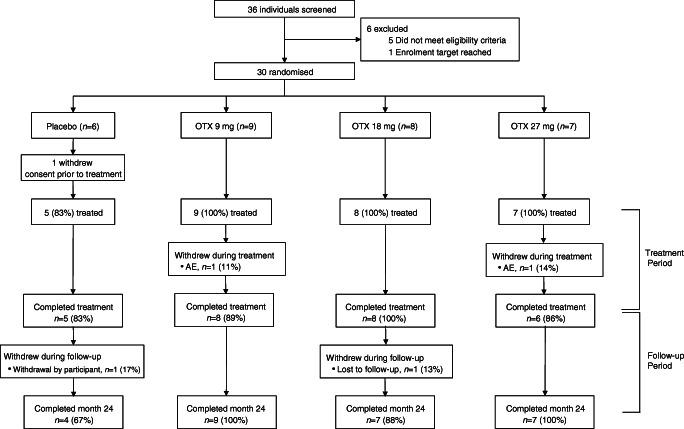
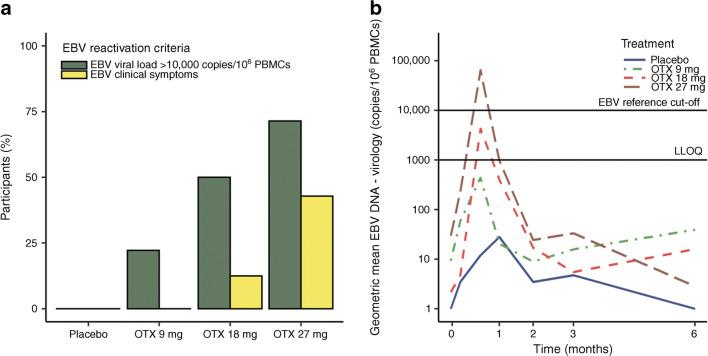
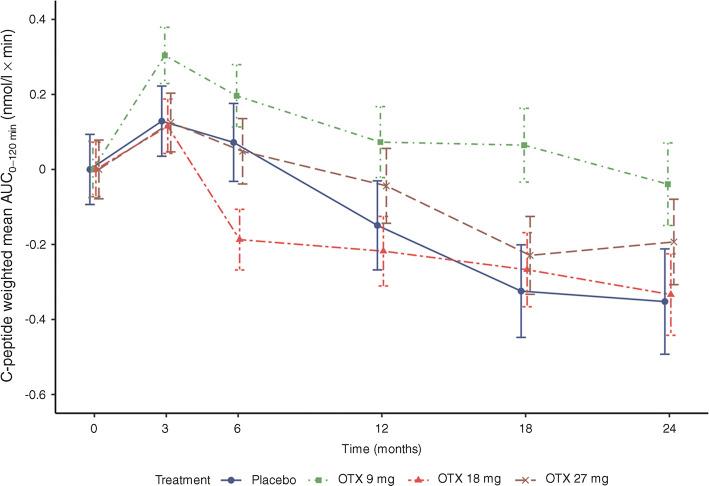
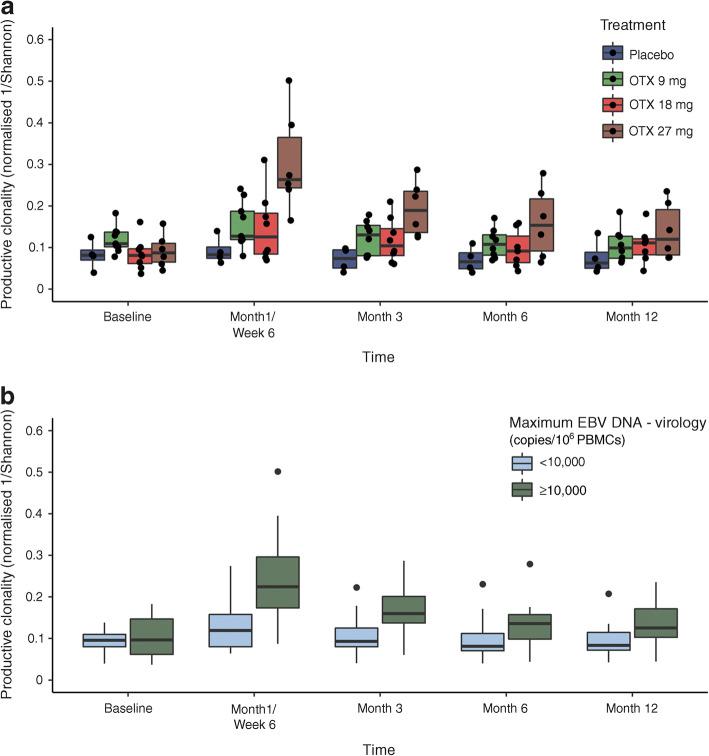
Thirty participants were randomised/28 were analysed (placebo, n = 6/5; otelixizumab 9 mg, n = 9/8; otelixizumab 18 mg, n = 8/8; otelixizumab 27 mg, n = 7/7; otelixizumab 36 mg, n = 0). Dosing was stopped at otelixizumab 27 mg as the predefined EBV reactivation stopping criteria were met. Adverse event frequency and severity were dose dependent; all participants on otelixizumab experienced at least one adverse event related to cytokine release syndrome during the dosing period. EBV reactivation (otelixizumab 9 mg, n = 2/9; 18 mg, n = 4/8: 27 mg, n = 5/7) and clinical manifestations (otelixizumab 9 mg, n = 0/9; 18 mg, n = 1/8; 27 mg, n = 3/7) were rapid, dose dependent and transient, and were associated with increased productive T cell clonality that diminished over time. Change from baseline mixed-meal tolerance test C-peptide weighted mean AUC min following otelixizumab 9 mg was above baseline for up to 18 months (difference from placebo 0.39 [95% CI 0.06, 0.72]; p = 0.023); no beta cell function preservation was observed at otelixizumab 18 and 27 mg.
CONCLUSIONS/INTERPRETATION: A metabolic response was observed with otelixizumab 9 mg, while doses higher than 18 mg increased the risk of unwanted clinical EBV reactivation. Although otelixizumab can temporarily compromise immunocompetence, allowing EBV to reactivate, the effect is dose dependent and transient, as evidenced by a rapid emergence of EBV-specific T cells preceding long-term control over EBV reactivation.
TRIAL REGISTRATION
ClinicalTrials.gov NCT02000817.
FUNDING
The study was funded by GlaxoSmithKline. Graphical abstract.
目的/假设:许多临床研究已经调查了抗 CD3ɛ 单克隆抗体 otelixizumab 在 1 型糖尿病患者中的作用,但在确定具有可接受的耐受性和安全性的最佳临床剂量方面进展有限。本研究的目的是评估新诊断的 1 型糖尿病患者中 otelixizumab 的剂量反应、安全性和耐受性、β细胞功能保存和免疫效应之间的关系。
方法
在这项由比利时糖尿病登记处进行的、在比利时的五个中心进行的随机、单盲、安慰剂对照、24 个月的研究中,参与者(年龄 16-27 岁,确诊 1 型糖尿病后 <32 天)被安排接受安慰剂或 otelixizumab,剂量分为四组(静脉累积剂量 9、18、27 或 36mg,在 6 天内给药;计划 n = 40)。通过中央计算机系统进行随机分组;只有参与者和床边研究人员对研究治疗不知情。主要终点是不良事件的发生率、EBV 再激活的发生率以及实验室指标和生命体征。采用混合餐耐量试验评估β细胞功能;采用探索性生物标志物测量 T 细胞反应。
结果
30 名参与者被随机分配/28 名被分析(安慰剂,n = 6/5;otelixizumab 9mg,n = 9/8;otelixizumab 18mg,n = 8/8;otelixizumab 27mg,n = 7/7;otelixizumab 36mg,n = 0)。由于达到了预定的 EBV 再激活停止标准,因此停止了 otelixizumab 27mg 的给药。不良事件的频率和严重程度与剂量有关;在给药期间,所有接受 otelixizumab 治疗的参与者均经历了至少一次与细胞因子释放综合征相关的不良事件。EBV 再激活(otelixizumab 9mg,n = 2/9;18mg,n = 4/8:27mg,n = 5/7)和临床表现(otelixizumab 9mg,n = 0/9;18mg,n = 1/8;27mg,n = 3/7)迅速、剂量依赖性和短暂,与增殖性 T 细胞克隆性增加有关,这种增加随时间而减少。与安慰剂相比,otelixizumab 9mg 后混合餐耐量试验 C 肽加权平均 AUC min 的基线变化持续长达 18 个月(与安慰剂相比,差异为 0.39[95%CI 0.06,0.72];p = 0.023);在 otelixizumab 18 和 27mg 时未观察到β细胞功能保存。
结论/解释:在 otelixizumab 9mg 时观察到代谢反应,而高于 18mg 的剂量增加了不希望发生的临床 EBV 再激活的风险。尽管 otelixizumab 会暂时削弱免疫能力,使 EBV 重新激活,但这种影响是剂量依赖性和短暂的,正如 EBV 特异性 T 细胞的快速出现所证明的那样,这种 T 细胞在 EBV 再激活的长期控制之前出现。
临床试验注册
ClinicalTrials.gov NCT02000817。
资金来源
该研究由葛兰素史克公司资助。

 Zotero 插件