
COVID-19大流行期间远程医疗的应用:范围综述
Use of Telehealth During the COVID-19 Pandemic: Scoping Review.
作者信息
Doraiswamy Sathyanarayanan, Abraham Amit, Mamtani Ravinder, Cheema Sohaila
机构信息
Institute for Population Health, Weill Cornell Medicine, Doha, Qatar.
出版信息
J Med Internet Res. 2020 Dec 1;22(12):e24087. doi: 10.2196/24087.
BACKGROUND
With over 37.8 million cases and over 1 million deaths worldwide, the COVID-19 pandemic has created a societal and economic upheaval of unparalleled magnitude. A positive transformation has been brought about by innovative solutions in the health care sector that aim to mitigate the impact of COVID-19 on human health. For instance, the use of telehealth has been on the rise amidst this public health emergency.
OBJECTIVE
Given the unprecedented scale of the pandemic with no definitive endpoint, we aimed to scope the existing telehealth-related literature during a defined period of the ongoing pandemic (ie, January to June 2020).
METHODS
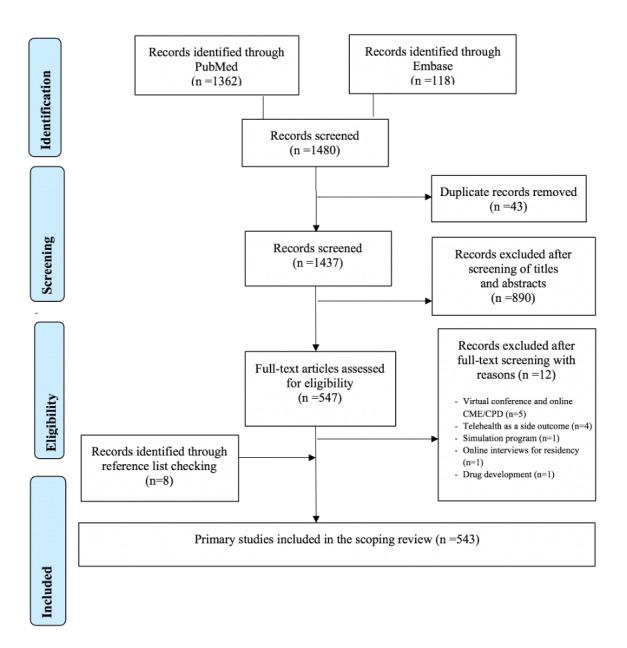
Our scoping review was guided by the Joanna Briggs Institute Reviewer Manual. We systematically searched PubMed and Embase databases with specific eligibility criteria. Data extracted from the shortlisted articles included first author and affiliation, journal title, publication type, terminologies used to describe telehealth and their accompanying definitions, health discipline or medical specialties and subspecialties wherein telehealth had been applied, the purpose of telehealth use, and the authors' overall sentiment on telehealth use. We collated the available information and used descriptive statistics to analyze the synthesized data.
RESULTS
In all, 543 articles published across 331 different journals were included in this scoping review. The Journal of Medical Internet Research and its sister journals featured the highest number of articles (25/543, 4.6%). Nearly all (533/543, 98.2%) articles were in English. The majority of the articles were opinions, commentaries, and perspectives (333/543, 61.3%). Most authors of the articles reviewed were from high-income countries (470/543, 86.6%), especially from the United States of America (237/543, 43.6%). In all, 39 different definitions were used to describe terms equivalent to telehealth. A small percentage (42/543, 7.7%) of the articles focused on the provision of COVID-19-related care. Moreover, 49.7% (270/543) of the articles primarily focused on the provision of multiple components of clinical care, and 23% (125/543) of the articles focused on various specialties and subspecialties of internal medicine. For a vast majority (461/543, 84.9%) of the articles, the authors expressed a celebratory sentiment about the use of telehealth.
CONCLUSIONS
This review identified considerable emerging literature on telehealth during the first six months of the COVID-19 pandemic, albeit mostly from high-income countries. There is compelling evidence to suggest that telehealth may have a significant effect on advancing health care in the future. However, the feasibility and application of telehealth in resource-limited settings and low- and middle-income countries must be established to avail its potential and transform health care for the world's population. Given the rapidity with which telehealth is advancing, a global consensus on definitions, boundaries, protocols, monitoring, evaluation, and data privacy is urgently needed.
背景
新型冠状病毒肺炎疫情在全球范围内已导致超过3780万例确诊病例和超过100万人死亡,引发了前所未有的社会和经济动荡。医疗保健领域的创新解决方案带来了积极转变,旨在减轻新型冠状病毒肺炎对人类健康的影响。例如,在此次突发公共卫生事件期间,远程医疗的使用呈上升趋势。
目的
鉴于此次疫情规模空前且尚无明确终点,我们旨在梳理在疫情持续期间(即2020年1月至6月)已有的与远程医疗相关的文献。
方法
我们的范围综述以乔安娜·布里格斯研究所综述手册为指导。我们按照特定的纳入标准,系统检索了PubMed和Embase数据库。从入围文章中提取的数据包括第一作者及其所属机构、期刊名称、出版类型、用于描述远程医疗的术语及其相应定义、应用远程医疗的健康学科或医学专业及亚专业、使用远程医疗的目的,以及作者对远程医疗使用的总体看法。我们整理了可用信息,并使用描述性统计方法分析综合数据。
结果
本范围综述共纳入了331种不同期刊发表的543篇文章。《医学互联网研究杂志》及其姊妹期刊刊载的文章数量最多(25/543,4.6%)。几乎所有文章(533/543,98.2%)均为英文。大多数文章为观点、评论和视角类(333/543,61.3%)。所综述文章的大多数作者来自高收入国家(470/543,86.6%),尤其是美国(237/543,43.6%)。共有39种不同的定义用于描述与远程医疗等同的术语。一小部分文章(42/543,7.7%)聚焦于提供与新型冠状病毒肺炎相关的护理。此外,49.7%(270/543)的文章主要聚焦于提供临床护理的多个组成部分,23%(125/543)的文章聚焦于内科的各个专业和亚专业。对于绝大多数文章(461/543,84.9%),作者对远程医疗的使用表达了赞赏之情。
结论
本综述发现,在新型冠状病毒肺炎疫情的前六个月,涌现出了大量关于远程医疗的文献,不过大多来自高收入国家。有令人信服的证据表明,远程医疗可能会对未来推进医疗保健产生重大影响。然而,必须确定远程医疗在资源有限环境以及低收入和中等收入国家的可行性和应用情况,以发挥其潜力并为全球人口变革医疗保健。鉴于远程医疗发展迅速,迫切需要就定义、范围、协议、监测、评估和数据隐私达成全球共识。


 Zotero 插件