
光动力疗法治疗口腔扁平苔藓的疗效评价:系统评价和荟萃分析。
Efficacy evaluation of photodynamic therapy for oral lichen planus: a systematic review and meta-analysis.
机构信息
State Key Laboratory of Oral Diseases, National Clinical Research Center for Oral Diseases, Chinese Academy of Medical Sciences Research Unit of Oral Carcinogenesis and Management, West China Hospital of Stomatology, Sichuan University, No. 14, Sec.3, Ren Min Nan Road, Chengdu, 610041, Sichuan, China.
出版信息
BMC Oral Health. 2020 Nov 4;20(1):302. doi: 10.1186/s12903-020-01260-x.
BACKGROUND
Photodynamic therapy (PDT) is a new option for oral lichen planus (OLP) management; however, there are different opinions on the efficacy of PDT for OLP. The aim of this study was to comprehensively assess the efficacy of PDT in the treatment of OLP and compare PDT with steroid therapy.
METHODS
A systematic review and meta-analysis were conducted to assess the curative effect of PDT. Five electronic databases were searched, PubMed, Web of Science, the Cochrane Library, Embase, and EBSCO up to 1 December, 2019. Random and fixed effects models for pooled estimates calculation were used and the Meta package of R was applied.
RESULTS
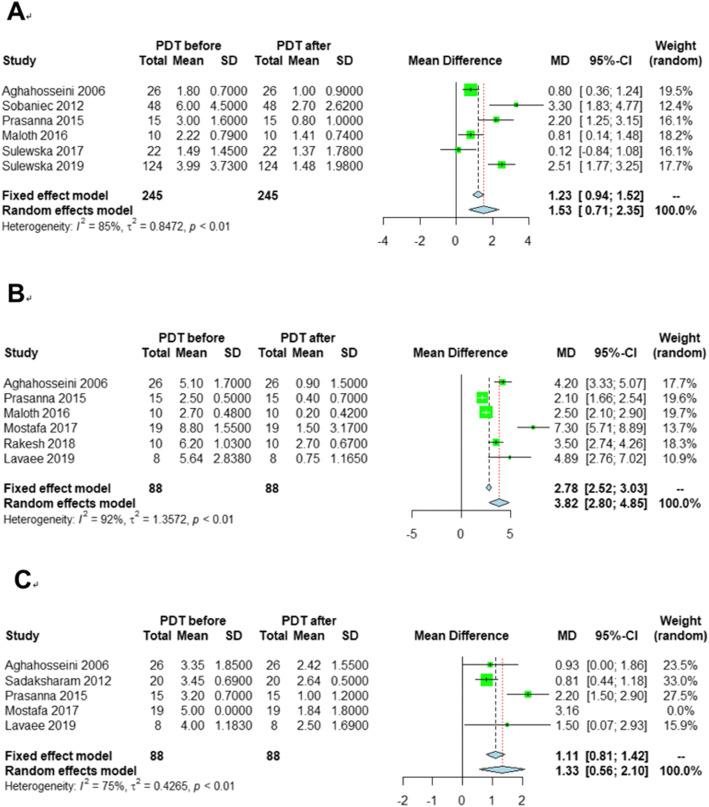
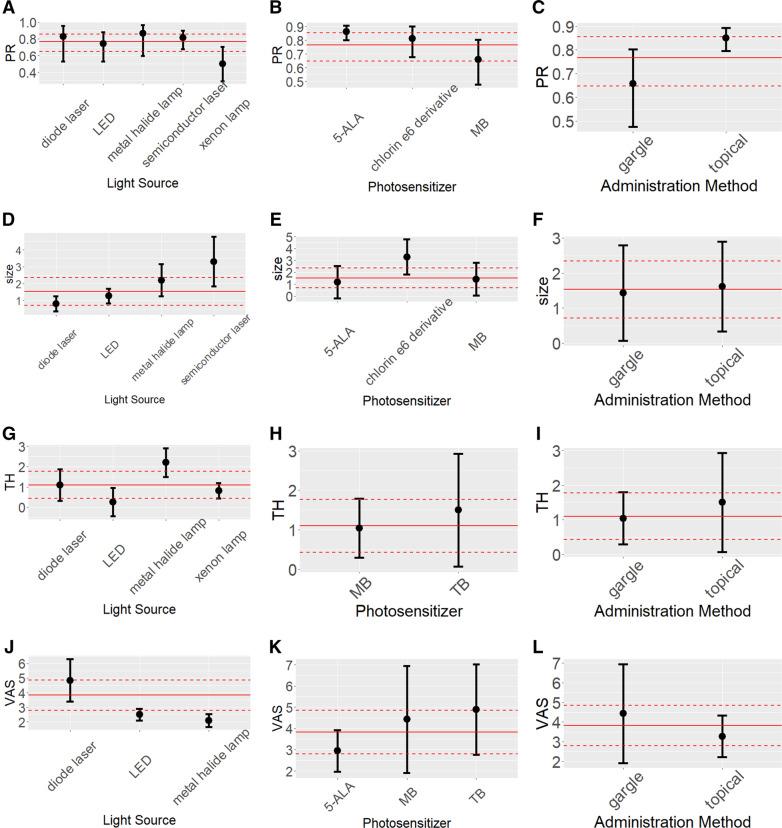
Pooled estimates revealed that, after PDT, the lesion size decreased by 1.53 cm (95% confidence interval (CI): 0.71-2.35) after PDT and the partial response (PR) was 0.77 (95% CI: 0.65-0.85). The visual analogue scale (VAS) score decreased by 3.82 (95% CI: 2.80-4.85) and the Thongprasom sign score decreased by 1.33 (95% CI: 0.56-2.10) after PDT. Subgroup analyses revealed that the 5-aminolevulinic acid (5-ALA) was more effective than methylene blue (MB), with a PR of 0.87 (95% CI: 0.80-0.91). The topical use of 5-ALA yielded a better response than gargling methylene blue. In terms of VAS, the diode laser showed a better clinical PR in the treatment of OLP. In terms of changes in lesion size, the efficacy of the semiconductor laser was higher than that of the diode laser. PDT had a similar efficacy to topical corticosteroids, as shown by pooled estimates of five randomised controlled trials with 139 lesions.
CONCLUSION
This systematic review indicates that PDT is an effective treatment modality for the management of OLP. PDT is as effective as topical corticosteroid in the treatment of OLP and could be used for cases resistant to steroids or when steroids are contraindicated.
背景
光动力疗法(PDT)是治疗口腔扁平苔藓(OLP)的新选择;然而,对于 PDT 治疗 OLP 的疗效存在不同意见。本研究旨在全面评估 PDT 治疗 OLP 的疗效,并将 PDT 与皮质类固醇治疗进行比较。
方法
系统评价和荟萃分析用于评估 PDT 的疗效。检索了 5 个电子数据库,包括 PubMed、Web of Science、Cochrane 图书馆、Embase 和 EBSCO,检索日期截至 2019 年 12 月 1 日。使用随机和固定效应模型进行汇总估计计算,并应用 R 中的 Meta 包。
结果
汇总估计显示,PDT 后,病变面积缩小 1.53cm(95%置信区间(CI):0.71-2.35),部分缓解(PR)为 0.77(95%CI:0.65-0.85)。视觉模拟量表(VAS)评分降低 3.82(95%CI:2.80-4.85),Thongprasom 评分降低 1.33(95%CI:0.56-2.10)。亚组分析显示,5-氨基酮戊酸(5-ALA)比亚甲蓝(MB)更有效,PR 为 0.87(95%CI:0.80-0.91)。5-ALA 局部应用比含漱 MB 更有效。在 VAS 方面,二极管激光治疗 OLP 的临床 PR 较好。就病变大小的变化而言,半导体激光的疗效高于二极管激光。五项随机对照试验共 139 个病变的汇总估计表明,PDT 与局部皮质类固醇具有相似的疗效。
结论
本系统评价表明,PDT 是治疗 OLP 的有效方法。PDT 与局部皮质类固醇治疗 OLP 的疗效相当,可用于对皮质类固醇耐药或禁忌的病例。


 Zotero 插件