
多倍体巨癌细胞,肿瘤病毒的一个标志及新的治疗挑战。
Polyploid Giant Cancer Cells, a Hallmark of Oncoviruses and a New Therapeutic Challenge.
作者信息
Herbein Georges, Nehme Zeina
机构信息
Pathogens & Inflammation/EPILAB Laboratory, EA 4266, University of Franche-Comté, Université Bourgogne Franche-Comté (UBFC), Besançon, France.
Department of Virology, CHRU Besancon, Besançon, France.
出版信息
Front Oncol. 2020 Oct 14;10:567116. doi: 10.3389/fonc.2020.567116. eCollection 2020.
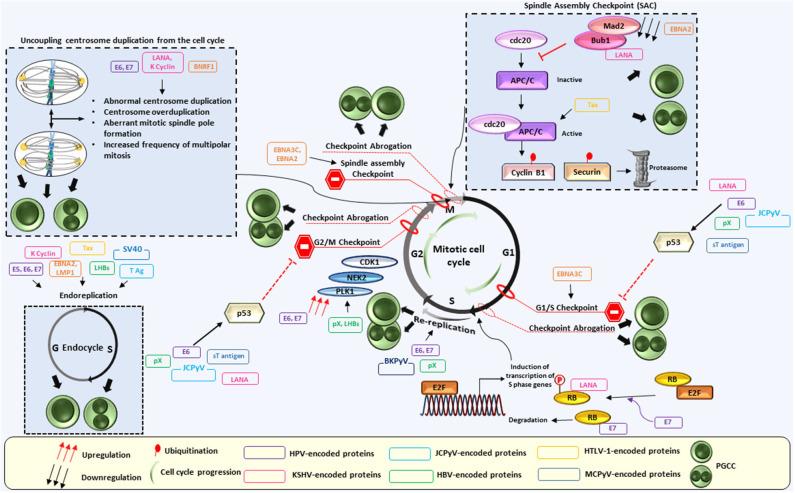
Tumors are renowned as intricate systems that harbor heterogeneous cancer cells with distinctly diverse molecular signatures, sizes and genomic contents. Among those various genomic clonal populations within the complex tumoral architecture are the polyploid giant cancer cells (PGCC). Although described for over a century, PGCC are increasingly being recognized for their prominent role in tumorigenesis, metastasis, therapy resistance and tumor repopulation after therapy. A shared characteristic among all tumors triggered by oncoviruses is the presence of polyploidy. Those include Human Papillomaviruses (HPV), Epstein Barr Virus (EBV), Hepatitis B and C viruses (HBV and HCV, respectively), Human T-cell lymphotropic virus-1 (HTLV-1), Kaposi's sarcoma herpesvirus (KSHV) and Merkel polyomavirus (MCPyV). Distinct viral proteins, for instance Tax for HTLV-1 or HBx for HBV have demonstrated their etiologic role in favoring the appearance of PGCC. Different intriguing biological mechanisms employed by oncogenic viruses, in addition to viruses with high oncogenic potential such as human cytomegalovirus, could support the generation of PGCC, including induction of endoreplication, inactivation of tumor suppressors, development of hypoxia, activation of cellular senescence and others. Interestingly, chemoresistance and radioresistance have been reported in the context of oncovirus-induced cancers, for example KSHV and EBV-associated lymphomas and high-risk HPV-related cervical cancer. This points toward a potential linkage between the previously mentioned players and highlights PGCC as keystone cancer cells in virally-induced tumors. Subsequently, although new therapeutic approaches are actively needed to fight PGCC, attention should also be drawn to reveal the relationship between PGCC and oncoviruses, with the ultimate goal of establishing effective therapeutic platforms for treatment of virus-associated cancers. This review discusses the presence of PGCCs in tumors induced by oncoviruses, biological mechanisms potentially favoring their appearance, as well as their consequent implication at the clinical and therapeutic level.
肿瘤是复杂的系统,其中含有具有明显不同分子特征、大小和基因组内容的异质性癌细胞。在复杂肿瘤结构中的各种基因组克隆群体中,有多倍体巨癌细胞(PGCC)。尽管PGCC已被描述了一个多世纪,但它们在肿瘤发生、转移、治疗抗性和治疗后肿瘤再增殖中的突出作用正越来越受到认可。由致癌病毒引发的所有肿瘤的一个共同特征是多倍体的存在。这些病毒包括人乳头瘤病毒(HPV)、爱泼斯坦-巴尔病毒(EBV)、乙型和丙型肝炎病毒(分别为HBV和HCV)、人类嗜T淋巴细胞病毒1型(HTLV-1)、卡波西肉瘤疱疹病毒(KSHV)和默克尔多瘤病毒(MCPyV)。不同的病毒蛋白,例如HTLV-1的Tax蛋白或HBV的HBx蛋白,已证明它们在促进PGCC出现方面的病因学作用。除了具有高致癌潜力的病毒(如人类巨细胞病毒)外,致癌病毒采用的不同有趣生物学机制可能支持PGCC的产生,包括内复制的诱导、肿瘤抑制因子的失活、缺氧的发展、细胞衰老的激活等。有趣的是,在致癌病毒诱导的癌症中已报道了化学抗性和放射抗性,例如KSHV和EBV相关淋巴瘤以及高危HPV相关宫颈癌。这表明上述因素之间存在潜在联系,并突出了PGCC作为病毒诱导肿瘤中的关键癌细胞。随后,尽管积极需要新的治疗方法来对抗PGCC,但也应关注揭示PGCC与致癌病毒之间的关系,最终目标是建立治疗病毒相关癌症的有效治疗平台。本综述讨论了致癌病毒诱导的肿瘤中PGCC的存在、可能促进其出现的生物学机制以及它们在临床和治疗水平上的后续影响。

 Zotero 插件