
扩张型心肌病患者的表型聚类突出了重要的病理生理差异。
Phenotypic clustering of dilated cardiomyopathy patients highlights important pathophysiological differences.
机构信息
Department of Cardiology, Cardiovascular Research Institute (CARIM), Maastricht University Medical Center, PO Box 5800, 6202 AZ Maastricht, The Netherlands.
Department of Clinical Genetics, Maastricht University Medical Center, Maastricht, The Netherlands.
出版信息
Eur Heart J. 2021 Jan 7;42(2):162-174. doi: 10.1093/eurheartj/ehaa841.
AIMS
The dilated cardiomyopathy (DCM) phenotype is the result of combined genetic and acquired triggers. Until now, clinical decision-making in DCM has mainly been based on ejection fraction (EF) and NYHA classification, not considering the DCM heterogenicity. The present study aimed to identify patient subgroups by phenotypic clustering integrating aetiologies, comorbidities, and cardiac function along cardiac transcript levels, to unveil pathophysiological differences between DCM subgroups.
METHODS AND RESULTS
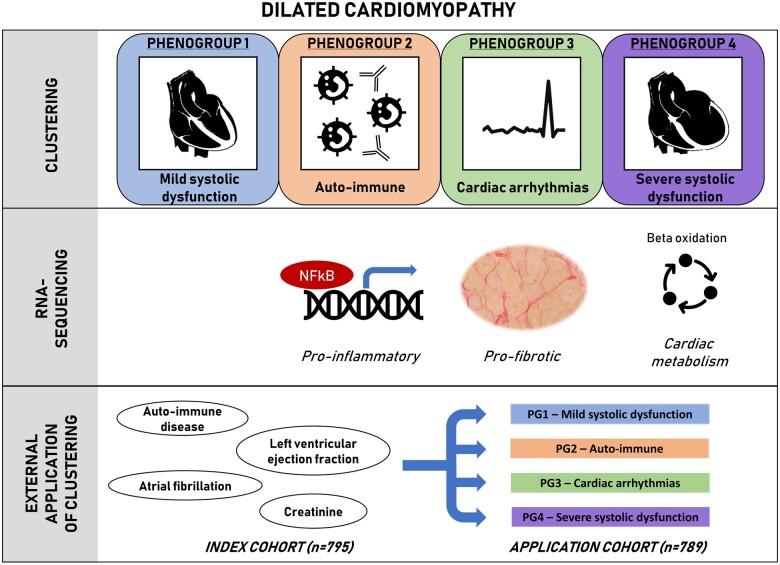
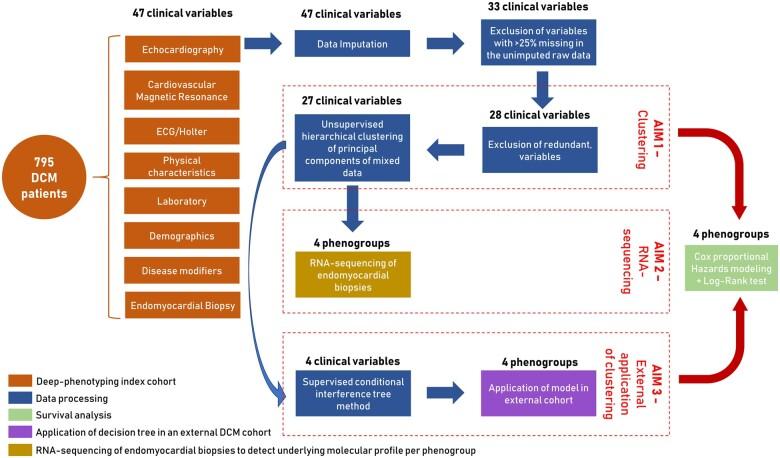
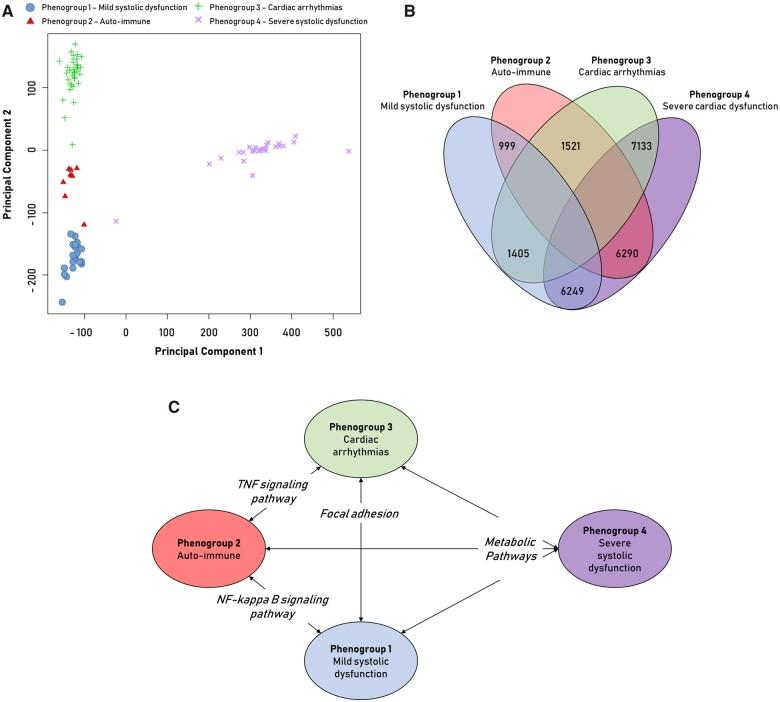
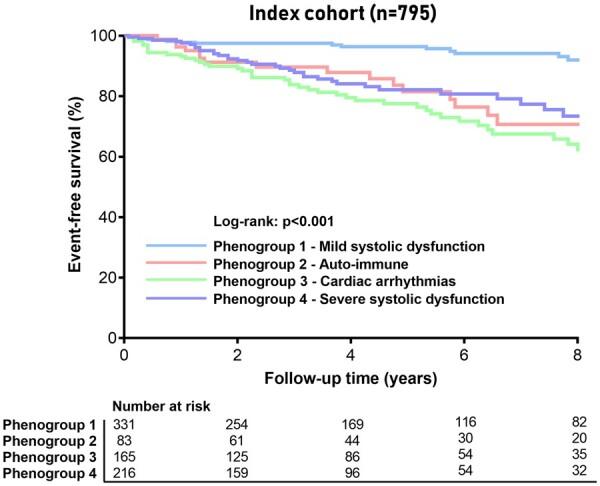
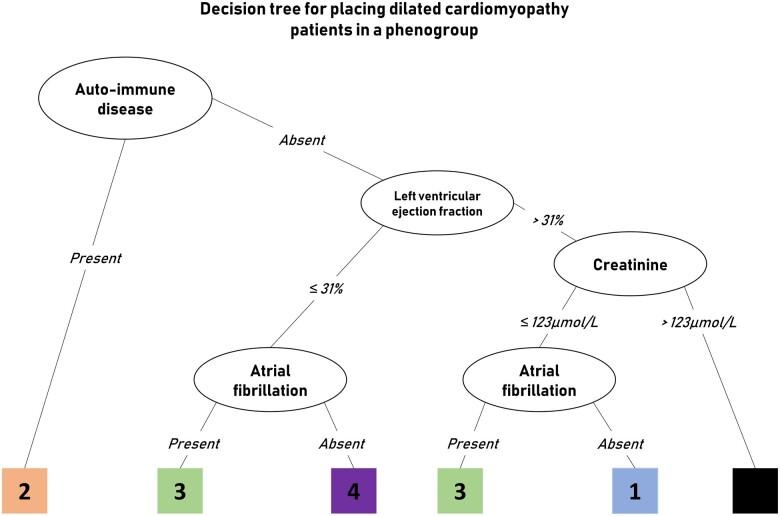
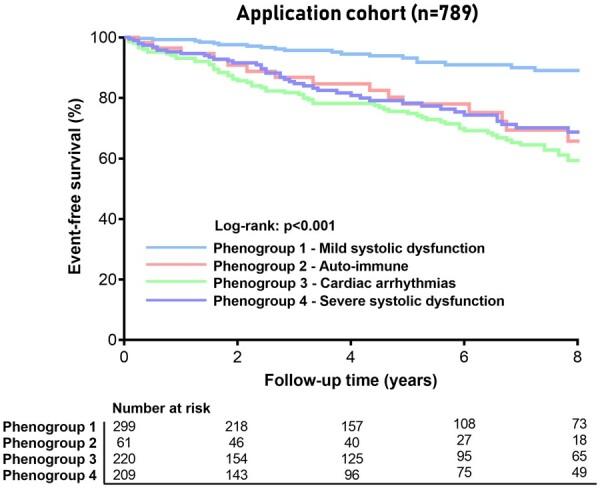
We included 795 consecutive DCM patients from the Maastricht Cardiomyopathy Registry who underwent in-depth phenotyping, comprising extensive clinical data on aetiology and comorbodities, imaging and endomyocardial biopsies. Four mutually exclusive and clinically distinct phenogroups (PG) were identified based upon unsupervised hierarchical clustering of principal components: [PG1] mild systolic dysfunction, [PG2] auto-immune, [PG3] genetic and arrhythmias, and [PG4] severe systolic dysfunction. RNA-sequencing of cardiac samples (n = 91) revealed a distinct underlying molecular profile per PG: pro-inflammatory (PG2, auto-immune), pro-fibrotic (PG3; arrhythmia), and metabolic (PG4, low EF) gene expression. Furthermore, event-free survival differed among the four phenogroups, also when corrected for well-known clinical predictors. Decision tree modelling identified four clinical parameters (auto-immune disease, EF, atrial fibrillation, and kidney function) by which every DCM patient from two independent DCM cohorts could be placed in one of the four phenogroups with corresponding outcome (n = 789; Spain, n = 352 and Italy, n = 437), showing a feasible applicability of the phenogrouping.
CONCLUSION
The present study identified four different DCM phenogroups associated with significant differences in clinical presentation, underlying molecular profiles and outcome, paving the way for a more personalized treatment approach.
目的
扩张型心肌病(DCM)的表型是遗传和获得性因素共同作用的结果。到目前为止,DCM 的临床决策主要基于射血分数(EF)和纽约心脏协会(NYHA)分类,而不考虑 DCM 的异质性。本研究旨在通过表型聚类来识别患者亚组,该聚类综合了病因、合并症和心脏功能以及心脏转录水平,以揭示 DCM 亚组之间的病理生理差异。
方法和结果
我们纳入了来自马斯特里赫特心肌病注册中心的 795 例连续 DCM 患者,这些患者接受了深入的表型分析,包括病因和合并症的广泛临床数据、影像学和心内膜心肌活检。基于主成分的无监督层次聚类,确定了四个相互排斥且具有临床意义的表型群(PG):[PG1]轻度收缩功能障碍,[PG2]自身免疫性,[PG3]遗传和心律失常,以及[PG4]严重收缩功能障碍。对心脏样本(n=91)进行 RNA 测序,揭示了每个 PG 独特的潜在分子谱:PG2(自身免疫性)为促炎,PG3(心律失常)为促纤维化,PG4(低 EF)为代谢基因表达。此外,在调整了已知的临床预测因素后,四个表型群之间的无事件生存情况也存在差异。决策树模型确定了四个临床参数(自身免疫性疾病、EF、心房颤动和肾功能),通过这些参数,两个独立的 DCM 队列中的每一位 DCM 患者都可以被归入四个表型群之一,同时伴有相应的结局(n=789;西班牙队列,n=352;意大利队列,n=437),表明这种表型分组具有可行的适用性。
结论
本研究确定了四个不同的 DCM 表型群,它们与临床表现、潜在的分子谱和结局有显著差异,为更个性化的治疗方法铺平了道路。

 Zotero 插件