
感染. 后小鼠肠道微生物组和代谢物特征分析
Alterations of Gut Microbiome and Metabolite Profiling in Mice Infected by .
机构信息
Key Laboratory of Tropical Disease Control (Sun Yat-sen University), Ministry of Education, Guangzhou, China.
Key Laboratory of Tropical Translational Medicine of Ministry of Education, Hainan Medical University, Haikou, China.
出版信息
Front Immunol. 2020 Oct 8;11:569727. doi: 10.3389/fimmu.2020.569727. eCollection 2020.
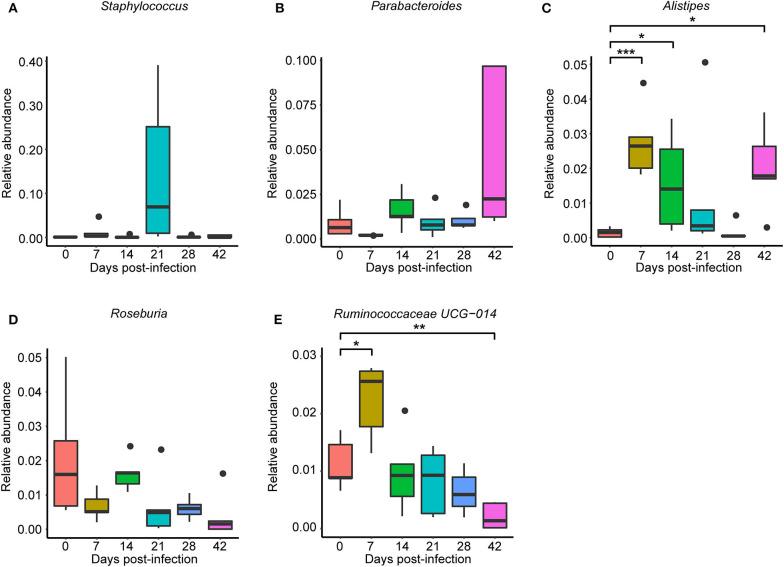
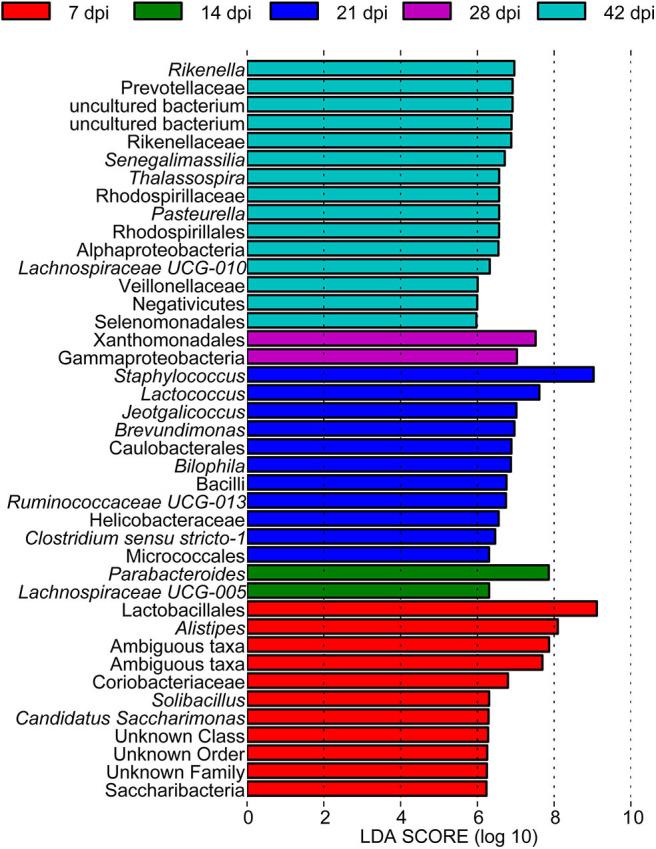
() is one of the etiological agents of schistosomiasis, a widespread zoonotic parasitic disease. However, the mechanism of the balanced co-existence between the host immune system and as well as their complex interaction remains unclear. In this study, rRNA gene sequencing, combined with metagenomic sequencing approach as well as ultraperformance liquid chromatography-mass spectrometry metabolic profiling, was applied to demonstrate changes in the gut microbiome community structure during schistosomiasis progression, the functional interactions between the gut bacteria and infection in BALB/c mice, and the dynamic metabolite changes of the host. The results showed that both gut microbiome and the metabolites were significantly altered at different time points after the infection. Decrease in richness and diversity as well as differed composition of the gut microbiota was observed in the infected status when compared with the uninfected status. At the phylum level, the gut microbial communities in all samples were dominated by Firmicutes, Bacteroidetes, Proteobacteria, and Deferribacteres, while at the genus level, , and were the most abundant. After exposure, , and decreased, while , and increased, which could raise the risk of infections. Furthermore, LEfSe demonstrated several bacterial taxa that could discriminate between each time point of infection. Besides that, metagenomic analysis illuminated that the AMP-activated protein kinase (AMPK) signaling pathway and the chemokine signaling pathway were significantly perturbed after the infection. Phosphatidylcholine and colfosceril palmitate in serum as well as xanthurenic acid, naphthalenesulfonic acid, and pimelylcarnitine in urine might be metabolic biomarkers due to their promising diagnostic potential at the early stage of the infection. Alterations of glycerophospholipid and purine metabolism were also discovered in the infection. The present study might provide further understanding of the mechanisms during schistosome infection in aspects of gut microbiome and metabolites, and facilitate the discovery of new targets for early diagnosis and prognostic purposes. Further validations of potential biomarkers in human populations are necessary, and the exploration of interactions among , gut microbiome, and metabolites is to be deepened in the future.
()是血吸虫病的病原体之一,血吸虫病是一种广泛流行的动物源性寄生虫病。然而,宿主免疫系统与 之间平衡共存的机制以及它们之间的复杂相互作用仍不清楚。在这项研究中,我们应用 16S rRNA 基因测序、宏基因组测序方法以及超高效液相色谱-质谱代谢组学分析,来证明在血吸虫病进展过程中肠道微生物群落结构的变化、BALB/c 小鼠肠道细菌与 感染之间的功能相互作用以及宿主的动态代谢物变化。结果表明,在感染后不同时间点,肠道微生物组和代谢物都发生了显著改变。与未感染状态相比,感染状态下肠道微生物群落的丰富度和多样性降低,组成也发生了差异。在门水平上,所有样本中的肠道微生物群落主要由厚壁菌门、拟杆菌门、变形菌门和脱硫菌门组成,而在属水平上, 、 和 是最丰富的。暴露后, 、 和 减少,而 、 和 增加,这可能增加感染的风险。此外,LEfSe 分析表明,有几个细菌分类群可以区分 感染的每个时间点。除此之外,宏基因组分析表明,感染后 AMP 激活蛋白激酶(AMPK)信号通路和趋化因子信号通路受到显著干扰。血清中磷酸胆碱和棕榈酸科尔福塞尔以及尿液中的黄尿酸、萘磺酸和吡咯烷二羧酸可能是由于其在感染早期具有有希望的诊断潜力而成为代谢生物标志物。感染还发现了甘油磷脂和嘌呤代谢的改变。本研究可能为从肠道微生物组和代谢物角度进一步了解血吸虫感染的机制提供帮助,并有助于发现早期诊断和预后的新靶点。有必要在人类群体中进一步验证潜在的生物标志物,并在未来深入探索 、肠道微生物组和代谢物之间的相互作用。






 Zotero 插件