
护士对重症监护病房和医院急诊服务中 COVID-19 护理的看法和需求。
Nurses' perceptions and demands regarding COVID-19 care delivery in critical care units and hospital emergency services.
机构信息
Nursing Department, Faculty of Medicine, Autonomous University of Madrid, Spain.
Nursing Department, Faculty of Medicine, Autonomous University of Madrid, Spain.
出版信息
Intensive Crit Care Nurs. 2021 Feb;62:102966. doi: 10.1016/j.iccn.2020.102966. Epub 2020 Oct 28.
BACKGROUND
The COVID-19 pandemic is a public health challenge that puts health systems in a highly vulnerable situation. Nurses in critical care units (CCUs) and hospital emergency services (HESs) have provided care to patients with COVID-19 under pressure and uncertainty.
OBJECTIVE
To identify needs related to safety, organisation, decision-making, communication and psycho-socio-emotional needs perceived by critical care and emergency nurses in the region of Madrid, Spain, during the acute phase of the epidemic crisis.
METHODS
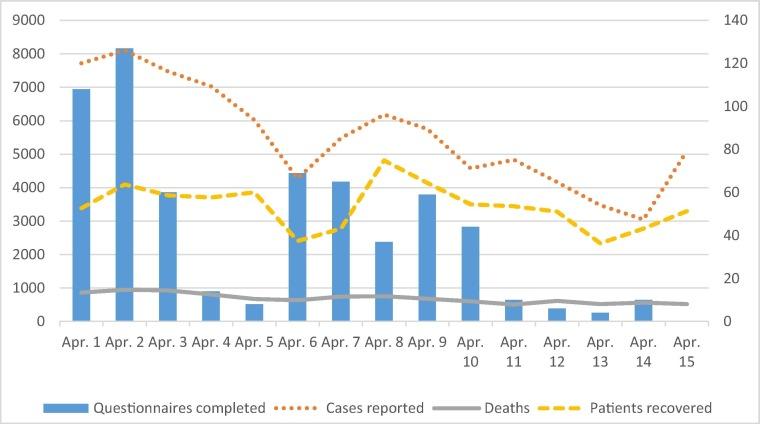
This is a cross-sectional study (the first phase of a mixed methods study) with critical care and emergency nurses from 26 public hospitals in Madrid using an online questionnaire.
RESULTS
The response rate was 557, with 37.5% reporting working with the fear of becoming infected and its consequences, 28.2% reported elevated workloads, high patient-nurse ratios and shifts that did not allow them to disconnect or rest, while taking on more responsibilities when managing patients with COVID-19 (23.9%). They also reported deficiencies in communication with middle management (21.2%), inability to provide psycho-social care to patients and families and being emotionally exhausted (53.5%), with difficulty in venting emotions (44.9%).
CONCLUSIONS
Critical care and emegency nurses may be categorised as a vulnerable population. It is thus necessary to delve deeper into further aspects of their experiences of the pandemic.
背景
COVID-19 大流行是对卫生系统构成高度脆弱性的公共卫生挑战。重症监护病房(CCU)和医院急诊服务(HES)的护士在压力和不确定的情况下为 COVID-19 患者提供护理。
目的
在西班牙马德里地区,确定在疫情危机的急性阶段,重症监护和急诊护士在安全、组织、决策、沟通和心理社会情感方面的需求。
方法
这是一项使用在线问卷对来自马德里 26 家公立医院的重症监护和急诊护士进行的横断面研究(混合方法研究的第一阶段)。
结果
应答率为 557,37.5%的人报告说担心感染及其后果,28.2%的人报告说工作量增加,患者与护士比例高,轮班不允许他们断开连接或休息,同时在管理 COVID-19 患者时承担更多责任(23.9%)。他们还报告与中层管理人员沟通不畅(21.2%),无法为患者和家属提供心理社会关怀,情绪疲惫(53.5%),情绪发泄困难(44.9%)。
结论
重症监护和急诊护士可能被归类为弱势群体。因此,有必要更深入地探讨他们在大流行期间的其他经历。
 Zotero 插件