
医生对过敏性反应中肾上腺素使用不足情况的了解。
Physicians' knowledge regarding epinephrine underuse in anaphylaxis.
作者信息
Pimentel-Hayashi Joaquin A, Navarrete-Rodriguez Elsy M, Moreno-Laflor Oscar I, Del Rio-Navarro Blanca E
机构信息
Department of Allergy and Immunology, WAO Center of Excellence, Hospital Infantil de México Federico Gomez, Mexico City, Mexico.
出版信息
Asia Pac Allergy. 2020 Oct 22;10(4):e40. doi: 10.5415/apallergy.2020.10.e40. eCollection 2020 Oct.
BACKGROUND
Anaphylaxis is a life-threating hypersensitivity reaction. Epinephrine underuse in patients with anaphylaxis could lead to poor outcomes. There is evidence that the epinephrine use in such patients could be as low as 8%.
OBJECTIVE
To assess the percentage of physicians who know that epinephrine is the first-line treatment in anaphylaxis. The secondary objective was to assess knowledge gaps regarding anaphylaxis diagnosis and treatment that could lead to epinephrine underuse.
METHODS
We performed an online survey for physicians in Mexico City, using a 10-item questionnaire assessing anaphylaxis knowledge. We obtained measures of central tendency for statistical analysis, such as frequency, 95% confidence interval, as well as the chi-square test for comparing the groups.
RESULTS
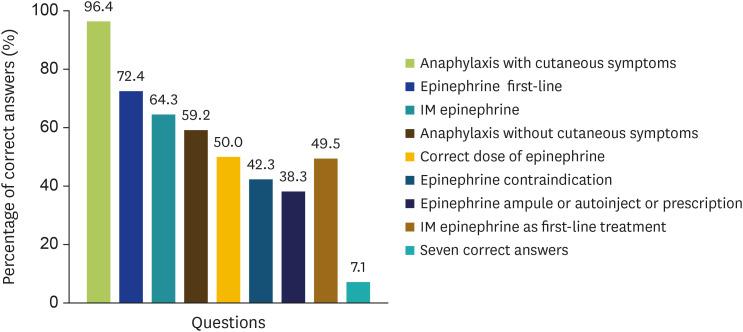
A total of 196 surveys were considered for analysis. Of all the participants, 96.44% were able to correctly diagnose an anaphylaxis case with cutaneous, respiratory, and cardiovascular symptoms. Fifty-two percent correctly diagnosed anaphylaxis without cutaneous symptoms. The 72.4% of the respondents chose epinephrine as the first-line treatment, 42.3% correctly answered that there is no absolute contraindication to giving epinephrine, and 20.9% ignored whether there was any contraindication for its use. Only 38.3% of participants answered that during discharge they would prescribe an autoinjector. Regarding the administration route, 63.4% answered that the first dose of epinephrine is applied intramuscularly and 50% of the participants chose the correct dose of epinephrine. Only 2.6% of the participants answered all 10 questions correctly.
CONCLUSION
There is still some difficulty recognizing anaphylaxis without cutaneous symptoms. Even though two-thirds of physicians identified that epinephrine is the treatment of choice, only 49.5% would have used intramuscular epinephrine as first-line treatment. We found a low percentage of epinephrine ampule prescription and knowledge of the correct dose. These findings can account for epinephrine underuse when dealing with anaphylaxis in the real clinical practice.
背景
过敏反应是一种危及生命的超敏反应。过敏反应患者肾上腺素使用不足可能导致不良后果。有证据表明,此类患者中肾上腺素的使用率可能低至8%。
目的
评估知晓肾上腺素是过敏反应一线治疗药物的医生比例。次要目的是评估可能导致肾上腺素使用不足的过敏反应诊断和治疗方面的知识差距。
方法
我们对墨西哥城的医生进行了一项在线调查,使用一份包含10个项目的问卷来评估过敏反应知识。我们获取了用于统计分析的集中趋势度量,如频率、95%置信区间,以及用于比较组别的卡方检验。
结果
总共196份调查问卷被纳入分析。在所有参与者中,96.44%能够正确诊断出具有皮肤、呼吸和心血管症状的过敏反应病例。52%能够正确诊断出无皮肤症状的过敏反应。72.4%的受访者选择肾上腺素作为一线治疗药物,42.3%正确回答使用肾上腺素没有绝对禁忌证,20.9%忽略了其使用是否存在任何禁忌证。只有38.3%的参与者回答在出院时会开具自动注射器。关于给药途径,63.4%回答肾上腺素的首剂通过肌肉注射给药,50%的参与者选择了正确的肾上腺素剂量。只有2.6%的参与者正确回答了所有10个问题。
结论
识别无皮肤症状的过敏反应仍存在一些困难。尽管三分之二的医生认为肾上腺素是首选治疗药物,但只有49.5%会将肌肉注射肾上腺素作为一线治疗方法。我们发现肾上腺素安瓿处方率较低且对正确剂量的知晓率较低。这些发现可以解释在实际临床实践中处理过敏反应时肾上腺素使用不足的情况。
 Zotero 插件