
暴露于不同环境危险因素的慢性阻塞性肺疾病患者的特征:一项大型横断面研究。
Characteristics of Patients with Chronic Obstructive Pulmonary Disease Exposed to Different Environmental Risk Factors: A Large Cross-Sectional Study.
作者信息
Duan Jia-Xi, Cheng Wei, Zeng Yu-Qin, Chen Yan, Cai Shan, Li Xin, Zhu Ying-Qun, Chen Ming, Zhou Mei-Ling, Ma Li-Bing, Liu Qi-Mi, Chen Ping
机构信息
Department of Pulmonary and Critical Care Medicine, The Second Xiangya Hospital, Central South University, Changsha, Hunan 410011, People's Republic of China.
Research Unit of Respiratory Disease, Central South University, Changsha, Hunan 410011, People's Republic of China.
出版信息
Int J Chron Obstruct Pulmon Dis. 2020 Nov 6;15:2857-2867. doi: 10.2147/COPD.S267114. eCollection 2020.
PURPOSE
Tobacco smoking, biomass smoke, and occupational exposure are the main risk factors for chronic obstructive pulmonary disease (COPD). The present study analyzes data on exposure to these factors in a cohort of patients with COPD and assesses their differences in demographic and clinical characteristics.
PATIENTS AND METHODS
The cross-sectional observational study was conducted from November 2016 to December 2019. Inclusion criteria were patients aged over 40 years old with post-bronchodilator forced expiratory volume in 1 second (FEV)/forced vital capacity (FVC) <0.7. At baseline, demographic features and exposure history were recorded. Moreover, respiratory symptoms were assessed by the COPD Assessment Test (CAT) and modified Medical Research Council scale (mMRC). A generalized linear mixed model was used to adjust for potential confounders.
RESULTS
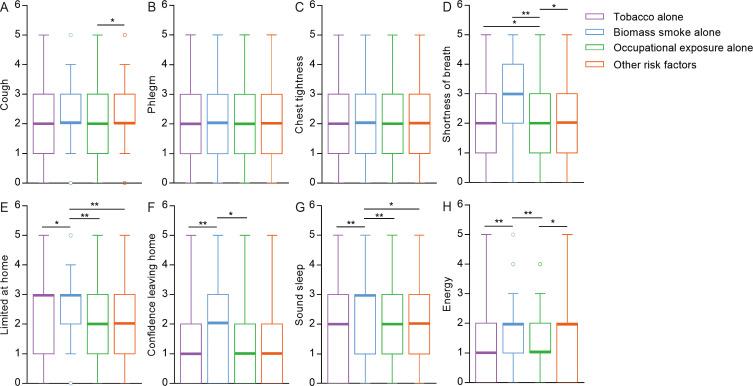
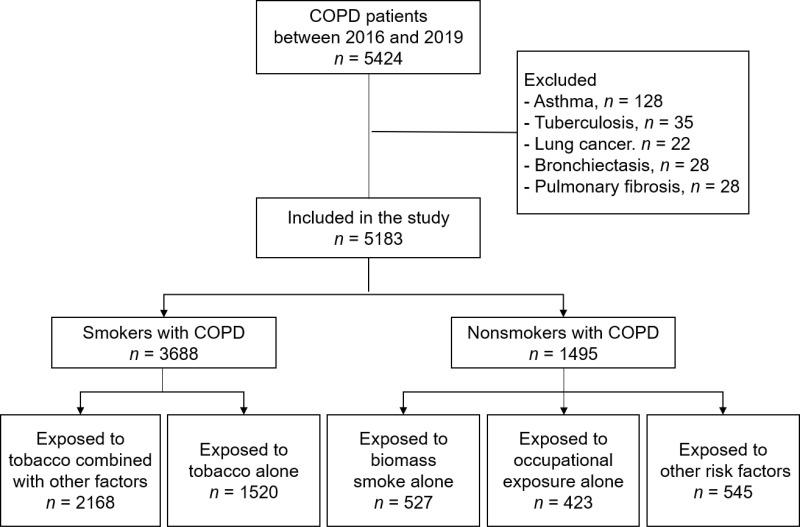
A total of 5183 patients with COPD were included in the final analysis. The results demonstrate that exposure to tobacco combined with other risk factors resulted in significantly higher CAT scores (16.0 ± 6.7 vs 15.3 ± 6.3, = 0.003) and more severe dyspnea (patients with mMRC ≥ 2, 71.5% vs 61.6%, < 0.001) than exposure to tobacco alone. In addition, COPD patients with biomass smoke exposure alone had higher CAT scores than patients with only tobacco or occupational exposure (17.5 ± 6.3 vs 15.3 ± 6.3, and 15.2 ± 6.3, respectively, < 0.05 for each comparison) and were more likely to be female and older. In addition, COPD patients who suffered from occupational exposure developed more severe dyspnea than those exposed to tobacco alone (70.8% vs 61.6%, < 0.05), as did those exposed to biomass smoke alone (74.2% vs 61.6%, < 0.05). This difference remained strong even after adjustment for potential confounders.
CONCLUSION
There are significant demographic and clinical differences among COPD patients with tobacco smoking, biomass smoke, and occupational exposures.
目的
吸烟、生物质烟雾和职业暴露是慢性阻塞性肺疾病(COPD)的主要危险因素。本研究分析了一组COPD患者的这些因素暴露数据,并评估了它们在人口统计学和临床特征方面的差异。
患者与方法
横断面观察性研究于2016年11月至2019年12月进行。纳入标准为年龄超过40岁、支气管扩张剂后1秒用力呼气容积(FEV)/用力肺活量(FVC)<0.7的患者。在基线时,记录人口统计学特征和暴露史。此外,通过慢性阻塞性肺疾病评估测试(CAT)和改良医学研究委员会量表(mMRC)评估呼吸道症状。使用广义线性混合模型来调整潜在的混杂因素。
结果
共有5183例COPD患者纳入最终分析。结果表明,与仅暴露于烟草相比,暴露于烟草并伴有其他危险因素会导致CAT评分显著更高(16.0±6.7对15.3±6.3,P = 0.003)和更严重的呼吸困难(mMRC≥2的患者,71.5%对61.6%,P<0.001)。此外,仅暴露于生物质烟雾的COPD患者的CAT评分高于仅暴露于烟草或职业暴露的患者(分别为17.5±6.3对15.3±6.3和15.2±6.3,每次比较P<0.05),并且更可能为女性且年龄更大。此外,遭受职业暴露的COPD患者比仅暴露于烟草的患者出现更严重的呼吸困难(70.8%对61.6%,P<0.05),仅暴露于生物质烟雾的患者也是如此(74.2%对61.6%,P<0.05)。即使在调整潜在混杂因素后,这种差异仍然很显著。
结论
吸烟、生物质烟雾和职业暴露的COPD患者在人口统计学和临床方面存在显著差异。
 Zotero 插件