
新型1-脒基-4-苯基哌嗪作为人TAAR1受体的强效激动剂:合理设计、合成、生物学评价及分子对接研究
Novel 1-Amidino-4-Phenylpiperazines as Potent Agonists at Human TAAR1 Receptor: Rational Design, Synthesis, Biological Evaluation and Molecular Docking Studies.
作者信息
Francesconi Valeria, Cichero Elena, Kanov Evgeny V, Laurini Erik, Pricl Sabrina, Gainetdinov Raul R, Tonelli Michele
机构信息
Dipartimento di Farmacia, Università degli Studi di Genova, Viale Benedetto XV, 3, 16132 Genova, Italy.
Institute of Translational Biomedicine, St. Petersburg State University, 199034 St. Petersburg, Russia.
出版信息
Pharmaceuticals (Basel). 2020 Nov 14;13(11):391. doi: 10.3390/ph13110391.
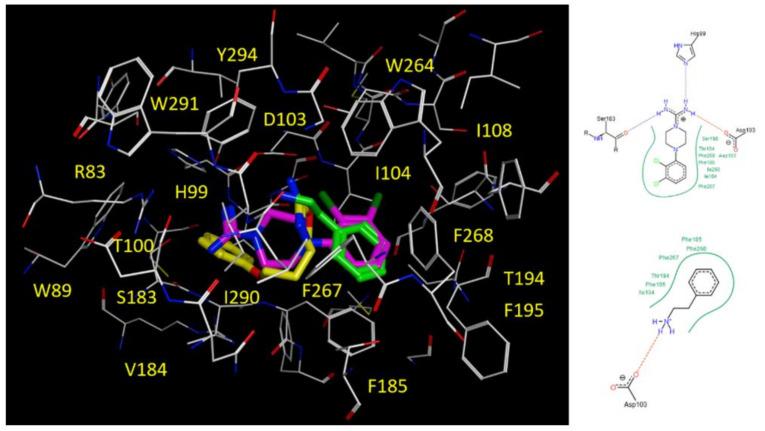
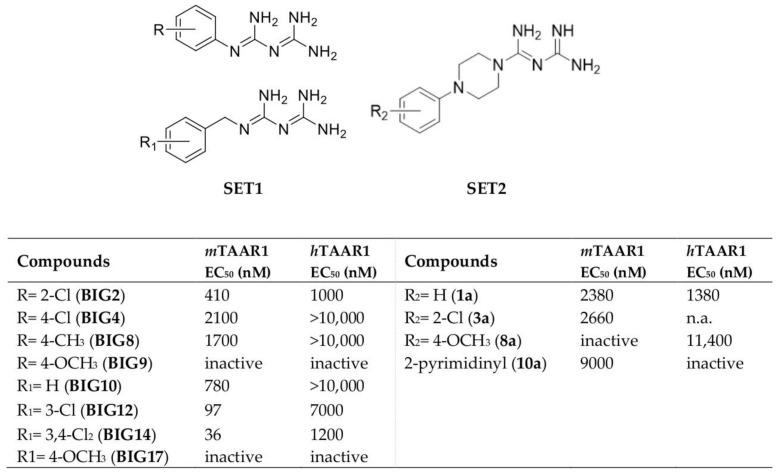
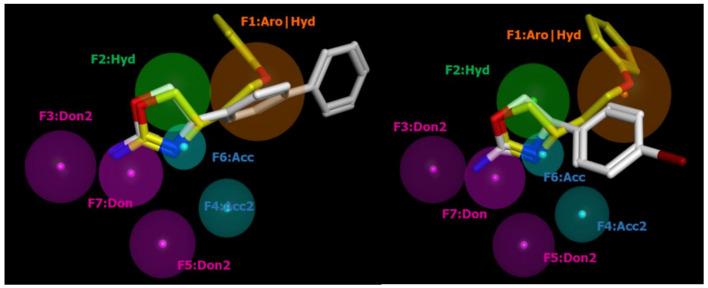
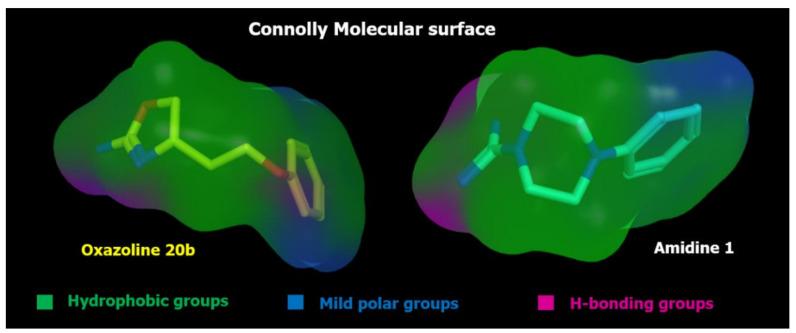
Targeting trace amine-associated receptor 1 (TAAR1) receptor continues to offer an intriguing opportunity to develop innovative therapies in different pharmacological settings. Pursuing our endeavors in the search for effective and safe human TAAR1 (TAAR1) ligands, we synthesized a new series of 1-amidino-4-phenylpiperazine derivatives (-) based on the application of a combined pharmacophore model/scaffold simplification strategy for an in-house series of biguanide-based TAAR1 agonists. Most of the novel compounds proved to be more effective than their prototypes, showing nanomolar EC values in functional activity at TAAR1 and low general cytotoxicity (CC > 80 µM) when tested on the Vero-76 cell line. In this new series, the main determinant for TAAR1 agonism ability appears to result from the appropriate combination between the steric size and position of the substituents on the phenyl ring rather than from their different electronic nature, since both electron-withdrawing and electron donor groups are permitted. In particular, the -substitution seems to impose a more appropriate spatial geometry to the molecule that entails an enhanced TAAR1 potency profile, as experienced, in the following order, by compounds (2,3-diCl, EC = 20 nM), (2-CH EC = 30 nM), (2-OCH EC = 93 nM) and (2-Cl, EC = 160 nM). Apart from the interest in them as valuable leads for the development of promising TAAR1 agonists, these simple small molecules have further allowed us to identify the minimal structural requirements for producing an efficient TAAR1 targeting ability.
靶向痕量胺相关受体1(TAAR1)仍然为在不同药理学环境中开发创新疗法提供了一个引人入胜的机会。为了寻找有效且安全的人TAAR1(TAAR1)配体,我们基于组合药效团模型/骨架简化策略,针对内部一系列基于双胍的TAAR1激动剂,合成了一系列新的1-脒基-4-苯基哌嗪衍生物(-)。大多数新型化合物被证明比其原型更有效,在TAAR1功能活性中显示出纳摩尔级的EC值,并且在Vero-76细胞系上测试时具有低的一般细胞毒性(CC>80μM)。在这个新系列中,TAAR1激动能力的主要决定因素似乎源于苯环上取代基的空间大小和位置的适当组合,而不是它们不同的电子性质,因为吸电子基团和供电子基团都是允许的。特别是,-取代似乎为分子赋予了更合适的空间几何形状,这带来了增强的TAAR1效价特征,如下列化合物(2,3-二氯,EC = 20 nM)、(2-甲基,EC = 30 nM)、(2-甲氧基,EC = 93 nM)和(2-氯,EC = 160 nM)所体现的顺序。除了作为开发有前景的TAAR1激动剂的有价值先导物而受到关注外,这些简单的小分子还使我们能够确定产生有效TAAR1靶向能力的最小结构要求。








 Zotero 插件