
用于治疗慢性上肢疼痛(UEP)的10千赫兹脊髓刺激疗法:前瞻性观察研究结果
Ten kilohertz SCS for Treatment of Chronic Upper Extremity Pain (UEP): Results from Prospective Observational Study.
作者信息
Burgher Abram, Kosek Peter, Surrett Steven, Rosen Steven M, Bromberg Todd, Gulve Ashish, Kansal Anu, Wu Paul, McRoberts W Porter, Udeshi Ashish, Esposito Michael, Gliner Bradford E, Maneshi Mona, Rotte Anand, Subbaroyan Jeyakumar
机构信息
Hope Research Institute, Phoenix, AZ, USA.
Oregon Neurosurgery, Eugene, OR, USA.
出版信息
J Pain Res. 2020 Nov 10;13:2837-2851. doi: 10.2147/JPR.S278661. eCollection 2020.
BACKGROUND
Chronic upper extremity pain (UEP) has complex etiologies and is often disabling. It has been shown that 10 kHz SCS can provide paresthesia-free and durable pain relief in multiple pain types and improve the quality of life of patients.
OBJECTIVE
To gain additional evidence on the safety and effectiveness of 10 kHz SCS for the treatment of chronic UEP.
STUDY DESIGN
It was a prospective, multicenter, and observational study. The study was registered on ClinicalTrials.gov prospectively (clinical trial identifier: NCT02703818).
SETTING
Multicenter.
PATIENTS INTERVENTION AND MAIN OUTCOMES
A total of 43 subjects with chronic UEP of ≥5 cm (on a 0-10 cm visual analog scale; VAS) underwent a trial of 10 kHz SCS, and subjects with ≥40% pain relief received a permanent implant. All subjects had upper limb pain at baseline, while some had concomitant shoulder or neck pain. Subject outcomes were assessed for 12 months, and the primary outcome was the responder rate (percentage of subjects experiencing ≥50% pain relief from baseline) at three months.
RESULTS
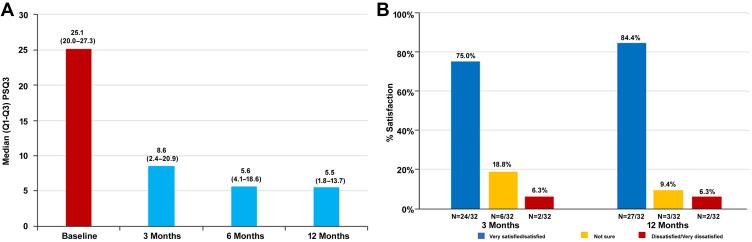
Thirty-eight subjects successfully completed the trial (88.3% success rate), 33 received permanent implants (five withdrew consent), and 32 had device activation (per protocol population). There were no paresthesias or uncomfortable changes in stimulation related to changes in posture during the study and there were no neurological deficits. Responder rates at 12 months for upper limb, shoulder, and neck pain in per protocol population (N=32) were 78.1%, 85.2%, and 75.0%, respectively. At 12 months, 84.4% of subjects were satisfied or very satisfied with 10 kHz SCS, and 38.7% either reduced or eliminated opioid usage.
CONCLUSION
This study further supports the effectiveness of 10 kHz SCS for chronic UEP treatment and documents the safety profile of the therapy.
CLINICAL TRIAL IDENTIFIER
NCT02703818.
背景
慢性上肢疼痛(UEP)病因复杂,常导致功能障碍。研究表明,10kHz脊髓刺激(SCS)可为多种疼痛类型提供无感觉异常且持久的疼痛缓解,并改善患者生活质量。
目的
获取更多关于10kHz SCS治疗慢性UEP安全性和有效性的证据。
研究设计
这是一项前瞻性、多中心观察性研究。该研究已前瞻性地在ClinicalTrials.gov注册(临床试验标识符:NCT02703818)。
研究地点
多中心。
患者干预与主要结局
共有43例慢性UEP患者(视觉模拟量表[VAS]评分≥5cm[0-10cm])接受了10kHz SCS试验,疼痛缓解≥40%的患者接受了永久性植入。所有受试者基线时均有上肢疼痛,部分患者伴有肩部或颈部疼痛。对受试者进行了12个月的结局评估,主要结局是3个月时的缓解率(疼痛较基线缓解≥50%的受试者百分比)。
结果
38例受试者成功完成试验(成功率88.3%),33例接受了永久性植入(5例撤回同意),32例进行了设备激活(符合方案人群)。研究期间,未出现与姿势改变相关的感觉异常或刺激不适变化,也未出现神经功能缺损。符合方案人群(N=32)中,上肢、肩部和颈部疼痛在12个月时的缓解率分别为78.1%、85.2%和75.0%。12个月时,84.4%的受试者对10kHz SCS感到满意或非常满意,38.7%的受试者减少或停用了阿片类药物。
结论
本研究进一步支持了10kHz SCS治疗慢性UEP的有效性,并记录了该疗法的安全性。
临床试验标识符
NCT02703818。


 Zotero 插件