
遗传性额颞叶痴呆的脑萎缩与局部基因表达分析
Analysis of brain atrophy and local gene expression in genetic frontotemporal dementia.
作者信息
Altmann Andre, Cash David M, Bocchetta Martina, Heller Carolin, Reynolds Regina, Moore Katrina, Convery Rhian S, Thomas David L, van Swieten John C, Moreno Fermin, Sanchez-Valle Raquel, Borroni Barbara, Laforce Robert, Masellis Mario, Tartaglia Maria Carmela, Graff Caroline, Galimberti Daniela, Rowe James B, Finger Elizabeth, Synofzik Matthis, Vandenberghe Rik, de Mendonça Alexandre, Tagliavini Fabrizio, Santana Isabel, Ducharme Simon, Butler Chris R, Gerhard Alex, Levin Johannes, Danek Adrian, Frisoni Giovanni, Ghidoni Roberta, Sorbi Sandro, Otto Markus, Ryten Mina, Rohrer Jonathan D
机构信息
Centre of Medical Image Computing, Department of Medical Physics, University College London, London, UK.
Dementia Research Centre, Department of Neurodegenerative Disease, UCL Queen Square Institute of Neurology, Queen Square, London, UK.
出版信息
Brain Commun. 2020 Aug 19;2(2). doi: 10.1093/braincomms/fcaa122. eCollection 2020 Jul.
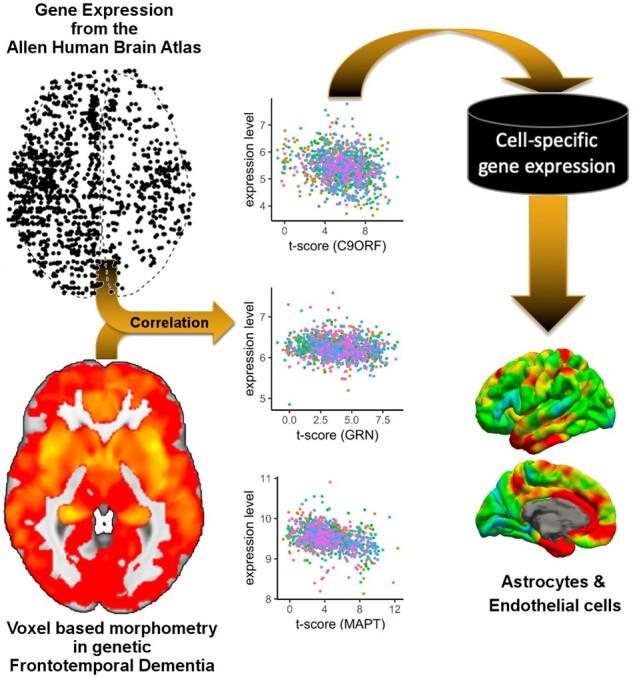
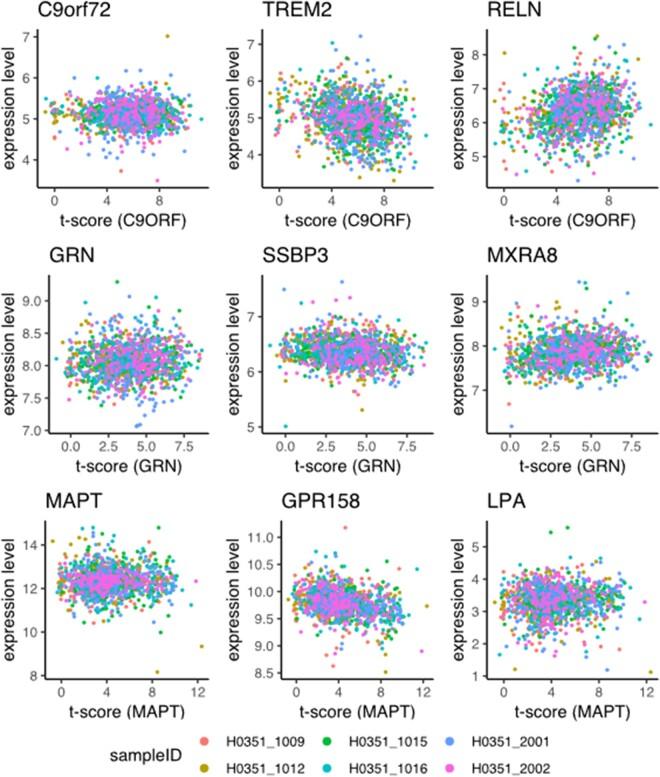
Frontotemporal dementia is a heterogeneous neurodegenerative disorder characterized by neuronal loss in the frontal and temporal lobes. Despite progress in understanding which genes are associated with the aetiology of frontotemporal dementia, the biological basis of how mutations in these genes lead to cell loss in specific cortical regions remains unclear. In this work we combined gene expression data for 16,772 genes from the Allen Institute for Brain Science atlas with brain maps of gray matter atrophy in symptomatic and mutation carriers obtained from the Genetic Frontotemporal dementia Initiative study. No significant association was seen between and expression and the atrophy patterns in the respective genetic groups. After adjusting for spatial autocorrelation, between 1,000 and 5,000 genes showed a negative or positive association with the atrophy pattern within each individual genetic group, with the most significantly associated genes being and (negative association in and respectively) and , and (positive association in and respectively). An overrepresentation analysis identified a negative association with genes involved in mitochondrial function, and a positive association with genes involved in vascular and glial cell function in each of the genetic groups. A set of 423 and 700 genes showed significant positive and negative association, respectively, with atrophy patterns in all three maps. The gene set with increased expression in spared cortical regions was enriched for neuronal and microglial genes, while the gene set with increased expression in atrophied regions was enriched for astrocyte and endothelial cell genes. Our analysis suggests that these cell types may play a more active role in the onset of neurodegeneration in frontotemporal dementia than previously assumed, and in the case of the positively-associated cell marker genes, potentially through emergence of neurotoxic astrocytes and alteration in the blood-brain barrier respectively.
额颞叶痴呆是一种异质性神经退行性疾病,其特征是额叶和颞叶的神经元丢失。尽管在了解哪些基因与额颞叶痴呆的病因相关方面取得了进展,但这些基因中的突变如何导致特定皮质区域的细胞丢失的生物学基础仍不清楚。在这项工作中,我们将来自艾伦脑科学研究所图谱的16772个基因的基因表达数据与从遗传性额颞叶痴呆倡议研究中获得的有症状和突变携带者的灰质萎缩脑图谱相结合。在所研究的基因表达与各遗传组的萎缩模式之间未发现显著关联。在调整空间自相关后,每个个体遗传组中有1000至5000个基因与萎缩模式呈负相关或正相关,其中最显著相关的基因是[具体基因1]和[具体基因2](分别在[遗传组1]和[遗传组2]中呈负相关)以及[具体基因3]、[具体基因4]和[具体基因5](分别在[遗传组3]和[遗传组4]中呈正相关)。一项过表达分析确定,每个遗传组中与线粒体功能相关的基因呈负相关,与血管和神经胶质细胞功能相关的基因呈正相关。一组423个和700个基因分别与所有三张图谱中的萎缩模式呈显著正相关和负相关。在未萎缩皮质区域表达增加的基因集富含神经元和小胶质细胞基因,而在萎缩区域表达增加的基因集富含星形胶质细胞和内皮细胞基因。我们的分析表明,这些细胞类型在额颞叶痴呆神经退行性变的发病过程中可能比以前认为的发挥更积极的作用,就正相关的细胞标记基因而言,可能分别是通过神经毒性星形胶质细胞的出现和血脑屏障的改变。



 Zotero 插件