
罕见儿科疾病的脸书支持小组:定量分析
Facebook Support Groups for Rare Pediatric Diseases: Quantitative Analysis.
作者信息
Titgemeyer Sarah Catrin, Schaaf Christian Patrick
机构信息
University of Cologne, Cologne, Germany.
Institute of Human Genetics, Heidelberg University, Heidelberg, Germany.
出版信息
JMIR Pediatr Parent. 2020 Nov 19;3(2):e21694. doi: 10.2196/21694.
BACKGROUND
Loneliness, social isolation, and feeling disconnected from society are commonly experienced by parents of children with rare diseases and are, among others, important reasons for special supportive care needs. Social networking platforms are increasingly used for health communication, information exchange, and support. In the field of rare pediatric diseases, qualitative studies have shown that Facebook online support groups are utilized by and beneficial for persons affected by rare pediatric diseases. Nonetheless, the extent of this usage has not been investigated.
OBJECTIVE
This study aims to provide a comprehensive quantitative analysis of the extent of Facebook usage as a tool for rare pediatric disease support groups and to explore factors that influence a disease's representation on Facebook. These results potentially offer important insights for future public health initiatives and give direction to further research that can give much needed support to parents of children with rare diseases.
METHODS
We determined rare pediatric diseases using the inventory of the online portal Orphanet. Facebook support groups were identified by searching 5 synonymous disease descriptions using the group category search bar. Disease- and group-describing parameters were statistically analyzed using standard descriptive statistical methods.
RESULTS
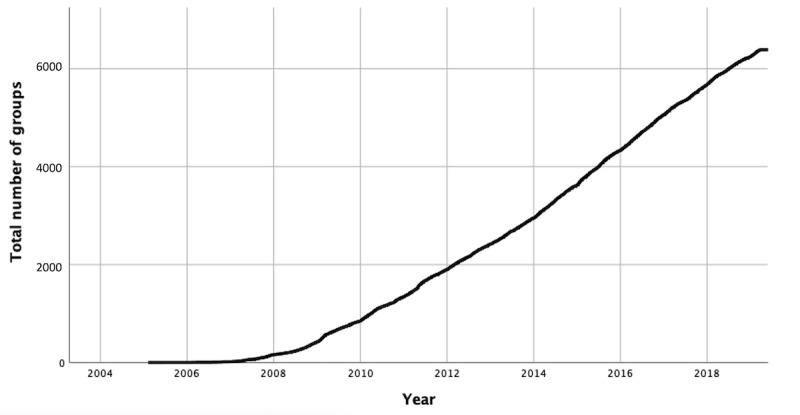
6398 Facebook support groups, representing 826 diseases (19.5% of all searched diseases), were found. 69% are private groups. Group type, size, activity (sum of posts, comments, and reactions calculated by Facebook), new memberships, and language varied largely between groups (member count: minimum 1, maximum 23,414; activity last 30 days: minimum 0, maximum 3606). The highest percentage of awareness and information groups was found for teratogenic diseases (18/68, 26%). The odds of finding a Facebook group increased according to the level of information available about the disease: known prevalence (odds ratio [OR] 3.98, 95% CI 3.39-4.66, P<.001), known disease type (OR 3.15, 95% CI 2.70-3.68, P<.001), and known inheritance mode (OR 2.06, 95% CI 1.68-2.52, P<.001) were all associated with higher odds of finding a Facebook group, as was dominant compared to nondominant inheritance (OR 2.05, 95% CI 1.74-3.42, P<.001). The number of groups per disease increased with higher prevalence.
CONCLUSIONS
Facebook is widely used as a tool for support groups for rare pediatric diseases and continues to be relevant. Two-thirds of the groups are private groups, indicating group participants' need for privacy, which should be further explored. The advantages and limitations of Facebook as a tool for support groups in the field of rare diseases should be further investigated as it will allow health professionals to use Facebook more meaningfully in their counseling and guidance of affected individuals and their family members.
背景
患有罕见病孩子的家长普遍感到孤独、社会孤立以及与社会脱节,这是他们需要特殊支持性护理的重要原因之一。社交网络平台越来越多地用于健康交流、信息交换和支持。在儿科罕见病领域,定性研究表明,Facebook在线支持小组被患有儿科罕见病的人所使用且对他们有益。尽管如此,这种使用的程度尚未得到调查。
目的
本研究旨在对Facebook作为儿科罕见病支持小组工具的使用程度进行全面定量分析,并探索影响疾病在Facebook上呈现的因素。这些结果可能为未来的公共卫生举措提供重要见解,并为能够为患有罕见病孩子的家长提供急需支持的进一步研究指明方向。
方法
我们使用在线门户网站Orphanet的清单来确定儿科罕见病。通过使用群组类别搜索栏搜索5个同义疾病描述来识别Facebook支持小组。使用标准描述性统计方法对疾病和群组描述参数进行统计分析。
结果
共发现6398个Facebook支持小组,代表826种疾病(占所有搜索疾病的19.5%)。69%是私人小组。小组类型、规模、活跃度(由Facebook计算的帖子、评论和反应总和)、新成员数量和语言在各小组之间差异很大(成员数量:最少1人,最多23414人;过去30天的活跃度:最少0,最多3606)。致畸性疾病的认知和信息小组比例最高(18/68,26%)。根据关于该疾病可用信息的水平,找到Facebook小组的几率会增加:已知患病率(优势比[OR]3.98,95%置信区间3.39 - 4.66,P <.001)、已知疾病类型(OR 3.15,95%置信区间2.70 - 3.68,P <.001)和已知遗传模式(OR 2.06,95%置信区间1.68 - 2.52,P <.001)都与找到Facebook小组的较高几率相关,与非显性遗传相比,显性遗传的几率也更高(OR 2.05,95%置信区间1.74 - 3.42,P <.001)。每种疾病的小组数量随着患病率的升高而增加。
结论
Facebook被广泛用作儿科罕见病支持小组的工具且仍然具有相关性。三分之二的小组是私人小组,这表明小组成员对隐私的需求,应进一步探讨。Facebook作为罕见病领域支持小组工具的优缺点应进一步研究,因为这将使卫生专业人员能够在为受影响个体及其家庭成员提供咨询和指导时更有意义地使用Facebook。
 Zotero 插件