
《妇女健康研究中地中海饮食与糖尿病发病的关联》。
Association of the Mediterranean Diet With Onset of Diabetes in the Women's Health Study.
机构信息
Center for Lipid Metabolomics, Brigham and Women's Hospital, Harvard Medical School, Boston, Massachusetts.
Division of Preventive Medicine, Brigham and Women's Hospital, Harvard Medical School, Boston, Massachusetts.
出版信息
JAMA Netw Open. 2020 Nov 2;3(11):e2025466. doi: 10.1001/jamanetworkopen.2020.25466.
IMPORTANCE
Higher Mediterranean diet (MED) intake has been associated with reduced risk of type 2 diabetes, but underlying biological mechanisms are unclear.
OBJECTIVE
To characterize the relative contribution of conventional and novel biomarkers in MED-associated type 2 diabetes risk reduction in a US population.
DESIGN, SETTING, AND PARTICIPANTS: This cohort study was conducted among 25 317 apparently healthy women. The participants with missing information regarding all traditional and novel metabolic biomarkers or those with baseline diabetes were excluded. Participants were invited for baseline assessment between September 1992 and May 1995. Data were collected from November 1992 to December 2017 and analyzed from December 2018 to December 2019.
EXPOSURES
MED intake score (range, 0 to 9) was computed from self-reported dietary intake, representing adherence to Mediterranean diet intake.
MAIN OUTCOMES AND MEASURES
Incident cases of type 2 diabetes, identified through annual questionnaires; reported cases were confirmed by either telephone interview or supplemental questionnaire. Proportion of reduced risk of type 2 diabetes explained by clinical risk factors and a panel of 40 biomarkers that represent different physiological pathways was estimated.
RESULTS
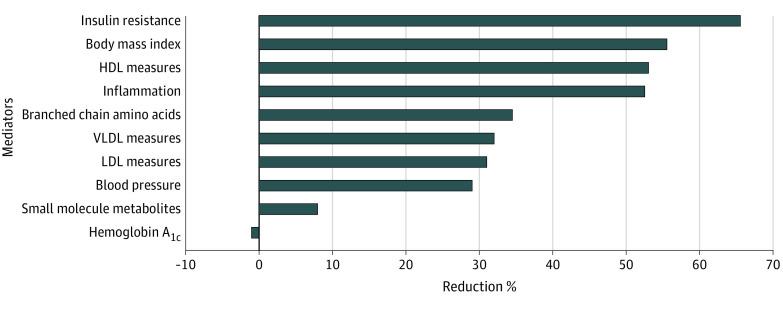
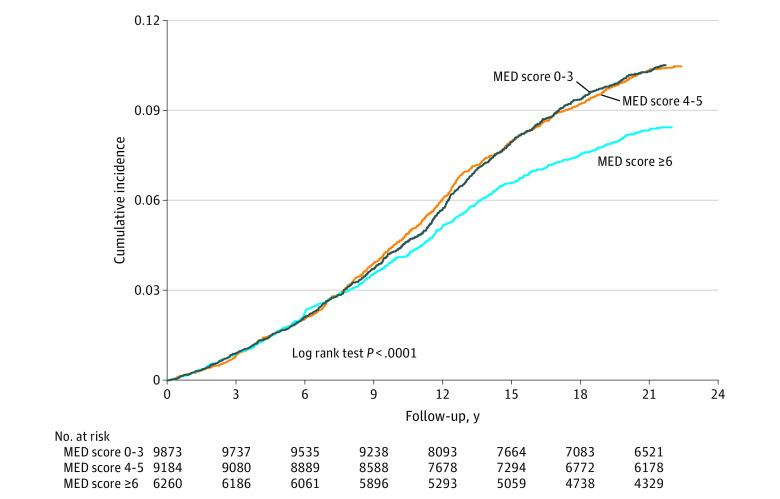
The mean (SD) age of the 25 317 female participants was 52.9 (9.9) years, and they were followed up for a mean (SD) of 19.8 (5.8) years. Higher baseline MED intake (score ≥6 vs ≤3) was associated with as much as a 30% lower type 2 diabetes risk (age-adjusted and energy-adjusted hazard ratio, 0.70; 95% CI, 0.62-0.79; when regression models were additionally adjusted with body mass index [BMI]: hazard ratio, 0.85; 95% CI, 0.76-0.96). Biomarkers of insulin resistance made the largest contribution to lower risk (accounting for 65.5% of the MED-type 2 diabetes association), followed by BMI (55.5%), high-density lipoprotein measures (53.0%), and inflammation (52.5%), with lesser contributions from branched-chain amino acids (34.5%), very low-density lipoprotein measures (32.0%), low-density lipoprotein measures (31.0%), blood pressure (29.0%), and apolipoproteins (23.5%), and minimal contribution (≤2%) from hemoglobin A1c. In post hoc subgroup analyses, the inverse association of MED diet with type 2 diabetes was seen only among women who had BMI of at least 25 at baseline but not those who had BMI of less than 25 (eg, women with BMI <25, age- and energy-adjusted HR for MED score ≥6 vs ≤3, 1.01; 95% CI, 0.77-1.33; P for trend = .92; women with BMI ≥25: HR, 0.76; 95% CI, 0.67-0.87; P for trend < .001).
CONCLUSIONS AND RELEVANCE
In this cohort study, higher MED intake scores were associated with a 30% relative risk reduction in type 2 diabetes during a 20-year period, which could be explained in large part by biomarkers of insulin resistance, BMI, lipoprotein metabolism, and inflammation.
重要性
较高的地中海饮食(MED)摄入量与 2 型糖尿病风险降低有关,但潜在的生物学机制尚不清楚。
目的
在一个美国人群中,描述与 MED 相关的 2 型糖尿病风险降低相关的常规和新型生物标志物的相对贡献。
设计、地点和参与者:这是一项队列研究,共纳入了 25317 名看似健康的女性。排除了那些对所有传统和新型代谢生物标志物有缺失信息或基线时有糖尿病的参与者。参与者于 1992 年 9 月至 1995 年 5 月之间被邀请进行基线评估。数据于 1992 年 11 月至 2017 年 12 月收集,并于 2018 年 12 月至 2019 年 12 月进行分析。
暴露
通过自我报告的饮食摄入计算 MED 摄入量评分(范围为 0 至 9),代表对地中海饮食摄入的依从性。
主要结果和措施
通过年度问卷调查确定 2 型糖尿病的发病病例;通过电话访谈或补充问卷确认报告病例。估计了临床危险因素和代表不同生理途径的 40 种生物标志物的组合对 2 型糖尿病风险降低的解释比例。
结果
25317 名女性参与者的平均(SD)年龄为 52.9(9.9)岁,平均随访(SD)时间为 19.8(5.8)年。基线 MED 摄入量较高(评分≥6 分与≤3 分)与 2 型糖尿病风险降低 30%相关(年龄调整和能量调整后的风险比,0.70;95%CI,0.62-0.79;当回归模型中进一步用体重指数 [BMI] 调整时:风险比,0.85;95%CI,0.76-0.96)。胰岛素抵抗的生物标志物对降低风险的贡献最大(占 MED 与 2 型糖尿病关联的 65.5%),其次是 BMI(55.5%)、高密度脂蛋白测量值(53.0%)和炎症(52.5%),支链氨基酸(34.5%)、极低密度脂蛋白测量值(32.0%)、低密度脂蛋白测量值(31.0%)、血压(29.0%)和载脂蛋白(23.5%)的贡献较小,血红蛋白 A1c 的贡献最小(≤2%)。在事后亚组分析中,仅在基线 BMI 至少为 25 的女性中观察到 MED 饮食与 2 型糖尿病之间的反比关联,而在 BMI 小于 25 的女性中则没有(例如,BMI<25 的女性,MED 评分≥6 分与≤3 分的年龄和能量调整后的 HR,1.01;95%CI,0.77-1.33;P 趋势 = .92;BMI≥25 的女性:HR,0.76;95%CI,0.67-0.87;P 趋势 < .001)。
结论和相关性
在这项队列研究中,较高的 MED 摄入量评分与 20 年内 2 型糖尿病的相对风险降低 30%相关,这在很大程度上可以用胰岛素抵抗、BMI、脂蛋白代谢和炎症的生物标志物来解释。
 Zotero 插件