
基线预后营养指数和治疗前体重指数变化与晚期癌症患者的免疫治疗反应相关。
Baseline prognostic nutritional index and changes in pretreatment body mass index associate with immunotherapy response in patients with advanced cancer.
机构信息
Medicine, New York University School of Medicine, New York City, New York, USA.
Dermatology, New York University School of Medicine, New York City, New York, USA.
出版信息
J Immunother Cancer. 2020 Nov;8(2). doi: 10.1136/jitc-2020-001674.
BACKGROUND
Recent research suggests that baseline body mass index (BMI) is associated with response to immunotherapy. In this study, we test the hypothesis that worsening nutritional status prior to the start of immunotherapy, rather than baseline BMI, negatively impacts immunotherapy response.
METHODS
We studied 629 patients with advanced cancer who received immune checkpoint blockade at New York University. Patients had melanoma (n=268), lung cancer (n=128) or other primary malignancies (n=233). We tested the association between BMI changes prior to the start of treatment, baseline prognostic nutritional index (PNI), baseline BMI category and multiple clinical end points including best overall response (BOR), objective response rate (ORR), disease control rate (DCR), progression-free survival (PFS) and overall survival (OS).
RESULTS
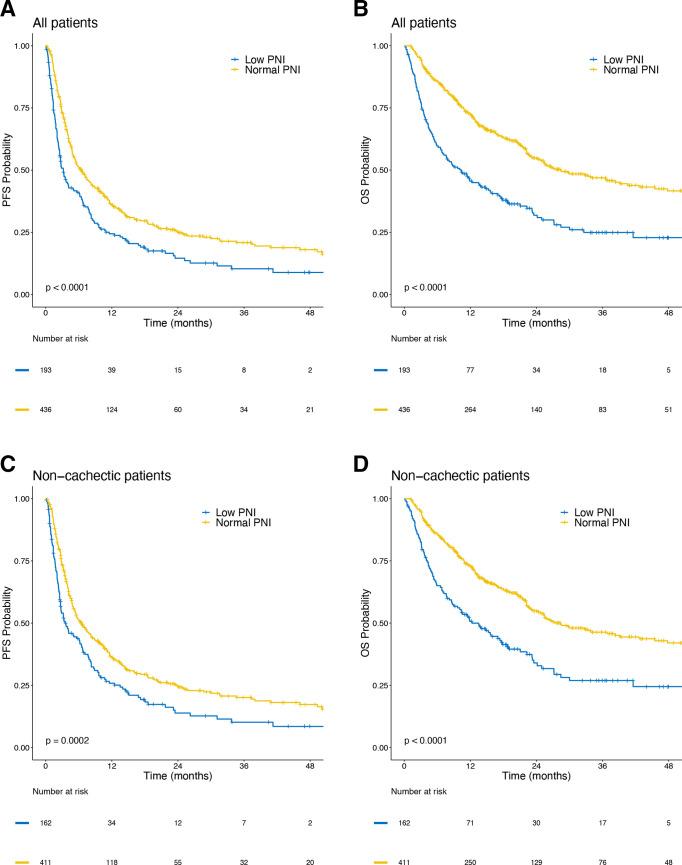
Decreasing pretreatment BMI and low PNI were associated with worse BOR (p0.04 and p0.0004), ORR (p0.01 and p0.0005), DCR (p0.01 and p0.0001), PFS (p=0.02 and p=0.01) and OS (p0.001 and p<0.001). Baseline BMI category was not significantly associated with any treatment outcomes.
CONCLUSION
Standard of care measures of worsening nutritional status more accurately associate with immunotherapy outcomes than static measurements of BMI. Future studies should focus on determining whether optimizing pretreatment nutritional status, a modifiable variable, leads to improvement in immunotherapy response.
背景
最近的研究表明,基线体重指数(BMI)与免疫治疗反应相关。在这项研究中,我们检验了这样一个假设,即在开始免疫治疗之前,营养状况的恶化而不是基线 BMI,会对免疫治疗反应产生负面影响。
方法
我们研究了在纽约大学接受免疫检查点阻断治疗的 629 名晚期癌症患者。患者患有黑色素瘤(n=268)、肺癌(n=128)或其他原发性恶性肿瘤(n=233)。我们测试了治疗前 BMI 变化、基线预后营养指数(PNI)、基线 BMI 类别与多个临床终点之间的关联,包括最佳总体反应(BOR)、客观缓解率(ORR)、疾病控制率(DCR)、无进展生存期(PFS)和总生存期(OS)。
结果
治疗前 BMI 降低和低 PNI 与较差的 BOR(p<0.04 和 p<0.0004)、ORR(p<0.01 和 p<0.0005)、DCR(p<0.01 和 p<0.0001)、PFS(p=0.02 和 p=0.01)和 OS(p<0.001 和 p<0.001)相关。基线 BMI 类别与任何治疗结局均无显著相关性。
结论
与 BMI 的静态测量相比,常规护理措施中衡量营养状况恶化的标准更能准确地与免疫治疗结果相关。未来的研究应集中于确定是否优化治疗前的营养状况(一个可改变的变量)会导致免疫治疗反应的改善。

 Zotero 插件