
AtMAD:拟南芥多组学关联数据库。
AtMAD: Arabidopsis thaliana multi-omics association database.
机构信息
Key Laboratory of Saline-alkali Vegetation Ecology Restoration, Ministry of Education, Northeast Forestry University, Harbin, Heilongjiang 150040, China.
The Center for Bioinformatics and Computational Biology, Shanghai Key Laboratory of Regulatory Biology, the Institute of Biomedical Sciences and School of Life Sciences, East China Normal University, Shanghai 200241, China.
出版信息
Nucleic Acids Res. 2021 Jan 8;49(D1):D1445-D1451. doi: 10.1093/nar/gkaa1042.
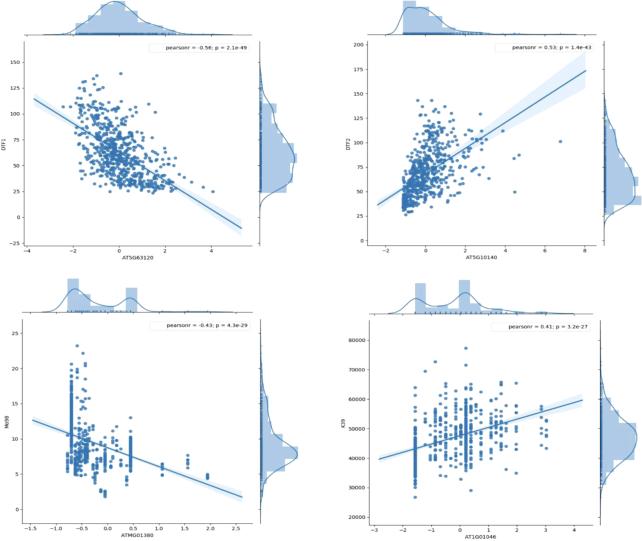
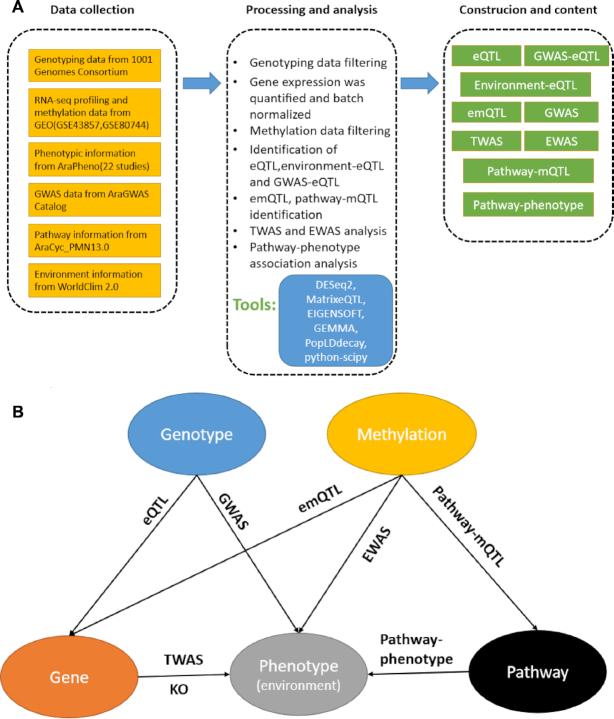
Integration analysis of multi-omics data provides a comprehensive landscape for understanding biological systems and mechanisms. The abundance of high-quality multi-omics data (genomics, transcriptomics, methylomics and phenomics) for the model organism Arabidopsis thaliana enables scientists to study the genetic mechanism of many biological processes. However, no resource is available to provide comprehensive and systematic multi-omics associations for Arabidopsis. Here, we developed an Arabidopsis thaliana Multi-omics Association Database (AtMAD, http://www.megabionet.org/atmad), a public repository for large-scale measurements of associations between genome, transcriptome, methylome, pathway and phenotype in Arabidopsis, designed for facilitating identification of eQTL, emQTL, Pathway-mQTL, Phenotype-pathway, GWAS, TWAS and EWAS. Candidate variants/methylations/genes were identified in AtMAD for specific phenotypes or biological processes, many of them are supported by experimental evidence. Based on the multi-omics association strategy, we have identified 11 796 cis-eQTLs and 10 119 trans-eQTLs. Among them, 68 837 environment-eQTL associations and 149 622 GWAS-eQTL associations were identified and stored in AtMAD. For expression-methylation quantitative trait loci (emQTL), we identified 265 776 emQTLs and 122 344 pathway-mQTLs. For TWAS and EWAS, we obtained 62 754 significant phenotype-gene associations and 3 993 379 significant phenotype-methylation associations, respectively. Overall, the multi-omics associated network in AtMAD will provide new insights into exploring biological mechanisms of plants at multi-omics levels.
多组学数据的整合分析为理解生物系统和机制提供了全面的视角。由于拟南芥这种模式生物拥有大量高质量的多组学数据(基因组学、转录组学、甲基组学和表型组学),科学家们得以研究许多生物学过程的遗传机制。然而,目前还没有资源可以为拟南芥提供全面系统的多组学关联。在这里,我们开发了一个拟南芥多组学关联数据库(AtMAD,http://www.megabionet.org/atmad),这是一个用于大规模测量拟南芥基因组、转录组、甲基组、通路和表型之间关联的公共存储库,旨在促进 eQTL、emQTL、Pathway-mQTL、Phenotype-pathway、GWAS、TWAS 和 EWAS 的鉴定。在 AtMAD 中,针对特定表型或生物学过程,我们鉴定了候选变体/甲基化/基因,其中许多都得到了实验证据的支持。基于多组学关联策略,我们共鉴定了 11 796 个 cis-eQTL 和 10 119 个 trans-eQTL。其中,鉴定并存储了 68 837 个环境-eQTL 关联和 149 622 个 GWAS-eQTL 关联。在表达-甲基化数量性状位点(emQTL)方面,我们共鉴定了 265 776 个 emQTL 和 122 344 个通路-mQTL。对于 TWAS 和 EWAS,我们分别获得了 62 754 个显著的表型-基因关联和 3 993 379 个显著的表型-甲基化关联。总的来说,AtMAD 中的多组学关联网络将为在多组学水平上探索植物的生物学机制提供新的见解。
 Zotero 插件