
感染诱导人胆管细胞发生上皮-间质转化。
Infection with Induces Epithelial to Mesenchymal Transition in Human Cholangiocytes.
作者信息
Thanaphongdecha Prissadee, Karinshak Shannon E, Ittiprasert Wannaporn, Mann Victoria H, Chamgramol Yaovalux, Pairojkul Chawalit, Fox James G, Suttiprapa Sutas, Sripa Banchob, Brindley Paul J
机构信息
Research Center for Neglected Tropical Diseases of Poverty, Department of Microbiology, Immunology and Tropical Medicine, School of Medicine & Health Sciences, The George Washington University, Washington, DC 20037, USA.
Tropical Disease Research Laboratory, Faculty of Medicine, Khon Kaen University, Khon Kaen 40002, Thailand.
出版信息
Pathogens. 2020 Nov 21;9(11):971. doi: 10.3390/pathogens9110971.
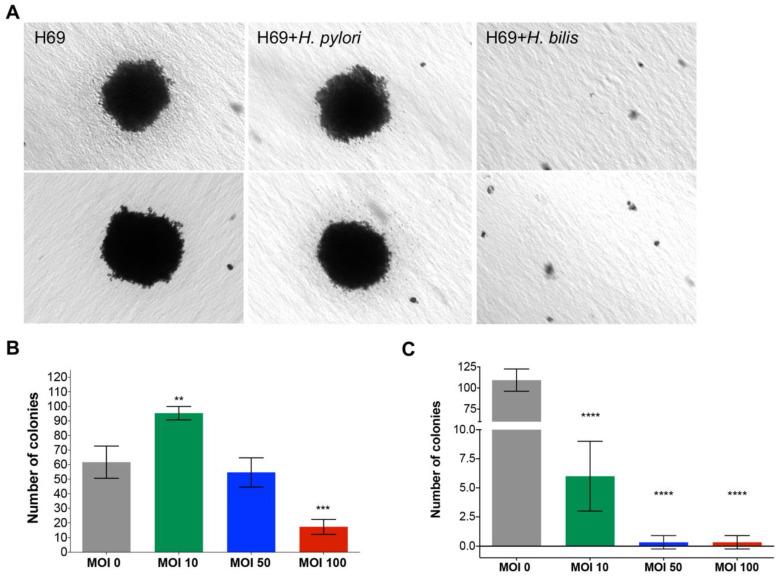
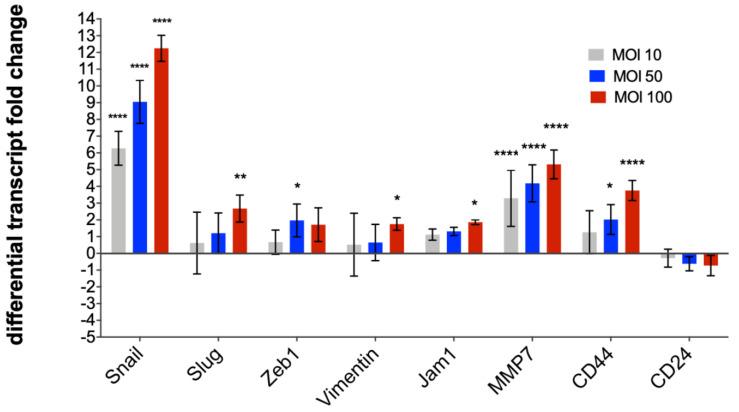
Recent reports suggest that the East Asian liver fluke infection, caused by , which is implicated in opisthorchiasis-associated cholangiocarcinoma, serves as a reservoir of . The opisthorchiasis-affected cholangiocytes that line the intrahepatic biliary tract are considered to be the cell of origin of this malignancy. Here, we investigated interactions in vitro among human cholangiocytes, strain NCTC 11637, and the congeneric bacillus, . Exposure to increasing numbers of at 0, 1, 10, 100 bacilli per cholangiocyte of the H69 cell line induced phenotypic changes including the profusion of thread-like filopodia and a loss of cell-cell contact, in a dose-dependent fashion. In parallel, following exposure to , changes were evident in levels of mRNA expression of epithelial to mesenchymal transition (EMT)-encoding factors including snail, slug, vimentin, matrix metalloprotease, zinc finger E-box-binding homeobox, and the cancer stem cell marker CD44. Analysis to quantify cellular proliferation, migration, and invasion in real-time by both H69 cholangiocytes and CC-LP-1 line of cholangiocarcinoma cells using the xCELLigence approach and Matrigel matrix revealed that exposure to 10 bacilli per cell stimulated migration and invasion by the cholangiocytes. In addition, 10 bacilli of stimulated contact-independent colony establishment in soft agar. These findings support the hypothesis that infection by contributes to the malignant transformation of the biliary epithelium.
最近的报告表明,由华支睾吸虫引起的东亚肝吸虫感染与华支睾吸虫病相关胆管癌有关,是某种病原体的储存宿主。肝内胆管内衬的受华支睾吸虫病影响的胆管细胞被认为是这种恶性肿瘤的起源细胞。在此,我们研究了人胆管细胞、NCTC 11637菌株和同属芽孢杆菌之间的体外相互作用。以每胆管细胞0、1、10、100个芽孢杆菌的数量递增方式暴露于该芽孢杆菌,H69细胞系的胆管细胞会出现表型变化,包括丝状丝状伪足大量出现和细胞间接触丧失,呈剂量依赖性。同时,暴露于该芽孢杆菌后,上皮-间质转化(EMT)编码因子(包括蜗牛蛋白、蛞蝓蛋白、波形蛋白、基质金属蛋白酶、锌指E盒结合同源框蛋白)以及癌症干细胞标志物CD44的mRNA表达水平发生明显变化。使用xCELLigence方法和基质胶基质对H69胆管细胞和胆管癌细胞CC-LP-1系的细胞增殖、迁移和侵袭进行实时定量分析表明,每细胞暴露于10个芽孢杆菌会刺激胆管细胞的迁移和侵袭。此外,10个该芽孢杆菌在软琼脂中刺激了非接触依赖性集落形成。这些发现支持了该芽孢杆菌感染导致胆管上皮恶性转化的假说。



 Zotero 插件