
锰铁氧体纳米颗粒(MnFeO):用于热疗及磁共振成像中阴性/阳性对比增强的尺寸依赖性
Manganese Ferrite Nanoparticles (MnFeO): Size Dependence for Hyperthermia and Negative/Positive Contrast Enhancement in MRI.
作者信息
Islam Khairul, Haque Manjurul, Kumar Arup, Hoq Amitra, Hyder Fahmeed, Hoque Sheikh Manjura
机构信息
Materials Science Division, Atomic Energy Centre, Dhaka 1000, Bangladesh.
Department of Electrical and Electronic Engineering, Islamic University, Kushtia 7003, Bangladesh.
出版信息
Nanomaterials (Basel). 2020 Nov 20;10(11):2297. doi: 10.3390/nano10112297.
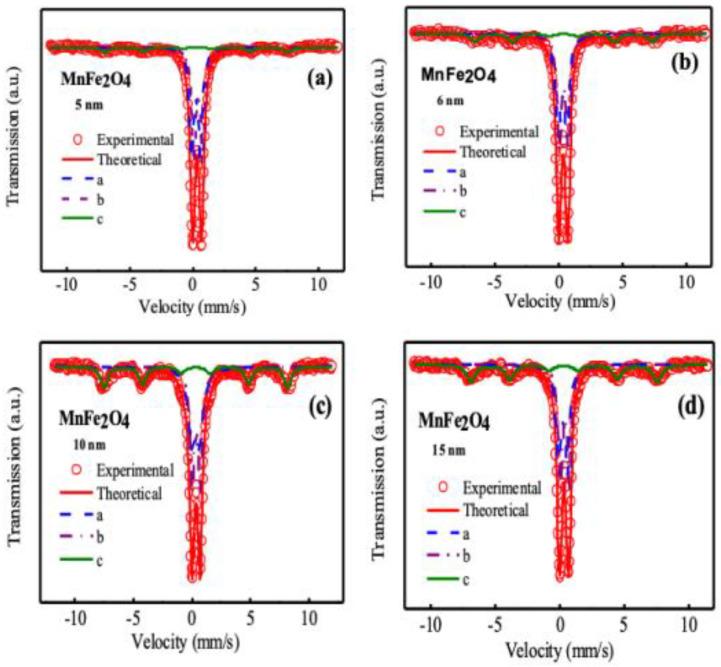
We synthesized manganese ferrite (MnFeO) nanoparticles of different sizes by varying pH during chemical co-precipitation procedure and modified their surfaces with polysaccharide chitosan (CS) to investigate characteristics of hyperthermia and magnetic resonance imaging (MRI). Structural features were analyzed by X-ray diffraction (XRD), high-resolution transmission electron microscopy (TEM), selected area diffraction (SAED) patterns, and Mössbauer spectroscopy to confirm the formation of superparamagnetic MnFeO nanoparticles with a size range of 5-15 nm for pH of 9-12. The hydrodynamic sizes of nanoparticles were less than 250 nm with a polydispersity index of 0.3, whereas the zeta potentials were higher than 30 mV to ensure electrostatic repulsion for stable colloidal suspension. MRI properties at 7T demonstrated that transverse relaxation (T) doubled as the size of CS-coated MnFeO nanoparticles tripled in vitro. However, longitudinal relaxation (T) was strongest for the smallest CS-coated MnFeO nanoparticles, as revealed by in vivo positive contrast MRI angiography. Cytotoxicity assay on HeLa cells showed CS-coated MnFeO nanoparticles is viable regardless of ambient pH, whereas hyperthermia studies revealed that both the maximum temperature and specific loss power obtained by alternating magnetic field exposure depended on nanoparticle size and concentration. Overall, these results reveal the exciting potential of CS-coated MnFeO nanoparticles in MRI and hyperthermia studies for biomedical research.
我们通过在化学共沉淀过程中改变pH值合成了不同尺寸的锰铁氧体(MnFeO)纳米颗粒,并用多糖壳聚糖(CS)对其表面进行修饰,以研究热疗和磁共振成像(MRI)的特性。通过X射线衍射(XRD)、高分辨率透射电子显微镜(TEM)、选区衍射(SAED)图谱和穆斯堡尔光谱分析结构特征,以确认在pH值为9 - 12时形成了尺寸范围为5 - 15 nm的超顺磁性MnFeO纳米颗粒。纳米颗粒的流体动力学尺寸小于250 nm,多分散指数为0.3,而zeta电位高于30 mV,以确保静电排斥形成稳定的胶体悬浮液。7T时的MRI特性表明,在体外,随着CS包覆的MnFeO纳米颗粒尺寸增加两倍,横向弛豫(T)增加一倍。然而,体内阳性对比MRI血管造影显示,最小的CS包覆的MnFeO纳米颗粒的纵向弛豫(T)最强。对HeLa细胞的细胞毒性试验表明,无论环境pH值如何,CS包覆的MnFeO纳米颗粒都是可行的,而热疗研究表明,通过交变磁场暴露获得的最高温度和比损耗功率均取决于纳米颗粒的尺寸和浓度。总体而言,这些结果揭示了CS包覆的MnFeO纳米颗粒在生物医学研究的MRI和热疗研究中的令人兴奋的潜力。




 Zotero 插件