
在中低收入国家的 IVF 和其他 ART:系统景观分析。
IVF and other ART in low- and middle-income countries: a systematic landscape analysis.
机构信息
Department of Obstetrics, Gynecology & Reproductive Sciences, University of Vermont Medical Center, Burlington, VT, USA.
Department of Reproductive Health and Research, UNDP-UNFPA-UNICEF-WHO-World Bank Special Programme of Research, Development and Research Training in Human Reproduction (HRP), World Health Organization, Geneva, Switzerland.
出版信息
Hum Reprod Update. 2021 Feb 19;27(2):213-228. doi: 10.1093/humupd/dmaa047.
BACKGROUND
Infertility affects 48.5 million couples worldwide with a prevalence estimated at 3.5-16.7% in low- and middle-income countries (LMIC), and as high as 30-40% in Sub-Saharan Africa. ART services are not accessible to the majority of these infertile couples due to the high cost of treatments in addition to cultural, religious and legal barriers. Infertility and childlessness, particularly in LMIC, have devastating consequences, which has resulted in considerable interest in developing affordable IVF procedures. However, there is a paucity of evidence on the safety, efficiency and ability to replicate techniques under different field conditions, and how to integrate more affordable ART options into existing infrastructures.
OBJECTIVE AND RATIONALE
This review was performed to investigate the current availability of IVF in LMIC and which other ART options are under development. This work will unfold the landscape of available and potential ART services in LMIC and is a key element in positioning infertility more broadly in the Global Public Health Agenda.
SEARCH METHODS
A systematic literature search was performed of articles and gray literature on IVF and other ART options in LMIC published between January 2010 and January 2020. We selected studies on IVF and other ART treatments for infertile couples of reproductive age (18-44 years) from LMIC. The review was limited to articles published after 2010, based on the recent evolution in the field of ART practices in LMIC over the last decade. Citations from high-income countries, including data prior to 2010 and focusing on specialized ART procedures, were excluded. The literature search included PubMed, Popline, CINHAL, EMBASE and Global Index Medicus. No restrictions were applied with regard to study design or language. Two reviewers independently screened the titles and abstracts, and extracted data. A search for gray literature was performed using the 'Google' search engine and specific databases (worldcat.org, greylit.org). In addition, the reference lists of included studies were assessed.
OUTCOMES
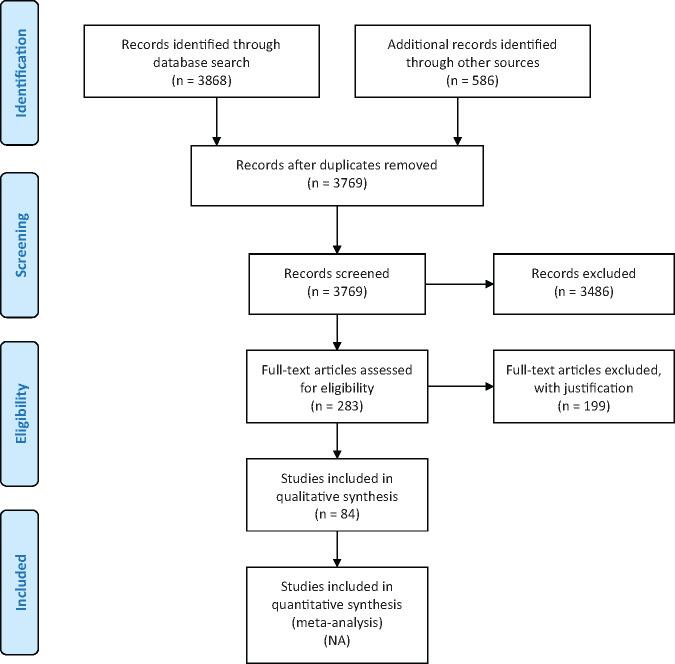
The search of the electronic databases yielded 3769 citations. After review of the titles and abstracts, 283 studies were included. The full texts were reviewed and a further 199 articles were excluded. The gray literature search yielded 586 citations, most of which were excluded after screening the title, and the remaining documents were excluded after full-text assessment due to duplicate entries, not from LMIC, not relevant or no access to the full document. Eighty-four citations were included as part of the review and separated into regions. The majority of the studies were observational and qualitative studies. In general, ART services are available and described in several LMIC, ranging from advanced techniques in China to basic introduction of IVF in some African countries. Efforts to provide affordable ART treatments are described in feasibility studies and efficacy studies; however, most citations were of low to very low quality. We found no studies from LMIC reporting the implementation of low-cost ART that is effective, accessible and affordable to most of those in need of the services.
WIDER IMPLICATIONS
The World Health Organization is in a unique position to provide much needed guidance for infertility management in LMIC. This review provides insight into the landscape of ART in LMIC in various regions worldwide, which will guide efforts to improve the availability, quality, accessibility and acceptability of biomedical infertility care, including ART in these countries.
背景
全球有 4850 万对夫妇受到不孕不育的影响,据估计,在低收入和中等收入国家(LMIC),不孕不育的患病率为 3.5-16.7%,在撒哈拉以南非洲地区甚至高达 30-40%。由于治疗费用高昂,再加上文化、宗教和法律方面的障碍,这些不孕不育夫妇中的大多数都无法获得辅助生殖技术(ART)服务。不孕不育和无子女在 LMIC 地区会产生毁灭性的后果,这导致人们对开发负担得起的体外受精(IVF)程序产生了浓厚的兴趣。然而,关于 IVF 在 LMIC 的安全性、效率和在不同现场条件下复制技术的能力,以及如何将更负担得起的 ART 选项整合到现有基础设施中的证据有限。
目的和理由
本综述旨在调查目前 LMIC 中 IVF 的可及性以及正在开发的其他 ART 选择。这项工作将揭示 LMIC 中现有和潜在的 ART 服务的全貌,是将不孕症更广泛地纳入全球公共卫生议程的关键要素。
检索方法
对 2010 年 1 月至 2020 年 1 月期间发表的关于 LMIC 中 IVF 和其他 ART 选择的文章和灰色文献进行了系统的文献搜索。我们选择了关于 LMIC 中生殖年龄(18-44 岁)不孕夫妇的 IVF 和其他 ART 治疗的研究。综述仅限于 2010 年后发表的文章,这是基于过去十年中 LMIC 中 ART 实践领域的最新发展。排除了来自高收入国家的引文,包括数据早于 2010 年和专注于专业 ART 程序的引文。文献检索包括 PubMed、Popline、CINHAL、EMBASE 和全球索引医学。在研究设计或语言方面没有设置任何限制。两名评审员独立筛选标题和摘要,并提取数据。使用“Google”搜索引擎和特定数据库(worldcat.org、greylit.org)进行灰色文献搜索。此外,还评估了纳入研究的参考文献列表。
结果
电子数据库的搜索产生了 3769 条引文。在审查标题和摘要后,纳入了 283 项研究。对全文进行了审查,又排除了 199 篇文章。灰色文献搜索产生了 586 条引文,其中大多数在筛选标题后被排除,其余文件在全文评估后被排除,因为存在重复条目、非来自 LMIC、不相关或无法获取全文。84 条引文被纳入综述并按地区划分。大多数研究是观察性和定性研究。一般来说,ART 服务在几个 LMIC 中都有提供和描述,范围从中国的先进技术到一些非洲国家的基本 IVF 介绍。在可行性研究和疗效研究中描述了提供负担得起的 ART 治疗的努力;然而,大多数引文的质量都很低或非常低。我们没有发现来自 LMIC 的研究报告实施了低成本的 ART,这种 ART 对大多数需要服务的人来说是有效、可及和负担得起的。
广泛影响
世界卫生组织处于独特的地位,可以为 LMIC 的不孕不育管理提供急需的指导。本综述提供了对全球不同地区 LMIC 中 ART 状况的深入了解,这将指导改善生物医学不孕症护理的可及性、质量、可及性和可接受性的努力,包括这些国家的 ART。

 Zotero 插件