
基于微电极的 Ru-MOFs 的合成与表征及其痕量汞检测。
Synthesis and Characterization of Ru-MOFs on Microelectrode for Trace Mercury Detection.
机构信息
State Key Laboratory of Transducer Technology, Aerospace Information Research Institute, Chinese Academy of Sciences, Beijing 100190, China.
School of Electronic, Electrical and Communication Engineering, University of Chinese Academy of Sciences, Beijing 100049, China.
出版信息
Sensors (Basel). 2020 Nov 23;20(22):6686. doi: 10.3390/s20226686.
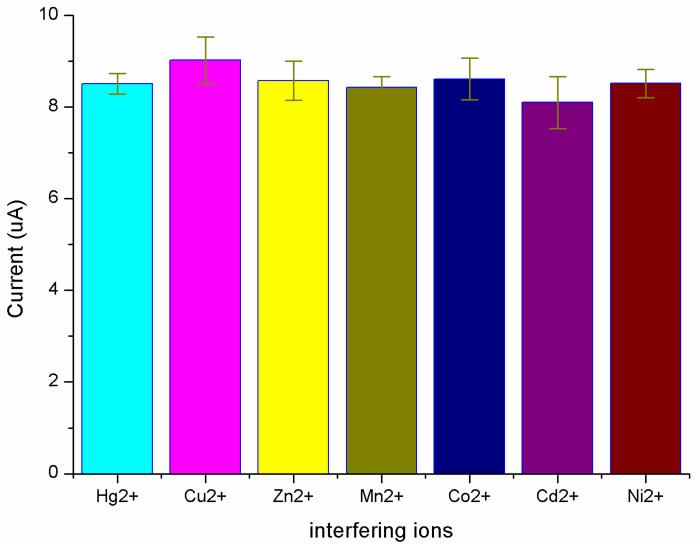
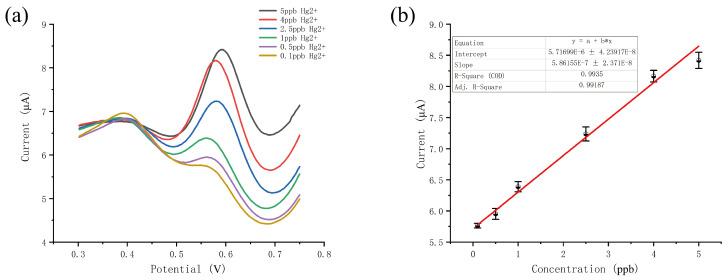
Mercury ions (Hg2+) pollution in the water environment can cause serious harm to human health. Trace Hg2+ detection is of vital importance for environmental monitoring. Herein, we report a novel design of Ru-MOFs modified gold microelectrode for Hg2+ determination. Ru-MOFs are synthesized directly by the cathodic method on gold microelectrode, with the covered area accurately controlled. Cathodic synthesized Ru-MOFs show good conductivity and are suitable to be used as the electrode surface material directly. The synergy of the pre-deposition process and the adsorption process of Ru-MOFs can effectively improves the performance of the sensor. The results show good linearity (R2 = 0.996) from 0.1 ppb to 5 ppb, with a high sensitivity of 0.583 μA ppb-1 mm-2. The limit of detection is found to be 0.08 ppb and the test process is within 6 min. Most importantly, the senor has a good anti-interference ability and the recoveries are satisfactory. This miniature electrochemical sensor has the potential for on-site detection of trace mercury in the field.
水环境中的汞离子(Hg2+)污染会对人类健康造成严重危害。痕量 Hg2+的检测对于环境监测至关重要。在此,我们报告了一种新型的 Ru-MOFs 修饰金微电极用于 Hg2+测定的设计。Ru-MOFs 通过在金微电极上的阴极方法直接合成,覆盖面积可以精确控制。合成的 Ru-MOFs 具有良好的导电性,适合直接用作电极表面材料。Ru-MOFs 的预沉积过程和吸附过程的协同作用可以有效地提高传感器的性能。结果表明,从 0.1 ppb 到 5 ppb 具有良好的线性关系(R2 = 0.996),灵敏度高,为 0.583 μA ppb-1 mm-2。检测限为 0.08 ppb,检测过程在 6 分钟内完成。最重要的是,传感器具有良好的抗干扰能力,回收率令人满意。这种微型电化学传感器有望用于现场检测痕量汞。


 Zotero 插件