
加纳将高血压妊娠点检测作为孕产妇保健的一个组成部分,提供地理上可及的服务。
Geographical access to point-of-care testing for hypertensive disorders of pregnancy as an integral part of maternal healthcare in Ghana.
机构信息
Department of Public Health Medicine, School of Nursing and Public Health, University of KwaZulu-Natal, Durban, South Africa.
Research for Sustainable Development Consult, Sunyani, Ghana.
出版信息
BMC Pregnancy Childbirth. 2020 Nov 25;20(1):733. doi: 10.1186/s12884-020-03441-6.
BACKGROUND
Hypertensive disorders of pregnancy (HDP) are associated with high maternal mortality in Ghana and globally. Evidence shows that there is poor availability of pregnancy-related point-of-care (POC) tests in Ghana's primary healthcare (PHC) clinics (health centre or community-based health planning services facilities). Therefore, we employed geographic information systems to estimate the geographical distribution of and physical accessibility to HDP POC testing services in the Upper East Region (UER), Ghana.
METHODS
We collected data on 100 out of 365 PHC clinics, public hospitals providing HDP testing, PHC clinic type, ownership, and availability of urine dipsticks and blood pressure (BP) devices. We also obtained the geo-located data of the PHC clinics and hospitals using the global positioning system. We employed ArcGIS 10.4 to measure the distance and travel time from the location of each PHC clinic without HDP POC testing services as well as from all locations of each district to the nearest hospital/clinic where the service is available. The travel time was estimated using an assumed motorised tricycle speed of 20 km/hour. We further calculated the spatial distribution of the hospitals/clinics providing HDP POC testing services using the spatial autocorrelation tool in ArcMap, and Stata version 14 for descriptive statistical analysis.
RESULTS
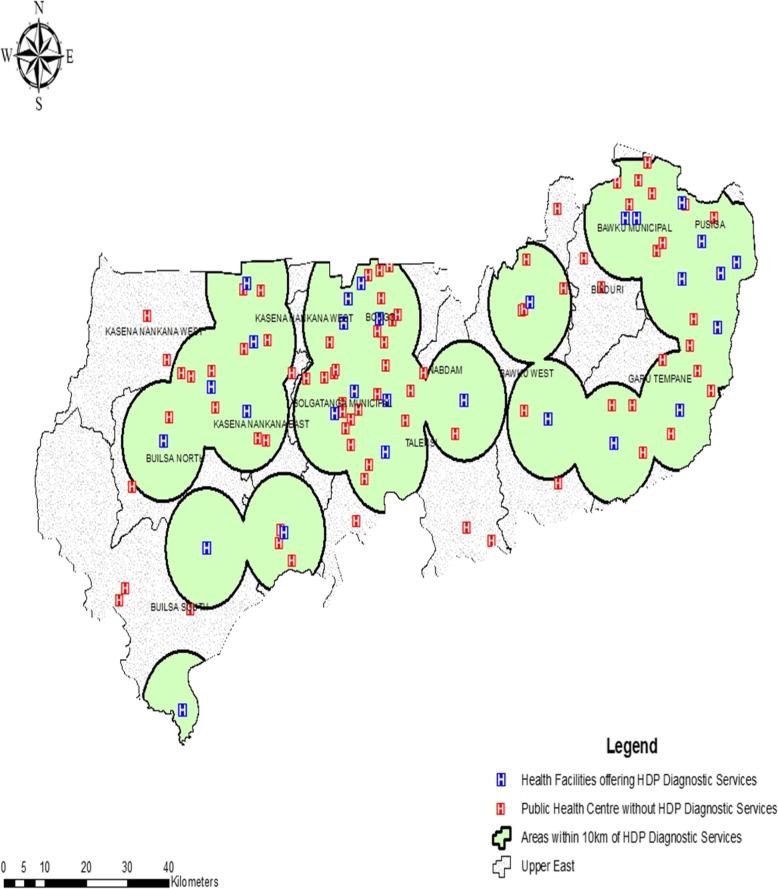
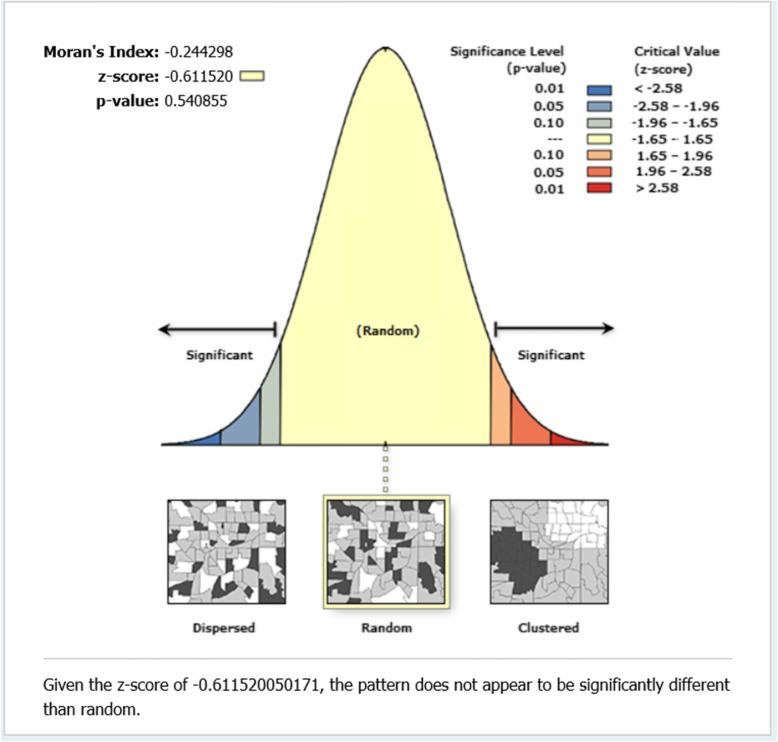
Of the 100 participating PHC clinics, POC testing for HDP was available in 19% (14% health centres and 5% community-based health planning services compounds) in addition to the 10 hospitals use as referral points for the service. The findings indicated that the spatial pattern of the distribution of the health facilities providing HDP POC testing was random (z-score = -0.61; p = 0.54). About 17% of the PHC clinics without HDP POC testing service were located > 10 km to the nearest facility offering the service. The mean distance and travel time from PHC clinics without HDP POC testing to a health facility providing the service were 11.4 ± 9.9 km and 31.1 ± 29.2 min respectively. The results suggest that if every 19% of the 365 PHC clinics are offering HDP POC testing in addition to these 10 hospitals identified, then the estimated coverage (health facility-to-women in fertility age ratio) in the UER is 1: 3,869.
CONCLUSIONS
There is poor physical accessibility to HDP POC testing services from PHC clinics without HDP POC testing in the UER. Mothers who obtain maternal healthcare in about 17% of the PHC clinics travel long distances (> 10 km) to access the service when needed. Hence, there is a need to improve the availability of HDP POC diagnostic tests in Ghana's rural clinics.
背景
妊娠高血压疾病(HDP)与加纳和全球范围内的高孕产妇死亡率有关。有证据表明,加纳的初级保健(PHC)诊所(卫生中心或社区为基础的卫生规划服务设施)中,与妊娠相关的即时检测(POC)的可用性很差。因此,我们使用地理信息系统来估计加纳上东部地区(UER)HDP POC 检测服务的地理分布和实际可及性。
方法
我们收集了 365 个 PHC 诊所中的 100 个的数据,这些诊所提供 HDP 检测服务,还包括 PHC 诊所类型、所有权、尿试纸和血压(BP)设备的可用性。我们还使用全球定位系统获取了 PHC 诊所和医院的地理位置数据。我们使用 ArcGIS 10.4 测量了每个没有 HDP POC 检测服务的 PHC 诊所以及每个地区到最近提供服务的医院/诊所的位置之间的距离和旅行时间。旅行时间是根据假设的机动三轮车 20 公里/小时的速度估算的。我们还使用 ArcMap 中的空间自相关工具和 Stata 版本 14 进一步计算了提供 HDP POC 检测服务的医院/诊所的空间分布。
结果
在参与的 100 个 PHC 诊所中,除了 10 家用作该服务转诊点的医院外,19%(14%的卫生中心和 5%的社区为基础的卫生规划服务机构)提供 HDP POC 检测。结果表明,提供 HDP POC 检测服务的卫生设施的分布空间模式是随机的(z 分数=-0.61;p=0.54)。大约 17%的没有 HDP POC 检测服务的 PHC 诊所距离最近的提供该服务的设施超过 10 公里。没有 HDP POC 检测服务的 PHC 诊所到提供该服务的卫生设施的平均距离和旅行时间分别为 11.4±9.9 公里和 31.1±29.2 分钟。结果表明,如果除了确定的这 10 家医院外,365 家 PHC 诊所中的 19%提供 HDP POC 检测,那么在上东部地区的估计覆盖率(育龄妇女与卫生设施的比例)为 1:3869。
结论
在上东部地区,没有 HDP POC 检测服务的 PHC 诊所很难获得 HDP POC 检测服务。在大约 17%的 PHC 诊所获得孕产妇保健的母亲,在需要时需要长途跋涉(超过 10 公里)才能获得该服务。因此,加纳农村诊所需要改善 HDP POC 诊断检测的可用性。

 Zotero 插件