
影响神经功能障碍成年人康复干预措施实施的因素:系统评价。
Factors affecting the delivery of complex rehabilitation interventions in research with neurologically impaired adults: a systematic review.
机构信息
Division of Rehabilitation, Ageing and Wellbeing, School of Medicine, Univeristy of Nottingham, Nottingham, NG7 2UH, UK.
出版信息
Syst Rev. 2020 Nov 25;9(1):268. doi: 10.1186/s13643-020-01508-1.
BACKGROUND
Rehabilitation research does not always improve patient outcomes because of difficulties implementing complex health interventions. Identifying barriers and facilitators to implementation fidelity is critical. Not reporting implementation issues wastes research resources and risks erroneously attributing effectiveness when interventions are not implemented as planned, particularly progressing from single to multicentre trials. The Consolidated Framework for Implementation Research (CFIR) and Conceptual Framework for Implementation Fidelity (CFIF) facilitate identification of barriers and facilitators. This review sought to identify barriers and facilitators (determinants) affecting implementation in trials of complex rehabilitation interventions for adults with long-term neurological conditions (LTNC) and describe implementation issues.
METHODS
Implementation, complex health interventions and LTNC search terms were developed. Studies of all designs were eligible. Searches involved 11 databases, trial registries and citations. After screening titles and abstracts, two reviewers independently shortlisted studies. A third resolved discrepancies. One reviewer extracted data in two stages; 1) descriptive study data, 2) units of text describing determinants. Data were synthesised by (1) mapping determinants to CFIF and CFIR and (2) thematic analysis.
RESULTS
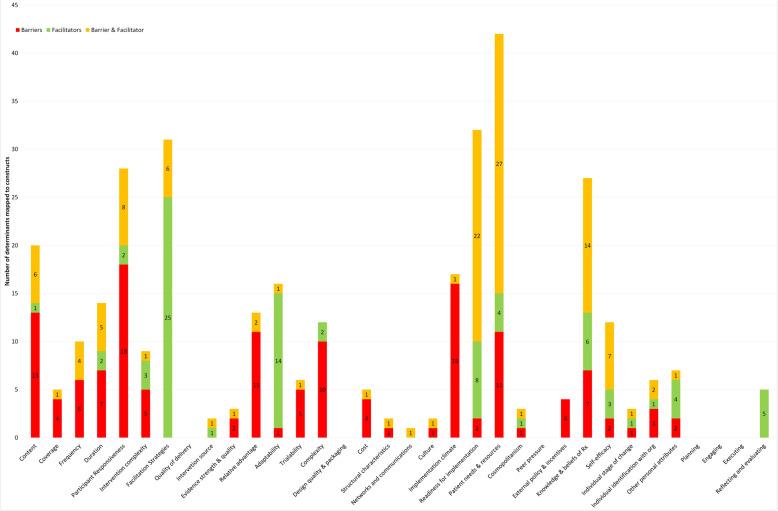
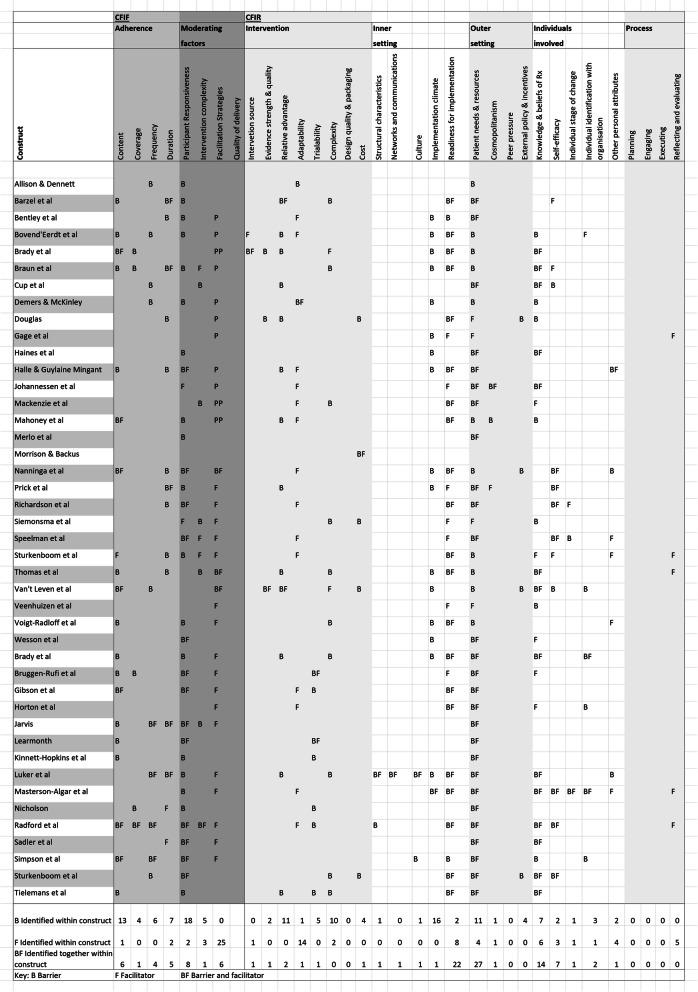
Forty-three studies, from 7434 records, reported implementation determinants; 41 reported both barriers and facilitators. Most implied determinants but five used implementation theory to inform recording. More barriers than facilitators were mapped onto CFIF and CFIR constructs. "Patient needs and resources", "readiness for implementation", "knowledge and beliefs about the intervention", "facilitation strategies", "participant responsiveness" were the most frequently mapped constructs. Constructs relating to the quality of intervention delivery, organisational/contextual aspects and trial-related issues were rarely tapped. Thematic analysis revealed the most frequently reported determinants related to adherence, intervention perceptions and attrition.
CONCLUSIONS
This review has described the barriers and facilitators identified in studies implementing complex interventions for people with LTNCs. Early adoption of implementation frameworks by trialists can simplify identification and reporting of factors affecting delivery of new complex rehabilitation interventions. It is vital to learn from previous experiences to prevent unnecessary repetitions of implementation failure at both trial and service provision levels. Reported facilitators can provide strategies for overcoming implementation issues. Reporting gaps may be due to the lack of standardised reporting methods, researcher ignorance and historical reporting requirements.
SYSTEMIC REVIEW REGISTRATION
PROSPERO CRD42015020423.
背景
由于难以实施复杂的健康干预措施,康复研究并不总能改善患者的结局。确定实施一致性的障碍和促进因素至关重要。不报告实施问题会浪费研究资源,并有可能在干预措施未按计划实施时错误地归因于有效性,特别是从单中心试验向多中心试验推进时。实施研究综合框架(CFIR)和实施一致性概念框架(CFIF)有助于确定障碍和促进因素。本综述旨在确定影响成人长期神经疾病(LTNC)复杂康复干预试验实施的障碍和促进因素(决定因素),并描述实施问题。
方法
制定了实施、复杂健康干预和 LTNC 搜索词。所有设计的研究都符合条件。搜索涉及 11 个数据库、试验登记处和引文。在筛选标题和摘要后,两名审查员独立筛选研究。第三名审查员解决了差异。一名审查员分两个阶段提取数据;1)描述性研究数据,2)描述决定因素的文本单元。通过(1)将决定因素映射到 CFIF 和 CFIR,(2)主题分析对数据进行综合。
结果
从 7434 条记录中筛选出 43 项研究报告了实施决定因素;41 项研究报告了障碍和促进因素。大多数研究暗示了决定因素,但有 5 项研究使用了实施理论来记录决定因素。与 CFIF 和 CFIR 结构相对应的障碍多于促进因素。“患者需求和资源”、“实施准备”、“对干预措施的知识和信念”、“促进策略”、“参与者反应性”是最常映射的结构。与干预提供质量、组织/背景方面和试验相关问题相关的结构很少被触及。主题分析揭示了与依从性、干预认知和失访最相关的最常报告决定因素。
结论
本综述描述了为 LTNC 人群实施复杂干预措施的研究中确定的障碍和促进因素。试验者尽早采用实施框架可以简化识别和报告影响新的复杂康复干预措施提供的因素。从以往经验中学习对于防止在试验和服务提供层面上不必要地重复实施失败至关重要。报告的促进因素可以为克服实施问题提供策略。报告差距可能是由于缺乏标准化的报告方法、研究人员的无知和历史报告要求所致。
系统评价注册
PROSPERO CRD42015020423。

 Zotero 插件