
糖皮质激素对血清胱抑素 C 识别急性肾损伤的影响:一项倾向评分匹配队列研究。
The effect of glucocorticoids on serum cystatin C in identifying acute kidney injury: a propensity-matched cohort study.
机构信息
Department of Intensive Care Unit of Cardiovascular Surgery, Guangdong Cardiovascular Institute, Guangdong Provincial People's Hospital, Guangdong Academy of Medical Sciences, 96 Dongchuan Road, Guangzhou, 510080, Guangdong Province, People's Republic of China.
Department of Critical Care Medicine, Guangdong Provincial People's Hospital, Guangdong Academy of Medical Sciences, 106 Zhongshan Er Road, Guangzhou, 510080, Guangdong Province, People's Republic of China.
出版信息
BMC Nephrol. 2020 Nov 27;21(1):519. doi: 10.1186/s12882-020-02165-1.
BACKGROUND
Glucocorticoids may impact the accuracy of serum cystatin C (sCysC) in reflecting renal function. We aimed to assess the effect of glucocorticoids on the performance of sCysC in detecting acute kidney injury (AKI) in critically ill patients.
METHODS
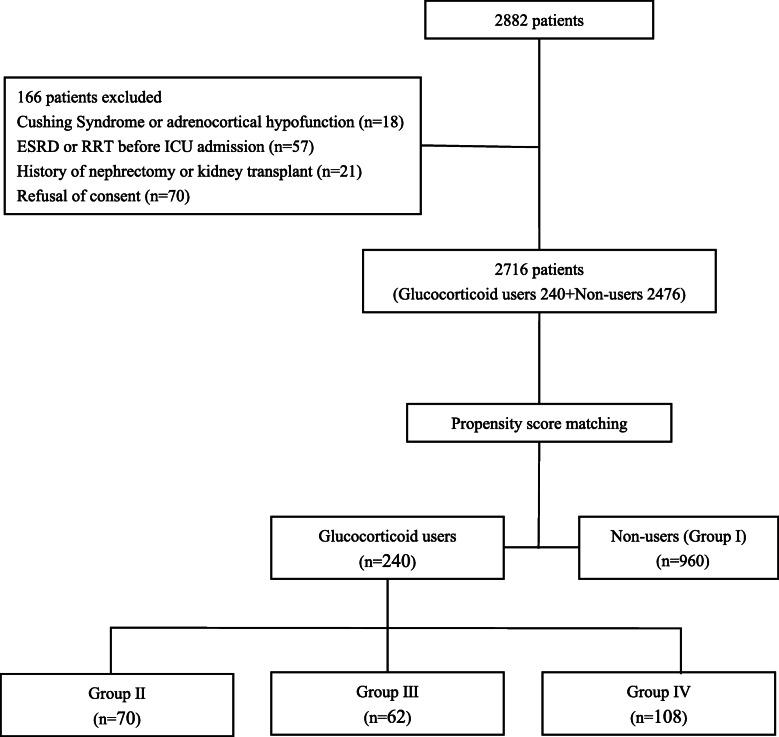
A prospective observational cohort study was performed in a general intensive care unit (ICU). Using propensity score matching, we successfully matched 240 glucocorticoid users with 960 non-users among 2716 patients. Serum creatinine (SCr) and sCysC were measured for all patients at ICU admission. Patients were divided into four groups based on cumulative doses of glucocorticoids within 5 days before ICU admission (Group I: non-users; Group II: 0 mg < prednisone ≤50 mg; Group III: 50 mg < prednisone ≤150 mg; Group IV: prednisone > 150 mg). We compared the performance of sCysC for diagnosing and predicting AKI in different groups using the area under the receiver operator characteristic curve (AUC).
RESULTS
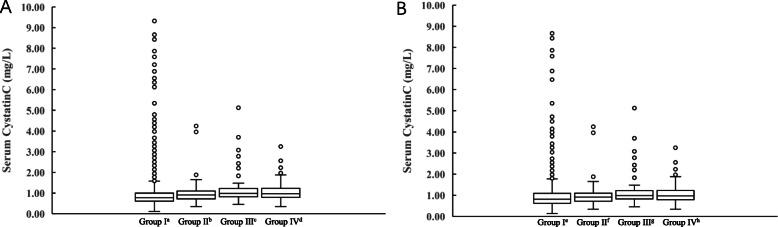
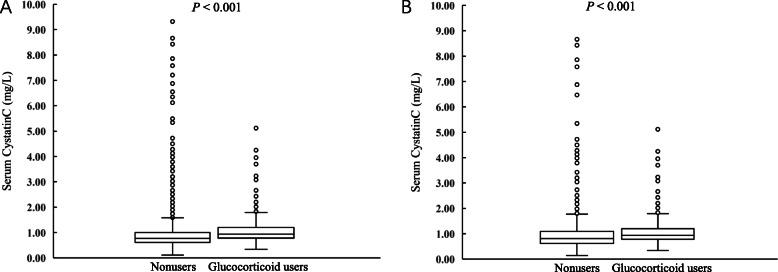
A total of 240 patients received glucocorticoid medication within 5 days before ICU admission. Before and after matching, the differences of sCysC levels between glucocorticoid users and non-users were both significant (P < 0.001). The multiple linear regression analysis revealed that glucocorticoids were independently associated with sCysC (P < 0.001). After matching, the group I had significantly lower sCysC levels than the group III and group IV (P < 0.05), but there were no significant differences in sCysC levels within different glucocorticoids recipient groups (P > 0.05). Simultaneously, we did not find significant differences in the AUC between any two groups in the matched cohort (P > 0.05).
CONCLUSIONS
Glucocorticoids did not impact the performance of sCysC in identifying AKI in critically ill patients.
背景
糖皮质激素可能会影响血清胱抑素 C(sCysC)反映肾功能的准确性。我们旨在评估糖皮质激素对重症患者中 sCysC 检测急性肾损伤(AKI)的性能的影响。
方法
在普通重症监护病房(ICU)进行了一项前瞻性观察队列研究。通过倾向评分匹配,我们成功地在 2716 名患者中匹配了 240 名糖皮质激素使用者和 960 名非使用者。所有患者在 ICU 入院时均测量血清肌酐(SCr)和 sCysC。根据 ICU 入院前 5 天内糖皮质激素的累积剂量,将患者分为四组(I 组:非使用者;II 组:0mg <泼尼松 ≤50mg;III 组:50mg <泼尼松 ≤150mg;IV 组:泼尼松 >150mg)。我们使用接受者操作特征曲线(ROC)下面积(AUC)比较不同组中 sCysC 诊断和预测 AKI 的性能。
结果
共有 240 名患者在 ICU 入院前 5 天内接受糖皮质激素治疗。在匹配前后,糖皮质激素使用者和非使用者的 sCysC 水平差异均有统计学意义(P < 0.001)。多元线性回归分析表明,糖皮质激素与 sCysC 独立相关(P < 0.001)。匹配后,I 组的 sCysC 水平明显低于 III 组和 IV 组(P < 0.05),但不同糖皮质激素接受者组之间的 sCysC 水平无差异(P > 0.05)。同时,在匹配队列中,我们没有发现任何两组之间 AUC 有显著差异(P > 0.05)。
结论
糖皮质激素不会影响 sCysC 在识别重症患者 AKI 中的性能。
 Zotero 插件