
间充质干细胞衍生的外泌体:转化医学中的现代方法。
Mesenchymal stem cell derived-exosomes: a modern approach in translational medicine.
作者信息
Nikfarjam Sepideh, Rezaie Jafar, Zolbanin Naime Majidi, Jafari Reza
机构信息
Department of Medical Biotechnology, Faculty of Advanced Medical Sciences, Tabriz University of Medical Sciences, Tabriz, Iran.
Solid Tumor Research Center, Cellular and Molecular Medicine Research Institute, Urmia University of Medical Sciences, Shafa St, Ershad Blvd, P.O. BoX: 1138, 57147, Urmia, Iran.
出版信息
J Transl Med. 2020 Nov 27;18(1):449. doi: 10.1186/s12967-020-02622-3.
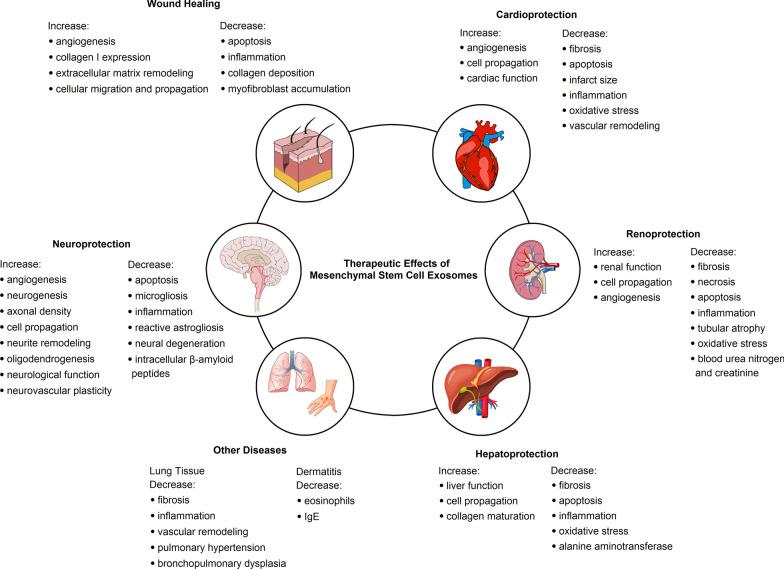
Mesenchymal stem cells (MSCs) have captured great attention in regenerative medicine for over a few decades by virtue of their differentiation capacity, potent immunomodulatory properties, and their ability to be favorably cultured and manipulated. Recent investigations implied that the pleiotropic effects of MSCs is not associated to their ability of differentiation, but rather is mediated by the secretion of soluble paracrine factors. Exosomes, nanoscale extracellular vesicles, are one of these paracrine mediators. Exosomes transfer functional cargos like miRNA and mRNA molecules, peptides, proteins, cytokines and lipids from MSCs to the recipient cells. Exosomes participate in intercellular communication events and contribute to the healing of injured or diseased tissues and organs. Studies reported that exosomes alone are responsible for the therapeutic effects of MSCs in numerous experimental models. Therefore, MSC-derived exosomes can be manipulated and applied to establish a novel cell-free therapeutic approach for treatment of a variety of diseases including heart, kidney, liver, immune and neurological diseases, and cutaneous wound healing. In comparison with their donor cells, MSC-derived exosomes offer more stable entities and diminished safety risks regarding the administration of live cells, e.g. microvasculature occlusion risk. This review discusses the exosome isolation methods invented and utilized in the clinical setting thus far and presents a summary of current information on MSC exosomes in translational medicine.
几十年来,间充质干细胞(MSCs)凭借其分化能力、强大的免疫调节特性以及易于培养和操控的能力,在再生医学领域备受关注。最近的研究表明,MSCs的多效性作用与其分化能力无关,而是由可溶性旁分泌因子的分泌介导的。外泌体是纳米级的细胞外囊泡,是这些旁分泌介质之一。外泌体将功能性物质如miRNA和mRNA分子、肽、蛋白质、细胞因子和脂质从MSCs转移到受体细胞。外泌体参与细胞间通讯事件,并有助于受损或患病组织和器官的愈合。研究报道,在众多实验模型中,单独的外泌体就负责MSCs的治疗效果。因此,源自MSCs的外泌体可以被操控并应用于建立一种新型的无细胞治疗方法,用于治疗包括心脏、肾脏、肝脏、免疫和神经疾病以及皮肤伤口愈合在内的多种疾病。与它们的供体细胞相比,源自MSCs的外泌体提供了更稳定的实体,并且在活细胞给药方面降低了安全风险,例如微血管阻塞风险。本文综述了迄今为止在临床环境中发明和使用的外泌体分离方法,并总结了转化医学中关于MSCs外泌体的当前信息。
 Zotero 插件