
幼年特发性关节炎患儿的唾液口腔微生物群:一项挪威横断面研究。
Salivary Oral Microbiome of Children With Juvenile Idiopathic Arthritis: A Norwegian Cross-Sectional Study.
作者信息
Frid Paula, Baraniya Divyashri, Halbig Josefine, Rypdal Veronika, Songstad Nils Thomas, Rosèn Annika, Berstad Johanna Rykke, Flatø Berit, Alakwaa Fadhl, Gil Elisabeth Grut, Cetrelli Lena, Chen Tsute, Al-Hebshi Nezar Noor, Nordal Ellen, Al-Haroni Mohammed
机构信息
Department of ENT, Division of Oral and Maxillofacial Surgery, University Hospital North Norway, Tromsø, Norway.
Public Dental Service Competence Centre of North Norway, Tromsø, Norway.
出版信息
Front Cell Infect Microbiol. 2020 Nov 4;10:602239. doi: 10.3389/fcimb.2020.602239. eCollection 2020.
BACKGROUND
The oral microbiota has been connected to the pathogenesis of rheumatoid arthritis through activation of mucosal immunity. The objective of this study was to characterize the salivary oral microbiome associated with juvenile idiopathic arthritis (JIA), and correlate it with the disease activity including gingival inflammation.
METHODS
Fifty-nine patients with JIA (mean age, 12.6 ± 2.7 years) and 34 healthy controls (HC; mean age 12.3 ± 3.0 years) were consecutively recruited in this Norwegian cross-sectional study. Information about demographics, disease activity, medication history, frequency of tooth brushing and a modified version of the gingival bleeding index (GBI) and the simplified oral hygiene index (OHI-S) was obtained. Microbiome profiling of saliva samples was performed by sequencing of the V1-V3 region of the 16S rRNA gene, coupled with a species-level taxonomy assignment algorithm; QIIME, LEfSe and R-package for Spearman correlation matrix were used for downstream analysis.
RESULTS
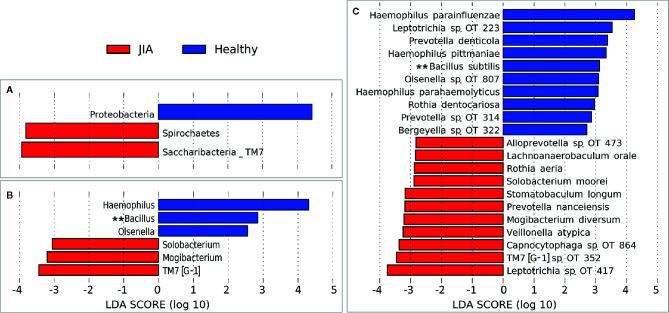
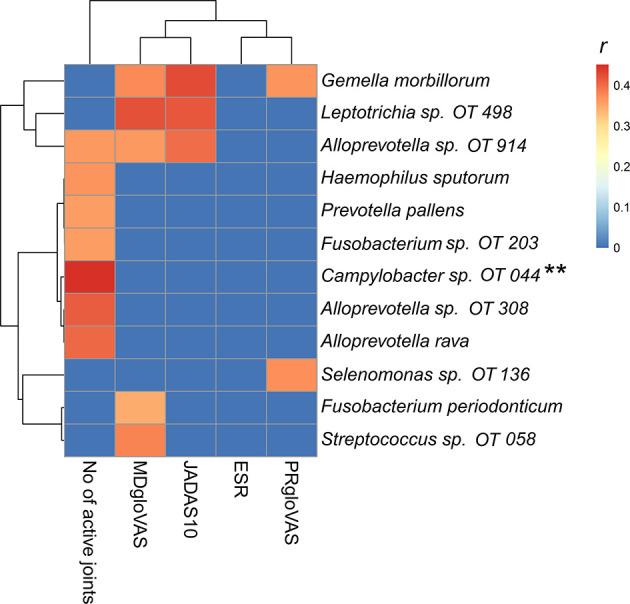
There were no significant differences between JIA and HC in alpha- and beta-diversity. However, differential abundance analysis revealed several taxa to be associated with JIA: , and at the genus level; and oral taxon 417, oral taxon 352 and oral taxon 864 among others, at the species level. species, oral taxon 223, and , were associated with healthy controls. , sp. oral taxon 498 and oral taxon 914 correlated positively with the composite juvenile arthritis 10-joint disease activity score (JADAS10), while oral taxon 44 among others, correlated with the number of active joints. Of all microbial markers identified, only and oral taxon 44 maintained false discovery rate (FDR) < 0.1.
CONCLUSIONS
In this exploratory study of salivary oral microbiome we found similar alpha- and beta-diversity among children with JIA and healthy. Several taxa associated with chronic inflammation were found to be associated with JIA and disease activity, which warrants further investigation.
背景
口腔微生物群已通过黏膜免疫激活与类风湿关节炎的发病机制相关联。本研究的目的是对与幼年特发性关节炎(JIA)相关的唾液口腔微生物群进行特征分析,并将其与包括牙龈炎症在内的疾病活动度相关联。
方法
在这项挪威横断面研究中,连续招募了59例JIA患者(平均年龄12.6±2.7岁)和34名健康对照者(HC;平均年龄12.3±3.0岁)。获取了有关人口统计学、疾病活动度、用药史、刷牙频率以及改良版牙龈出血指数(GBI)和简化口腔卫生指数(OHI-S)的信息。通过对16S rRNA基因的V1-V3区域进行测序,并结合物种水平的分类算法,对唾液样本进行微生物群分析;使用QIIME、LEfSe和用于Spearman相关矩阵的R包进行下游分析。
结果
JIA组和HC组在α-多样性和β-多样性方面无显著差异。然而,差异丰度分析显示,有几个分类群与JIA相关:在属水平上有 、 和 ;在种水平上有口腔分类群417、口腔分类群352和口腔分类群864等。 种、口腔分类群223和 与健康对照者相关。 、口腔分类群49和口腔分类群914与青少年关节炎10关节疾病活动综合评分(JADAS10)呈正相关,而口腔分类群44等与活动关节数量相关。在所有鉴定出的微生物标志物中,只有 和口腔分类群44的错误发现率(FDR)<0.1。
结论
在这项唾液口腔微生物群的探索性研究中,我们发现JIA患儿和健康儿童的α-多样性和β-多样性相似。发现一些与慢性炎症相关的分类群与JIA和疾病活动度相关,这值得进一步研究。



 Zotero 插件