
癌症中MYC与HIF之间的分子串扰
Molecular Crosstalk Between MYC and HIF in Cancer.
作者信息
Li Yanping, Sun Xiao-Xin, Qian David Z, Dai Mu-Shui
机构信息
Department of Molecular and Medical Genetics, School of Medicine, Portland, OR, United States.
The OHSU Knight Cancer Institute, Oregon Health and Science University, Portland, OR, United States.
出版信息
Front Cell Dev Biol. 2020 Nov 5;8:590576. doi: 10.3389/fcell.2020.590576. eCollection 2020.
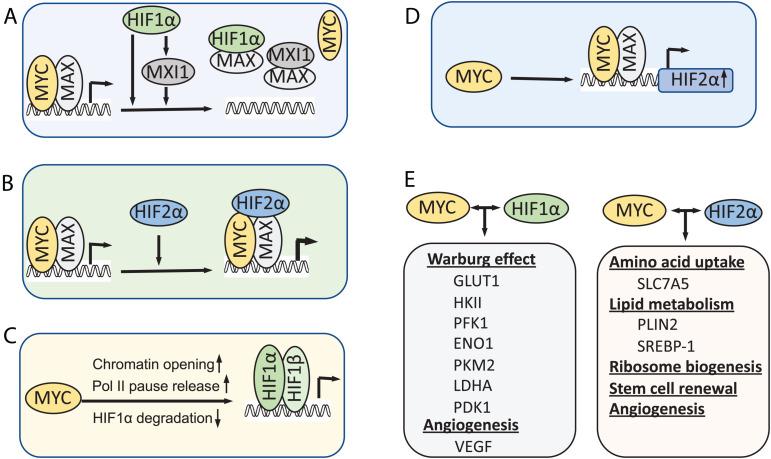
The transcription factor c-MYC (MYC thereafter) is a global regulator of gene expression. It is overexpressed or deregulated in human cancers of diverse origins and plays a key role in the development of cancers. Hypoxia-inducible factors (HIFs), a central regulator for cells to adapt to low cellular oxygen levels, is also often overexpressed and activated in many human cancers. HIF mediates the primary transcriptional response of a wide range of genes in response to hypoxia. Earlier studies focused on the inhibition of MYC by HIF during hypoxia, when MYC is expressed at physiological level, to help cells survive under low oxygen conditions. Emerging evidence suggests that MYC and HIF also cooperate to promote cancer cell growth and progression. This review will summarize the current understanding of the complex molecular interplay between MYC and HIF.
转录因子c-MYC(此后简称MYC)是基因表达的全局调节因子。它在多种起源的人类癌症中过度表达或失调,并在癌症发展中起关键作用。缺氧诱导因子(HIFs)是细胞适应低氧水平的核心调节因子,在许多人类癌症中也经常过度表达并被激活。HIF介导多种基因对缺氧的主要转录反应。早期研究集中在缺氧时HIF对MYC的抑制作用,此时MYC以生理水平表达,以帮助细胞在低氧条件下存活。新出现的证据表明,MYC和HIF也协同促进癌细胞的生长和进展。本综述将总结目前对MYC和HIF之间复杂分子相互作用的理解。
 Zotero 插件